Industrial Derivatives of Guar Gum: HPG, CMG, Cationic and CMHPG
A complete guide to derivatised Guar Gum — hydroxypropyl (HPG), carboxymethyl (CMG), cationic (Guar HPTC), and CMHPG — chemistry, applications and global market 2026.
Last updated:
Quick Answer
What are the main industrial derivatives of Guar Gum?
The principal industrial derivatives of Guar Gum are Hydroxypropyl Guar (HPG) for oilfield fracturing, Carboxymethyl Guar (CMG) for mining and paper, Cationic Guar (Guar Hydroxypropyltrimonium Chloride) for personal care, and CMHPG (Carboxymethyl Hydroxypropyl Guar) for high-temperature oilfield applications. Each derivative is produced by chemical modification of the natural galactomannan to add functional groups that native Guar lacks.
Native Guar Gum is already one of the most versatile natural polymers in industry, but its commercial reach is multiplied many times over by its chemical derivatives. By selectively modifying the hydroxyl groups on the galactomannan backbone, manufacturers create polymers tailored for the demanding conditions of oil-field fracturing, mining flotation, paper sizing, textile printing and personal care conditioning. As 2026 markets push for natural alternatives to synthetic polymers, Guar derivatives have become a strategic substitution category in their own right.
Research Overview
This article covers the four major commercial derivatives of Guar Gum, the chemistry that produces each one, the specific industrial application that drives demand, and the ways in which 2026 supply-chain and tariff conditions are reshaping the global derivatives market in B D Guar's favour.
Hydroxypropyl Guar (HPG)
HPG is produced by reacting native Guar Gum with propylene oxide under alkaline conditions, etherifying the hydroxyl groups on the polymer to introduce hydroxypropyl substituents. The molar substitution typically ranges from 0.3 to 0.6, which is enough to improve temperature stability and reduce sensitivity to mineral content in solution without losing the high cold-water viscosity that defines Guar. HPG is the dominant polymer in modern hydraulic-fracturing fluids, where it must deliver high viscosity at downhole temperatures and salinities while remaining capable of being broken down on cue by enzymes or oxidisers so the formation can produce hydrocarbons. The full application is covered in our fast hydration article.
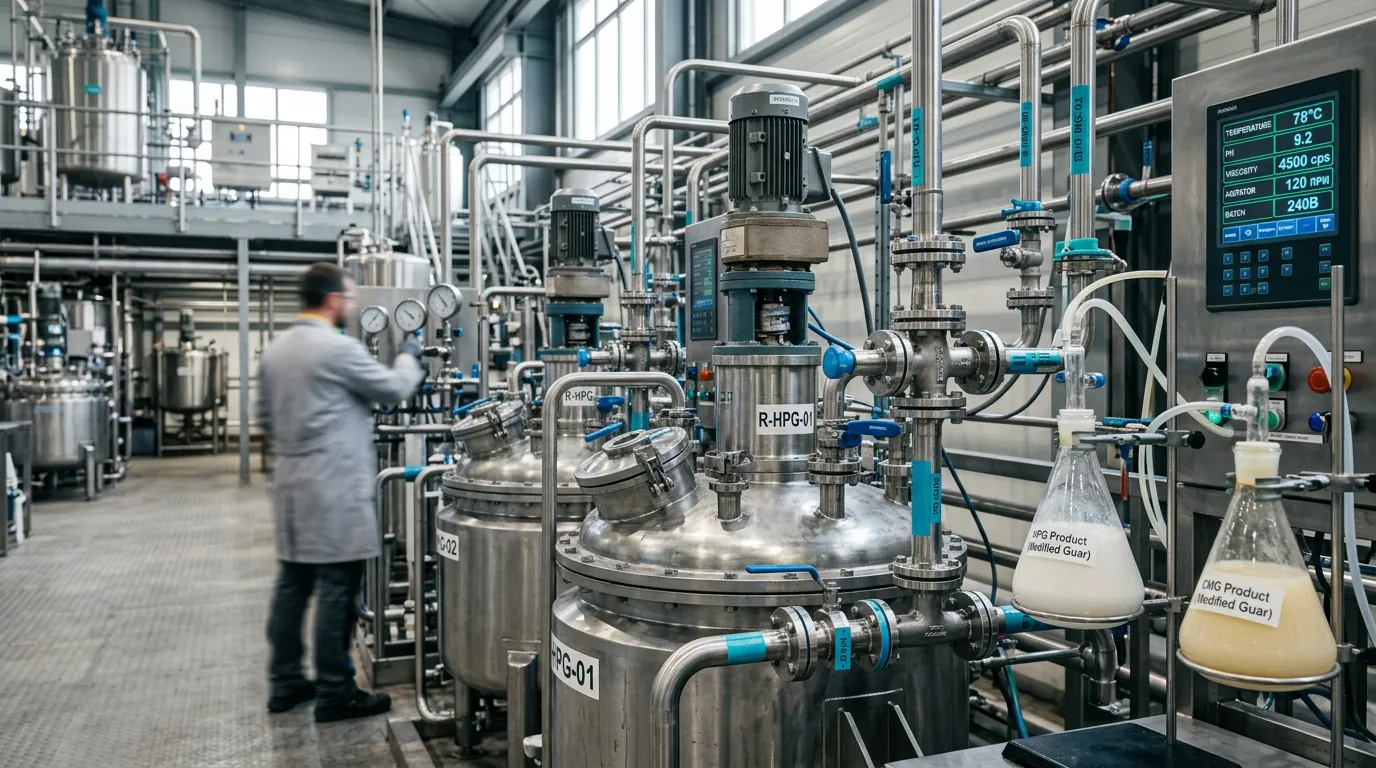
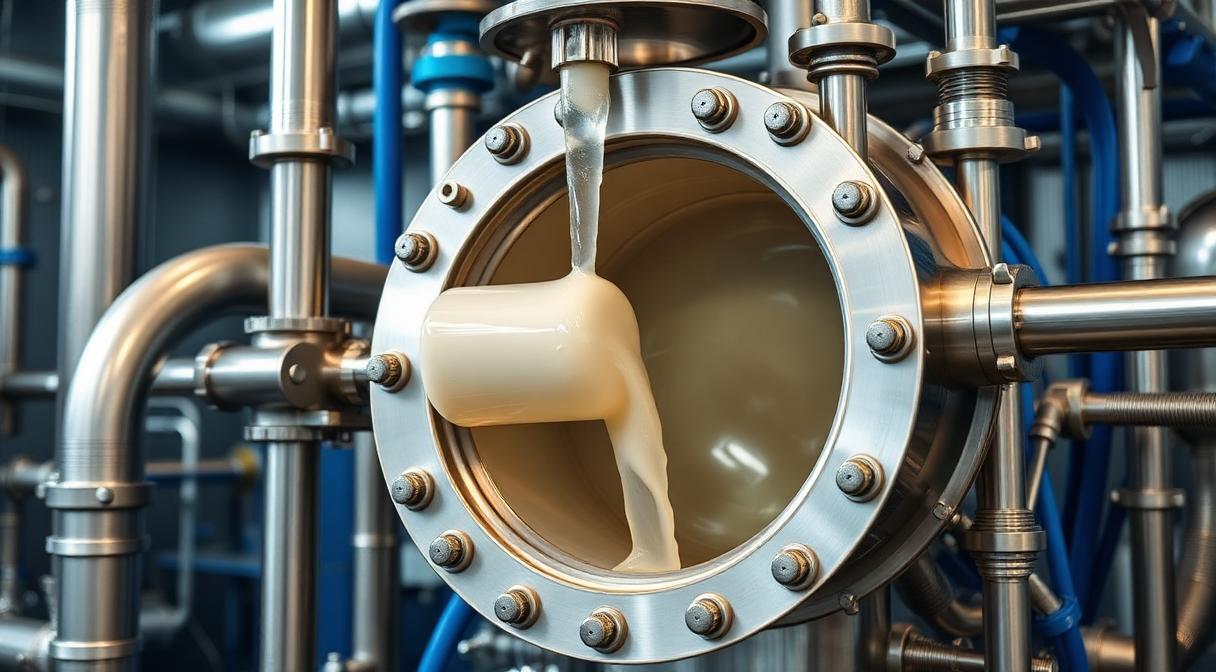 Industrial reactor producing a Guar derivative — etherification, carboxymethylation and cationisation reactions all start from the same natural polymer base.
Carboxymethyl Guar (CMG)
CMG is produced by reacting Guar Gum with monochloroacetic acid in the presence of sodium hydroxide, attaching carboxymethyl groups to the polymer backbone. The result is an anionic polymer that combines Guar's high viscosity with the surface activity of a negatively charged carboxylate. CMG dominates two markets. In mining, it is used as a depressant in selective mineral flotation, particularly in the separation of nickel and copper sulfides from gangue minerals. In the paper industry, it improves wet-end retention, sizing and surface smoothness. Lower-substitution CMG also serves as a thickener in laundry and household care products where anionic compatibility is needed.
Cationic Guar — Guar Hydroxypropyltrimonium Chloride
The most commercially valuable derivative for personal care is cationic Guar, produced by quaternising hydroxypropyl Guar with 2,3-epoxypropyltrimethylammonium chloride. The introduced positive charges adhere strongly to negatively charged hair and skin surfaces during washing, providing the conditioning effect that dominates 2026 shampoo and body wash formulations. The full chemistry and application discussion lives in our cationic Guar article. Charge density grades range from 0.5 to over 2.0 meq/g, with different positionings using different grades.
Carboxymethyl Hydroxypropyl Guar (CMHPG)
CMHPG is a dual-functional derivative that carries both anionic carboxymethyl groups and non-ionic hydroxypropyl groups. The combination delivers the temperature stability of HPG together with improved crosslinking behaviour with metal ions, making it the preferred polymer for high-temperature, high-pressure (HTHP) oilfield fracturing in deep wells. CMHPG can be crosslinked with zirconium or titanium chelates to form pumpable gels that retain viscosity at downhole temperatures above 150 °C and then break down predictably as the well is brought into production.
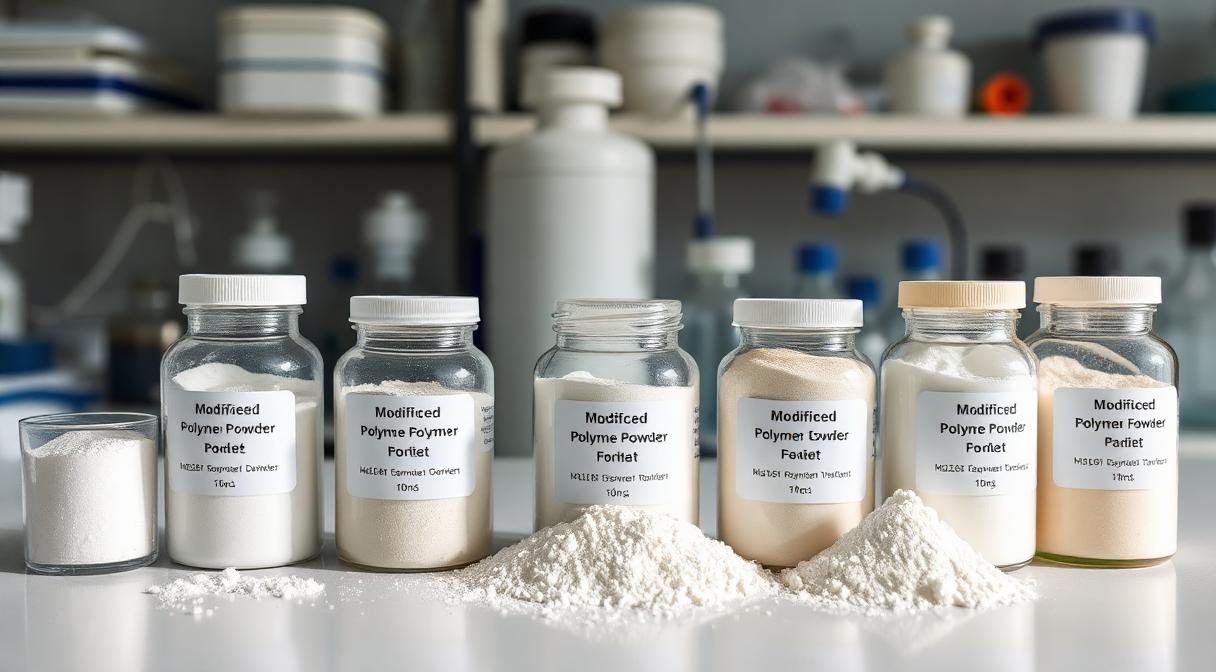 Different molar substitution levels and chemical groups produce a family of Guar derivatives tailored to specific industrial conditions — from oilfield to personal care.
Quality Control and Documentation
Every commercial Guar derivative ships with a certificate of analysis covering molar substitution, residual reagents (propylene oxide residues for HPG, residual sodium chloroacetate or sodium glycolate for CMG, residual quaternary reagent for cationic Guar), apparent viscosity at standardised conditions, moisture content, ash and particle size distribution. Reputable manufacturers maintain ISO 9001 and ISO 22000 certification for the derivatisation lines, with separate audits for Halal, Kosher and FSSC 22000 where the derivatives serve food or personal care customers. For procurement, the COA review should focus on substitution uniformity, residual reagent levels and viscosity at the conditions matching the buyer's process. See our quality and certifications page for the documentation framework.
2026 Supply Chain and Substitution Trends
Three trends are reshaping the global Guar derivatives market. First, the natural-substitution wave in personal care is accelerating the replacement of synthetic conditioning polymers (PQ-10, polyacrylates) with cationic Guar, where the cost gap favours the natural derivative by a wide margin. Second, the reciprocal-tariff environment has shifted the economic balance in mining and oilfield procurement toward Indian-origin Guar derivatives. Third, oil-field operators rebuilding fracturing fluid systems for ETO-free and tariff-resilient supply are consolidating around HPG and CMHPG produced by integrated suppliers who control both the seed-to-powder and powder-to-derivative chain. B D Guar's vertically integrated facility in Kalol exemplifies this integration.
Frequently Asked Questions
What is molar substitution (MS)?
Molar substitution is the average number of substituent groups attached per sugar unit on the polymer backbone. Higher MS means more chemical modification and stronger derivative properties. Typical MS values are 0.3 to 0.6 for HPG and 0.1 to 0.3 for CMG.
Are Guar derivatives more expensive than native Guar?
Yes, typically 50 to 200% more expensive depending on the derivative and degree of substitution. The premium is justified by the functional properties that native Guar cannot deliver.
Can Guar derivatives be used in food products?
Some can, with the appropriate regulatory approval. HPG is approved in several jurisdictions as a food additive, while CMG and cationic Guar are restricted to non-food industrial and personal care use.
What is the difference between HPG and CMHPG?
HPG carries only non-ionic hydroxypropyl groups, while CMHPG carries both hydroxypropyl and anionic carboxymethyl groups. CMHPG is preferred for high-temperature crosslinking applications in deep oilfield wells.
Do Guar derivatives biodegrade?
Yes. The native Guar polymer is fully biodegradable, and chemical modification reduces but does not eliminate biodegradability. Specific environmental certifications vary by derivative and use level.
For derivative specifications, COAs and free samples for trial formulation, contact the B D Guar technical team at /contact or browse the full product catalogue.