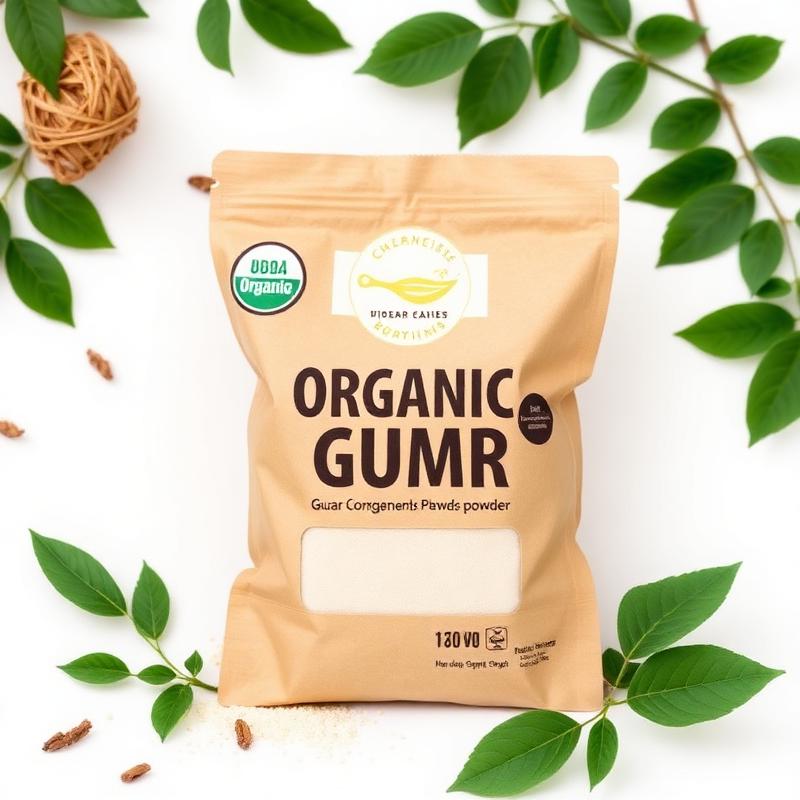
Organic Guar Gum
Certified organic guar gum sourced from organically cultivated guar beans, perfect for clean-label products and organic formulations.
Certified Organic Quality
Our organic guar gum is produced from guar beans grown without synthetic pesticides or fertilizers. Every batch is fully traceable from farm to final product, ensuring authentic organic integrity.
Industry Applications
Organic Food
- Organic bakery
- Organic dairy
- Baby food
- Health foods
Natural Products
- Dietary supplements
- Organic cosmetics
- Natural medicines
- Wellness products
Premium Markets
- Clean label products
- Specialty foods
- Export markets
- Retail brands
Specifications
Quick Answer
2026 Market Snapshot: Organic Guar Gum
The global organic guar gum market is valued at roughly USD 1.49 billion in 2025 and is projected to reach about USD 2.08 billion by 2034, driven by clean-label food, nutraceutical fiber, and natural personal-care demand. B D Guar supplies USDA/EU organic-certified HICOL guar gum from India, ISO 9001:2015 certified, since 1983.
Why is organic guar gum in higher demand in 2026?
European and North American food, beverage, and cosmetic brands are accelerating the shift toward clean-label, non-GMO ingredients produced without synthetic pesticides or fertilizers. Organic guar gum sits squarely in that demand pocket — a naturally derived galactomannan thickener that fits USDA Organic (NOP), EU Organic, and India Organic (NPOP) formulations without reformulation friction.
Certification is now a preferred-supplier gate: buyers of organic ice cream, plant-based dairy, organic bakery, and natural personal care increasingly require documented USDA / EU Organic status alongside ISO 9001:2015 quality management. Certified supply commands premium positioning in tenders and long-term supply contracts. Because certified organic guar farming yields less per hectare than conventional and carries ongoing certification and audit costs, organic grades trade at a structural premium versus conventional food-grade — see current pricing on the guar gum price page, and consider DIPOL de-polymerized guar (PHGG) for soluble-fiber nutraceutical applications where low viscosity is required.
How is guar farming becoming more sustainable?
Guar (Cyamopsis tetragonoloba) is a drought-resistant, largely rain-fed legume grown in the semi-arid belts of Rajasthan and Gujarat. As a nitrogen-fixing crop, it naturally replenishes soil fertility and is widely used in rotation with cereals and pulses, reducing dependence on synthetic nitrogen fertilizer.
Industry-wide sustainable-guar programs — supported by global hydrocolloid buyers and Indian agricultural institutions — are promoting climate-smart practices, groundwater conservation, improved seed varieties, and better agronomic training. Over the past decade these initiatives have contributed to roughly threefold yield improvements for participating smallholder farmers, alongside more predictable income and reduced input costs. Guar gum itself is biodegradable, vegan, gluten-free, and non-GMO — a natural alternative to synthetic thickeners in food-grade applications and a preferred fiber source explored in our article on organic guar gum for health supplements (2026).
Organic Guar Gum FAQs (2026)
Need Organic Guar Gum?
Contact us for organic certifications and specifications for your products.
Contact Us Today