Water-Based Paints: Preventing Sagging and Spatter with Thixotropic Rheology
Discover how Guar Gum thixotropic rheology delivers sag resistance, spatter-free rolling and stable pigment suspension in water-based paints.
Last updated:
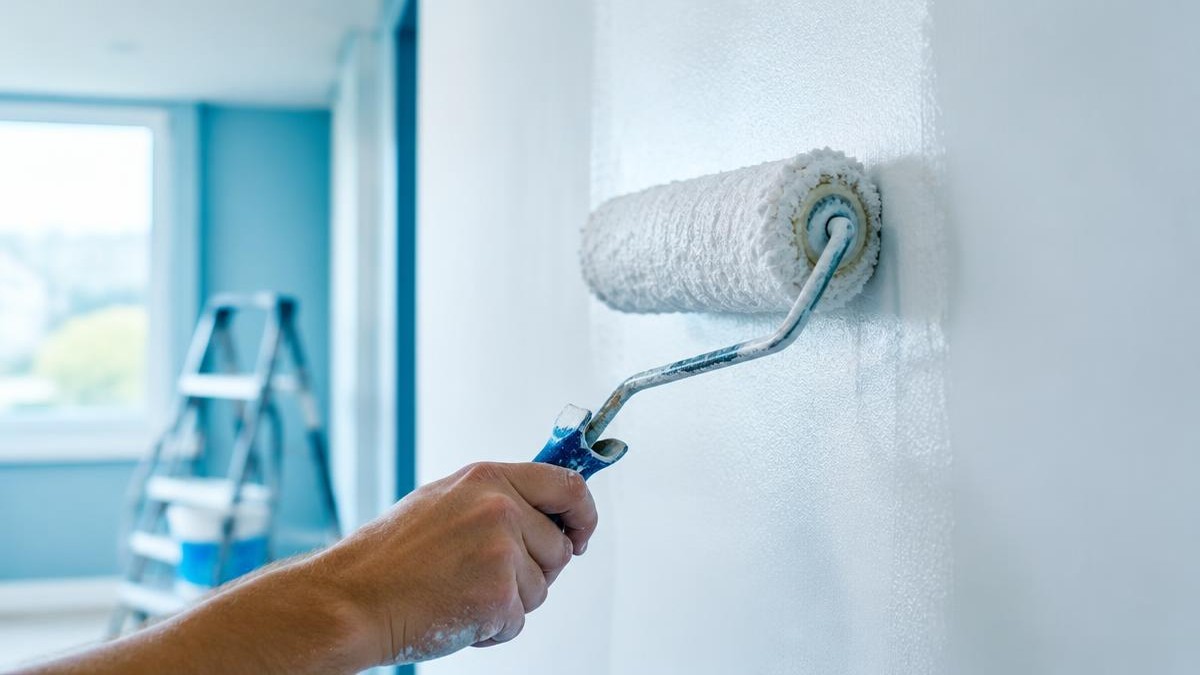
In the 2026 global coatings landscape, Guar Gum thixotropic rheology control has become a core technical benchmark for water-based paints. Stringent VOC regulations and rising demand for professional-grade finishes push formulators toward bio-based rheology modifiers. High-purity Guar Gum and its hydroxyalkyl derivatives deliver Superior shear-thinning behavior, supporting smooth brush and roller application, suppressing spatter, and providing dependable sag resistance across decorative and protective coatings.
Research Overview
The shift from solvent-borne alkyds to waterborne architectural paints has created difficult rheological challenges. Market research from IMARC indicates continued expansion of waterborne coatings through 2026. Unmodified latex dispersions have low native viscosity and little structural recovery, so unconditioned paints suffer roller spatter, pigment sedimentation, brush drag and vertical sagging. Guar Gum, a galactomannan of roughly 1.5 to 2.2 million Daltons with a 2:1 mannose-to-galactose ratio, hydrates rapidly and builds a three-dimensional network. Research in Carbohydrate Polymers describes the extensive hydrogen bonding of galactomannans with water, binder particles and pigments, which underpins reversible, time-dependent thixotropic behavior.
Thixotropic Flow Mechanics: Balancing Application and Sag Resistance
Rheology control in architectural paint must balance opposing shear regimes during application, leveling and drying. Learn more about grades suited to coatings on our products page.
- High-shear thinning: At shear rates above 10,000 s⁻¹ during brush, roller or spray application, entangled galactomannan chains uncoil and align with flow, lowering apparent viscosity for low drag and uniform film transfer.
- Spatter suppression: High extensional viscosity and elastic cohesion hold the wet film together, preventing fluid filaments from snapping into airborne droplets at the roller exit.
- Controlled structural recovery: The network rebuilds over roughly 30 to 120 seconds, allowing brush marks and roller stipple to level before static viscosity rises.
- Sag resistance: Restored zero-shear viscosity in the range of 10,000 to 20,000 cP immobilizes wet films up to 150 to 200 microns thick on vertical surfaces.
This balance between easy application and rapid recovery is what separates a professional finish from runs, drips and curtain sagging. For a broader comparison of thickener behavior, see our Guar Gum vs Xanthan Gum guide.
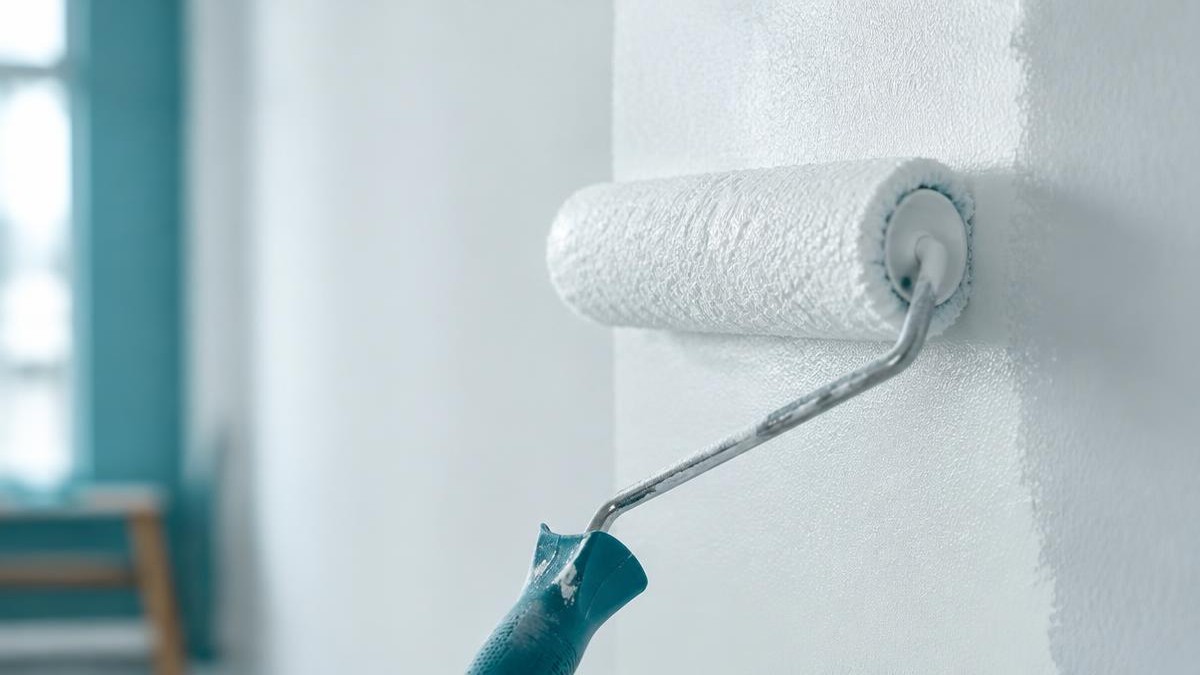 Roller application of a thixotropic water-based paint with minimal spatter.
Pigment Suspension, Color Stability and Film Uniformity
Uniform color acceptance and the absence of heavy mineral settling are essential for shelf life and consistent appearance.
- Sedimentation control: Titanium dioxide, calcium carbonate and kaolin have high specific gravity. The static yield stress of hydrated Guar Gum suspends these particles and resists hard-packing during extended warehouse storage.
- Flocculation and syneresis: Non-ionic Hydroxypropyl Guar (HPG) adsorbs onto pigment surfaces through hydrogen bonding, providing steric stabilization against agglomeration and liquid phase separation.
- Tint retention: Stable rheology supports compatibility with universal colorants at tinting stations, preserving tinting strength, color development and opacity across bases.
- Film thickness uniformity: A stabilized wet layer yields consistent dry film thickness, improving hiding power and scrub resistance in high-traffic interiors.
Consistent film build is also a quality outcome that buyers evaluate when comparing suppliers; see our quality standards for batch consistency practices.
Chemical Compatibility, Salt Tolerance and VOC-Free Formulation
Modern coatings need hydrocolloids that interact predictably with latex binders, surfactants, defoamers and coalescents without phase separation.
- Non-ionic backbone: Guar Gum and HPG tolerate ionic strength variations better than anionic cellulosic thickeners, holding stable viscosity in hard water and in high-pH latex systems (pH 8.5 to 10.5).
- Enzymatic resistance: Hydroxypropyl substitution sterically protects glycosidic linkages, improving long-term viscosity stability against microbial cellulase attack in the can.
- Bio-based, VOC-free: Sourced from Cyamopsis tetragonoloba seeds, Guar Gum is a plant-derived additive aligned with tightening 2026 VOC limits. Explore our sustainability commitments.
- Synergistic blends: Industry studies indicate that pairing HPG with hydroxyethyl cellulose (HEC) or associative thickeners tunes low-shear, Stormer mid-shear and ICI high-shear viscosity for tailored flow, leveling and spatter resistance.
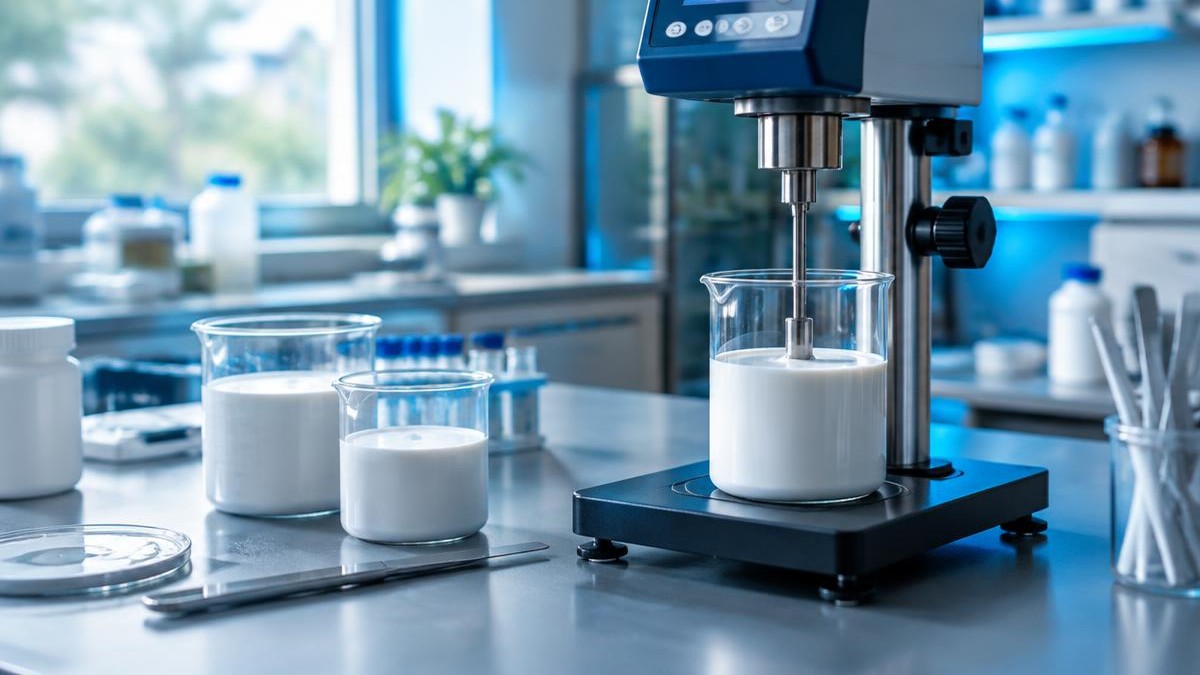 Rheology testing of waterborne paint formulations in the laboratory.
Manufacturing Integration, Hydration Kinetics and Quality Assurance
Integrating Guar Gum into paint plants calls for standardized addition techniques to protect throughput and batch consistency.
- Cold-water hydration: Guar Gum hydrates in ambient water (15 to 25 degrees Celsius) without heat or alkaline activation. Fine 200 mesh grades typically reach 85 to 90 percent of ultimate viscosity within 5 to 10 minutes under medium shear.
- Lump-free addition: Pre-blend dry powder with extender pigments such as calcium carbonate or talc, or slurry it in a glycol or surfactant pre-mix before adding the main water phase, to avoid fish-eyes.
- Mill-base stability: Guar Gum withstands high-shear grinding without irreversible chain degradation, supporting predictable final viscosity.
- Quality verification: A Certificate of Analysis with Brookfield viscosity, moisture content, ash and screen mesh pass rates ensures lot-to-lot consistency.
Key Takeaways
- Superior thixotropic control: Reversible, time-dependent rheology gives low application drag under shear and rapid recovery for sag resistance.
- Reduced roller spatter: Viscoelastic cohesion prevents filament breakup during high-speed rolling.
- Stable pigment suspension: High zero-shear viscosity limits titanium dioxide and extender settling and syneresis in storage.
- VOC-free, bio-based: A plant-derived rheology modifier supporting stricter 2026 coatings regulations.
- Better leveling and color development: Controlled recovery supports brush-mark leveling, uniform film thickness and colorant compatibility.
Frequently Asked Questions
How does Guar Gum prevent sagging in thick wet paint films?
Guar Gum and its hydroxyalkyl derivatives impart thixotropic rheology. High shear lowers viscosity for smooth spreading, and once application stops the galactomannan network rebuilds, restoring high static viscosity within seconds. This immobilizes heavy wet films on vertical walls and prevents runs, drips and sagging.
Why is HPG preferred over native Guar Gum in architectural paints?
Hydroxypropyl modification inserts hydroxypropyl groups along the polymer backbone. This improves resistance to microbial enzymes, enhances solubility and clarity in high-pH latex systems, and delivers Superior long-term viscosity stability in the can.
How does Guar Gum reduce roller spatter?
Spatter forms when low-viscosity paint creates fluid filaments that break into droplets at the roller edge. The high extensional viscosity and chain entanglement of Guar Gum raise the elastic cohesion of the wet film, preventing filament snapping and suppressing spatter.
Can Guar Gum be combined with HEC or associative thickeners?
Yes. HPG is commonly blended with HEC or HEUR thickeners, allowing formulators to tune low-shear viscosity for sag and in-can stability, mid-shear Stormer viscosity for package consistency, and high-shear ICI viscosity for film build and spatter control.
To optimize water-based paint formulations and secure reliable supply of high-purity Guar Gum and Hydroxypropyl Guar derivatives, contact the B.D. Guar technical team or write to sales@bdguar.com to request specifications, rheology data sheets and trial samples.