Tortilla Flexibility: Preventing Flatbread Cracking with Hydrocolloids
Guar Gum optimizes water distribution, boosts dough extensibility and prevents cracking in tortillas and flatbreads, preserving flexibility well beyond 30 days of storage.
Last updated:
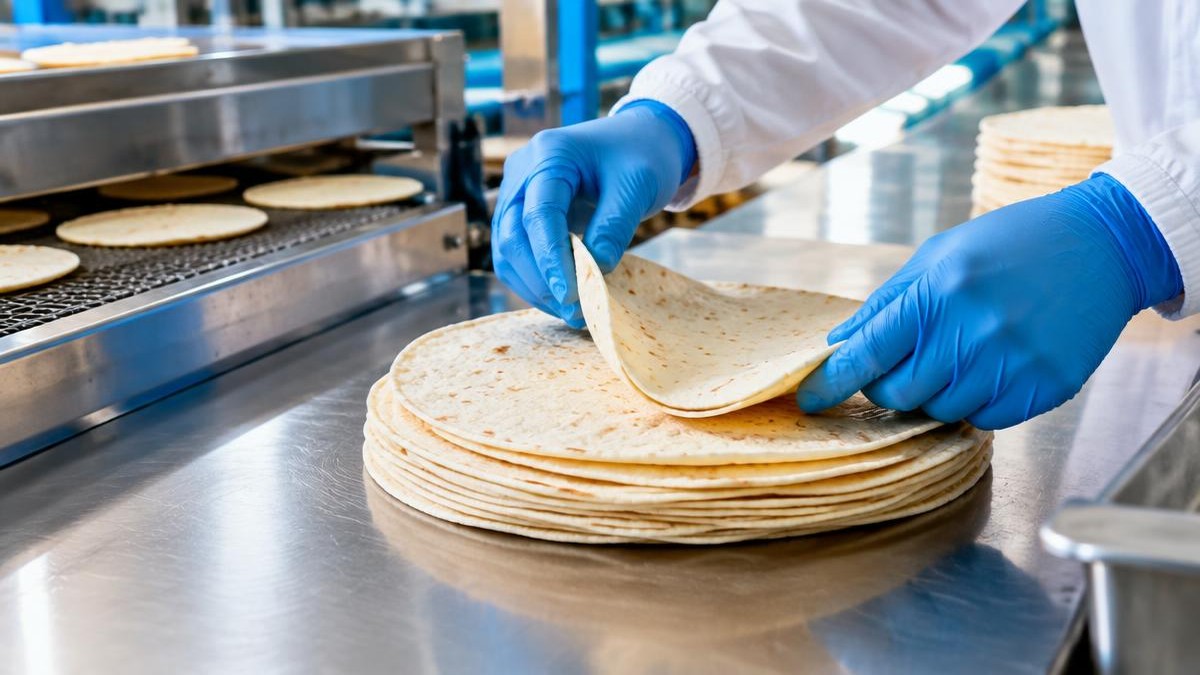
In the 2026 global commercial baking market, tortilla flexibility is an essential technical focus for industrial flatbread and tortilla bakeries. As demand for wraps and soft tacos expands, bakeries face continuous challenges with staling, moisture loss and structural cracking. Formulating with high-purity Guar Gum optimizes water distribution within the starch-protein matrix, increases dough extensibility during rolling, prevents cracking in packaging and extends freshness to deliver a Superior, shelf-stable product.
Research Overview
Market analysis published by IMARC indicates that flatbread sales account for a growing share of the commercial bakery sector across North America, Europe and Asia-Pacific. Tortillas are thin, low-moisture products with a high surface-area-to-volume ratio, making them highly susceptible to moisture evaporation, starch retrogradation and embrittlement. Research in Carbohydrate Polymers and J. Food Sci. shows that galactomannan hydrocolloids such as Guar Gum counter these effects through extensive hydrogen bonding with water, gluten proteins and starch.
Why Tortillas Crack: Starch Retrogradation and Dough Rheology
During commercial production, dough pieces are hot-pressed or roller-sheeted and then baked in tunnel ovens at roughly 200°C to 300°C for 15 to 30 seconds. On cooling, amylose expelled from swollen starch granules realigns and crystallizes, a process known as short-term staling, while amylopectin recrystallizes over extended storage.
As free water migrates from the gluten network toward crystalline starch domains, the flexible matrix becomes rigid. When consumers fold or roll the tortilla, the brittle structure yields, causing cracking, edge tearing and structural failure. Natural Guar Gum, a galactomannan of roughly 1.5 to 2.2 million Daltons with a mannose-to-galactose ratio of about 2:1, serves as an effective water-binding and dough-conditioning agent that hydrates rapidly in cold aqueous dough phases.
- Short-term staling driven by amylose realignment after baking
- Long-term firming driven by amylopectin recrystallization
- Moisture loss from high surface-area-to-volume geometry
- Mechanical stress at fold lines during consumer use
Hydrocolloid-Starch-Protein Matrix Interactions and Water Distribution
The flexibility of a baked flatbread depends on how water is bound and distributed within the gluten-protein and starch matrix. Guar Gum can absorb 20 to 30 times its dry weight in liquid, forming a high-viscosity hydro-gel phase that distributes water uniformly across proteins and starch granules.
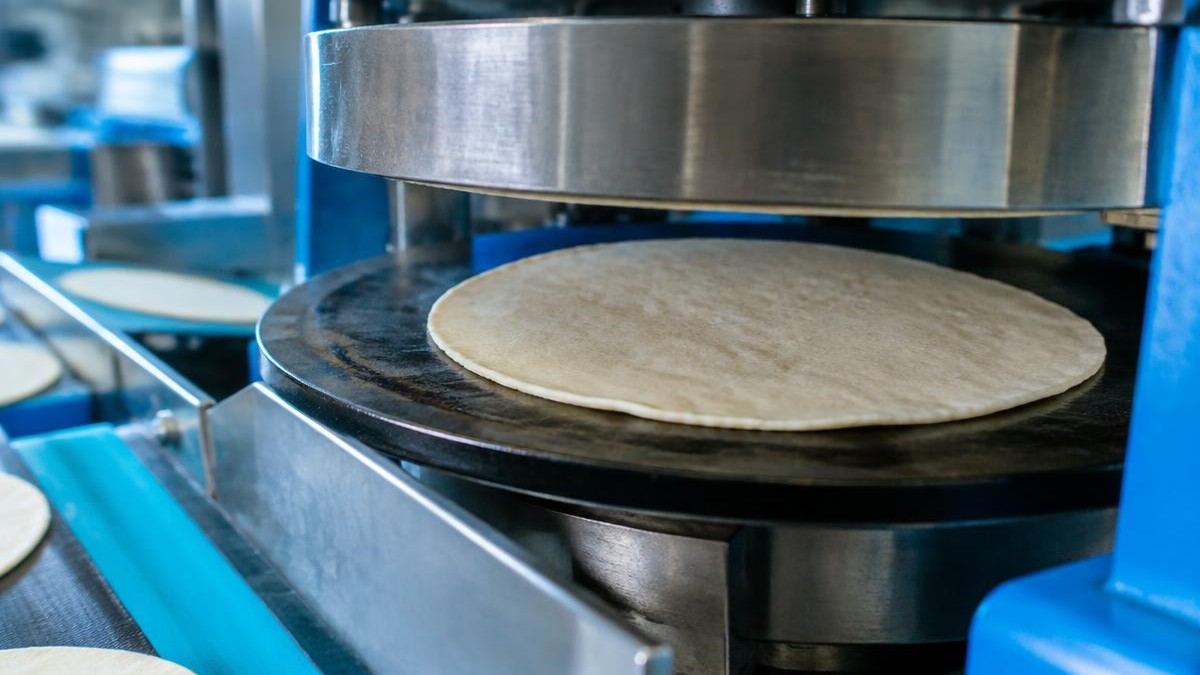 Commercial tortilla production relies on uniform water distribution within the dough matrix.
- Competitive water binding: Guar Gum hydrates in cold dough and immobilizes free water, limiting the mobility needed for starch chain realignment.
- Retrogradation inhibition: Studies in Carbohydrate Polymers indicate that hydrocolloid addition delays starch recrystallization over 14 to 21 days of storage.
- Gluten entanglement and plasticization: Long polysaccharide chains interpenetrate the glutenin-gliadin network, lowering the glass transition temperature of the amorphous matrix and keeping the tortilla supple.
- Moisture retention in tunnel ovens: Bound water stays in the crumb during flash baking at 230°C to 280°C, supporting a final moisture content of about 28% to 32%.
Rheological Control: Dough Extensibility and Machinability
On high-speed lines producing thousands of units per hour, dough consistency must stay uniform to prevent sheeting tears and weight variation. The shear-thinning (pseudoplastic) behavior of hydrated Guar Gum lowers apparent dough viscosity under roller shear, while viscosity recovery at rest prevents slump after sheeting.
In hot-pressed flour tortilla operations, dough balls are compressed between platens at 180°C to 210°C. Guar Gum reduces elastic snap-back so dough flattens evenly into thin discs without radial contraction. Excess free water in high-hydration formulas also causes sticking to belts and cutter dies; encapsulating that water within the polymer network removes surface tackiness and allows formulation water absorption to rise, increasing dough yield by about 2% to 4%.
- Reduced dough rebound during hot-pressing
- Smooth extrusion without ribbon tearing
- Lower machine stickiness at higher hydration
- Tighter weight, diameter and thickness tolerances that cut reject rates
Preventing Packaging Cracking, Zip-Locking and Shelf-Life Degradation
Post-bake packaging, shipping and retail display expose flatbreads to stacking pressure and temperature swings that accelerate structural failure. Guar Gum maintains matrix elasticity so tortillas can be bent 180 degrees or rolled around fillings without micro-cracking, flaking or seam splitting.
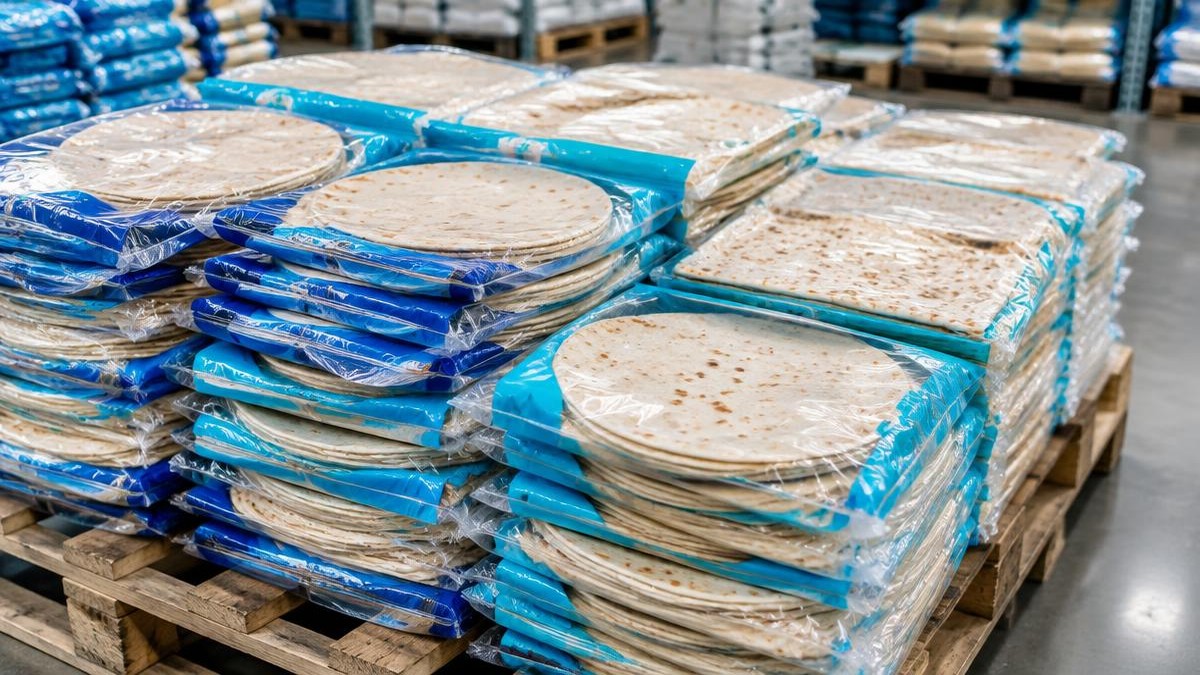 Flexible tortillas survive folding, stacking and long-distance distribution.
- Zip-locking control: Regulating surface moisture migration during cooling prevents stacked tortillas from welding together.
- Freeze-thaw stability: Cryoprotectant behavior limits ice crystal size and syneresis in frozen dough balls and pre-baked flatbreads.
- Extended rollability: Sensory panel work documented in J. Food Sci. reports that wheat tortillas with 0.25% to 0.50% Guar Gum retained Superior rollability after 30 days of ambient storage, while controls failed within 7 to 10 days.
Clean-Label Formulation, Dosage and Blending Guidelines
Consumer demand in 2026 favors short, recognizable ingredient declarations. Guar Gum (E412 / INS 412) is a plant-derived, non-GMO hydrocolloid that can replace synthetic mono- and diglycerides, sodium stearoyl lactylate and carboxymethylcellulose within EFSA and USDA-aligned frameworks. Quality parameters are detailed on the quality page, and grades are listed under products.
- Dosage: 0.15% to 0.50% of flour weight (1.5 to 5.0 g/kg) for wheat flour tortillas; 0.80% to 1.50% for gluten-free flatbreads based on rice, corn or sorghum.
- Blends: Industry studies indicate that combining Guar Gum with xanthan gum at a 2:1 or 3:1 ratio, or with anti-staling alpha-amylase, yields synergistic moisture binding. See the Guar Gum vs Xanthan Gum comparison.
- Dispersion: Dry-blend 200 mesh Guar Gum with flour, salt and dry leavening before adding water and shortening to avoid lumps.
Key Takeaways
- Superior staling resistance: Guar Gum binds water and retards starch retrogradation, extending flexibility beyond 30 days of ambient storage.
- Fewer package cracks: Higher matrix elasticity lets tortillas roll tightly without surface cracking or seam splitting.
- No zip-locking: Controlled moisture migration keeps stacked flatbreads separable.
- Better machinability and yield: Less dough snap-back and 2% to 4% higher water absorption.
- Clean-label choice: A non-GMO plant-based alternative to synthetic emulsifiers.
Frequently Asked Questions
How does Guar Gum prevent flour tortillas from cracking when folded or rolled?
Guar Gum binds water tightly within the dough matrix and entangles with wheat gluten proteins. This network acts as a macromolecular plasticizer, lowers the glass transition temperature and delays starch crystallization, so the baked tortilla stays elastic and bends without cracking along the fold line.
What is zip-locking in packaged tortillas, and how does Guar Gum help?
Zip-locking is a packaging defect where stacked flatbreads stick together and tear when separated. It results from moisture migrating to the surface of warm tortillas and dissolving surface starch. Guar Gum immobilizes moisture within the crumb, preventing surface buildup and inter-leaf adhesion.
What usage level of Guar Gum is recommended for flatbreads?
Wheat flour tortillas typically use 0.15% to 0.50% Guar Gum on flour weight, equal to 1.5 to 5.0 g/kg. Gluten-free flatbread formulations generally require 0.80% to 1.50% of total flour or starch weight to rebuild the elasticity normally provided by gluten.
Can Guar Gum be used in gluten-free tortillas and flatbreads?
Yes. In corn, rice, tapioca or sorghum doughs, the absence of gluten causes crumbling and poor machinability. Guar Gum forms a continuous viscoelastic gel network that mimics gluten elasticity, providing the cohesion, rollability and structural strength needed for gluten-free production.
To optimize flatbread formulations, eliminate cracking and secure Superior food-grade 200 mesh Guar Gum, partner with B.D. Guar Pvt. Ltd. Contact the bakery applications team at sales@bdguar.com for specifications, formulation guidance and trial samples.