Grouting and Cementing: Improving Slurry Stability and Water Retention
Guar Gum controls fluid loss, free water, and gas migration in well cementing slurries, delivering consistent density and a durable casing seal at 0.2% to 0.8% BWOC.
Last updated:

In the 2026 global well construction and zonal isolation landscape, Guar Gum cementing slurry stability is a fundamental technical priority for cementing service managers and technical engineers. As oil, gas, and geothermal drilling extends into high-pressure, high-temperature (HPHT) regimes and weak, permeable formations, maintaining cement slurry integrity during placement is essential. Formulating with high-purity Guar Gum and its hydroxyalkyl derivatives provides Superior fluid loss control, consistent slurry density, reliable setting times, and a secure casing seal.
Research Overview
The global well cementing and grouting market in 2026 is shaped by deeper offshore drilling, extended-reach horizontal laterals, geothermal development, and carbon capture and storage (CCUS) projects. According to IMARC, demand for specialized oilfield cementing additives continues to expand as operators prioritize long-term wellbore integrity. Studies published in the SPE Journal and Carbohydrate Polymers describe how the hydroxyl-rich galactomannan structure of Guar Gum adsorbs onto hydrating cement particles and forms a cohesive, flexible hydro-gel barrier. Native Guar Gum, extracted from the endosperm of Cyamopsis tetragonoloba, is a non-ionic polysaccharide with a beta-(1-4)-D-mannopyranose backbone and alpha-(1-6)-D-galactopyranose side branches at a 2:1 ratio.
Macromolecular Water Retention Mechanics and Fluid Loss Control
The primary operational challenge during slurry placement is fluid loss: the migration of mixing water from the slurry into permeable rock under high differential pressure. Uncontrolled filtration causes premature dehydration, density spikes, micro-annular channels, slurry bridging, and unpredictable thickening times. The principal function of Guar Gum is to bind and retain mixing water within the continuous liquid phase under mechanical and thermal stress.
- Hydrophilic Water Immobilization: abundant hydroxyl groups form hydrogen bonds with water, physically entrapping free water and raising the water-holding capacity of the slurry.
- Adsorption and Filter Cake Formation: dissolved galactomannan chains adsorb onto hydrating tricalcium silicate (C3S) and C-S-H gel grains, creating a thin, compressible, low-permeability filter cake on the borehole wall.
- Drastic Reduction in API Fluid Loss: unconditioned Portland slurries can exceed 1,000 mL per 30 minutes at 1,000 psi differential pressure, while high-purity Guar Gum reduces API fluid loss to roughly 50 to 100 mL per 30 minutes.
- Prevention of Flash Dehydration: restricting filtrate loss into high-permeability zones maintains a stable water-to-cement ratio and ensures complete fill-up along the casing column.
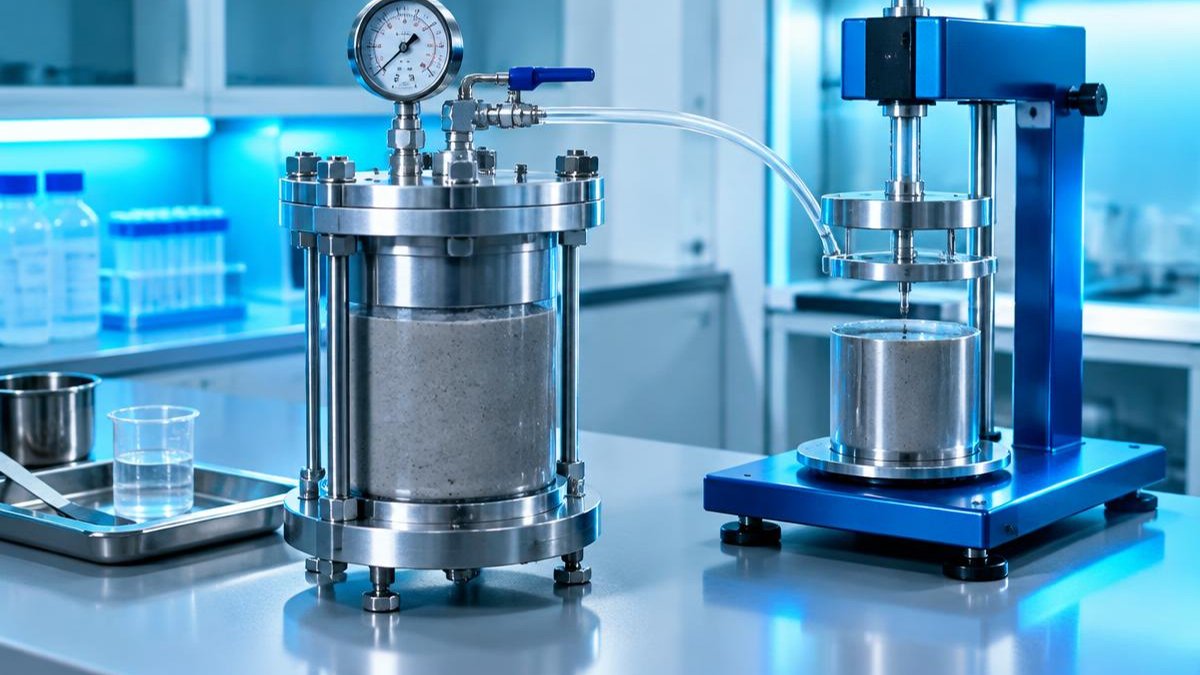 Laboratory fluid loss testing of Guar Gum modified cement slurry.
Slurry Density Consistency and Free-Water Control in Annular Cementing
Uniform slurry density throughout the job prevents static sedimentation, channeling, and downhole pressure imbalance. Guar Gum builds a viscoelastic network that holds solids in suspension during static wait-on-cement (WOC) periods. Learn more about grade options on the products page.
- Elimination of Free-Water Bleeding: Guar Gum imparts static yield stress that removes free water and prevents fluid channels along the upper side of horizontal wellbores.
- Suspension of Heavy Weighting Agents: in grouts weighted with barite, hematite, or manganese tetroxide, the polymer network prevents particle sag and density gradients.
- Suppression of Gas Migration: during the liquid-to-solid transition, Guar Gum maintains pore pressure within the setting matrix and seals interstitial voids, blocking gas channels behind casing.
- Homogeneous Compressive Strength: consistent particle packing and water distribution from shoe to surface give uniform hydration and strength across centralizer intervals.
High-Pressure Stability, Rheological Modulation, and Predictable Setting Kinetics
Cementing formulations must mix easily at surface, pump with low friction, and then set predictably downhole. Guar Gum behaves as a passive, predictable fluid loss additive that integrates with common retarders, accelerators, and defoamers. Compare options in the product comparison guide.
- Pseudoplastic Shear-Thinning Flow: polymer chains align under high shear in pumps and casing, lowering apparent viscosity and displacement friction pressure.
- Non-Ionic Stability in High-Salinity Water: seawater and sodium, potassium, or calcium chloride brines do not collapse the polymer conformation or cause salt-induced precipitation.
- Thermal Endurance of Derivatives: Hydroxypropyl Guar (HPG) and Carboxymethyl Hydroxypropyl Guar (CMHPG) resist thermal depolymerization at bottom-hole temperatures above 250 F (121 C).
- Predictable Thickening Time Compatibility: compatibility with lignosulfonate retarders and calcium chloride accelerators avoids erratic thickening shifts.
 Cement slurry placement in the casing annulus during primary cementing.
Long-Term Casing Seal Durability, Sheath Integrity, and Environmental Compliance
The objective of primary cementing is a permanent, gas-tight seal behind the casing that withstands decades of production stress. Retaining water during hydration supports that outcome, and the plant-based origin of Guar Gum aligns with the sustainability commitments of operators working offshore.
- Enhanced Set Cement Microstructure: complete hydration of calcium silicate phases yields a dense, low-porosity C-S-H matrix with reduced capillary permeability.
- Flexural Resilience: polymer networks improve flexural elasticity and impact resistance, helping the sheath absorb shocks during perforation, fracturing, and pressure testing without micro-annular cracking.
- Clean Environmental Profile: natural Guar Gum is plant-based, non-toxic, and biodegradable, an environmentally safe alternative to synthetic acrylamide or petroleum-based fluid loss polymers, consistent with expectations framed by EFSA, USDA, and CODEX guidance.
- Superior Cost-in-Use: typical dosage of 0.2% to 0.8% by weight of cement (BWOC) lowers chemical logistics costs.
Key Takeaways
- Superior Fluid Loss Control: galactomannans form an ultrathin, low-permeability filter cake, reducing API fluid loss from over 1,000 mL to roughly 50 to 100 mL per 30 minutes.
- Eliminates Free Water and Bleeding: static yield stress suspends cement and weighting agents in horizontal wells.
- Suppresses Gas Migration: pore pressure is held during the critical transition state, blocking gas channels.
- High-Salinity and HPHT Compatibility: non-ionic structure is stable in seawater and brines, with derivatives extending performance above 250 F.
- Biodegradable and Cost-Effective: a plant-derived additive that meets offshore environmental expectations at low dosage rates.
Frequently Asked Questions
How does Guar Gum improve water retention in cement slurries during placement?
Guar Gum carries dense hydroxyl groups along its galactomannan backbone that hydrogen-bond with water. Downhole, the dissolved polymer adsorbs onto hydrating cement grains and rock faces, creating a thin, compressible, low-permeability filter cake that keeps filtrate from escaping into the formation.
Why is free-water control critical in horizontal and deviated well cementing?
In deviated wellbores, gravity settles unstabilized particles toward the low side and forces clear water to the high side. That free water forms a continuous channel along the upper casing surface, destroying zonal isolation. Guar Gum provides static yield stress that prevents settling and free-water separation.
Is Guar Gum compatible with seawater and high-salinity mixing brines?
Yes. Native Guar Gum is non-ionic, so its conformation does not depend on electrostatic charge. It remains soluble and stable in seawater, sodium chloride brines, and calcium chloride fluids without charge collapse or salt-out precipitation.
What typical usage levels of Guar Gum are required in cementing formulations?
Typical inclusion rates range from 0.2% to 0.8% by weight of cement. Because of its high molecular weight and water-binding capacity, these low rates control fluid loss and slurry stability without significantly raising pumping pressure or disrupting retarder chemistry.
To optimize cementing formulations and secure a reliable supply of Superior, fast-hydrating Guar Gum for energy and construction applications, partner with B.D. Guar Pvt. Ltd. Visit the contact page or email sales@bdguar.com to request specifications, fluid loss testing protocols, and landed freight quotes. See our quality standards for batch testing details.