Soft-Serve Dairy Stabilization: Maintaining Clean Dispensing and Creamy Texture
Learn how Guar Gum protects milk-fat emulsions, limits ice crystal growth and delivers clean, drip-free dispensing in commercial soft-serve mixes.
Last updated:
Across the 2026 global frozen dessert landscape, soft-serve dairy stabilization with Guar Gum has become a core formulation priority for mix manufacturers supplying quick-service restaurants, frozen yogurt bars and automated kiosks. Continuous freezing, high-speed beater shear and nightly heat-treatment cycles place severe stress on the milk-fat emulsion. A well-designed Guar Gum system protects fat globules, restrains ice crystal growth and delivers the clean dispense and Superior creamy mouthfeel that operators and consumers expect.
Research Overview
Unlike hard-pack ice cream, which is blast frozen and held static at around -18°C, soft-serve is frozen dynamically in a scraped-surface barrel at roughly -6°C to -8°C and dispensed directly. The mix of water, milk fat, milk solids-not-fat, sugars and emulsifiers is repeatedly scraped and aerated. Industry studies indicate that the hydroxyl-rich galactomannan backbone of Guar Gum binds free water and thickens the serum phase, controlling emulsion breakdown, recrystallization and dispensing behaviour under these conditions.
Milk-Fat Emulsion Preservation Under Continuous Shear
Soft-serve depends on a controlled degree of partial fat coalescence. Enough coalescence traps air cells and gives the ribbon structure as it leaves the star orifice; too much produces butter grains, a greasy barrel and a waxy eat. The motorized beaters in a soft-serve freezer constantly threaten the milk fat globule membrane, the thin protein and phospholipid coating that keeps fat droplets apart.
Hydrated Guar Gum raises the micro-viscosity of the continuous serum phase surrounding each fat droplet. This dampens collision frequency and creates a steric buffer, so the emulsion can tolerate hours of agitation without catastrophic churning.
- Steric and viscous protection: a thickened serum phase reduces shear-induced rupture of the fat globule membrane and limits oiling-off.
- Controlled partial coalescence: regulated fat destabilization supports dry draw, stand-up and firm swirl definition without large butter aggregates.
- Cleaner freezer barrels: uniformly dispersed fat avoids the insulating butterfat film that coats cylinder walls and scraper blades, preserving heat-transfer efficiency and reducing compressor run time.
- Heat-treatment resilience: in self-pasteurizing machines that heat mix to around 65°C to 70°C overnight and recool, Guar Gum maintains serum-phase stability across repeated thermal cycles.
Cryogenic Water Immobilization and Ice Crystal Control
Ice crystal size largely determines whether soft-serve tastes velvety or coarse. Crystals are generally perceived as icy once they grow beyond roughly 40 to 50 microns. During machine idle periods and temperature swings in the hopper and barrel, small crystals melt and refreeze onto larger ones, a process known as heat shock or Ostwald ripening.
The abundant hydroxyl groups along the Guar Gum mannose backbone hydrogen-bond with unfrozen water, reducing water mobility in the concentrated serum. At the same time, entangled polymer chains form a physical network that slows diffusion of water molecules to growing crystal surfaces.
- Water binding: reduced free-water mobility lowers the driving force for crystal growth during idle and holding periods.
- Diffusion barrier: the entangled galactomannan network restricts migration of water to existing ice nuclei, keeping mean crystal size below sensory thresholds.
- Heat-shock resistance: recrystallization kinetics are retarded, so texture holds up through fluctuating shop and kitchen temperatures.
- Reduced sandiness: maintaining serum hydration delays lactose crystallization in high-solids mixes, preventing a gritty mouthfeel.
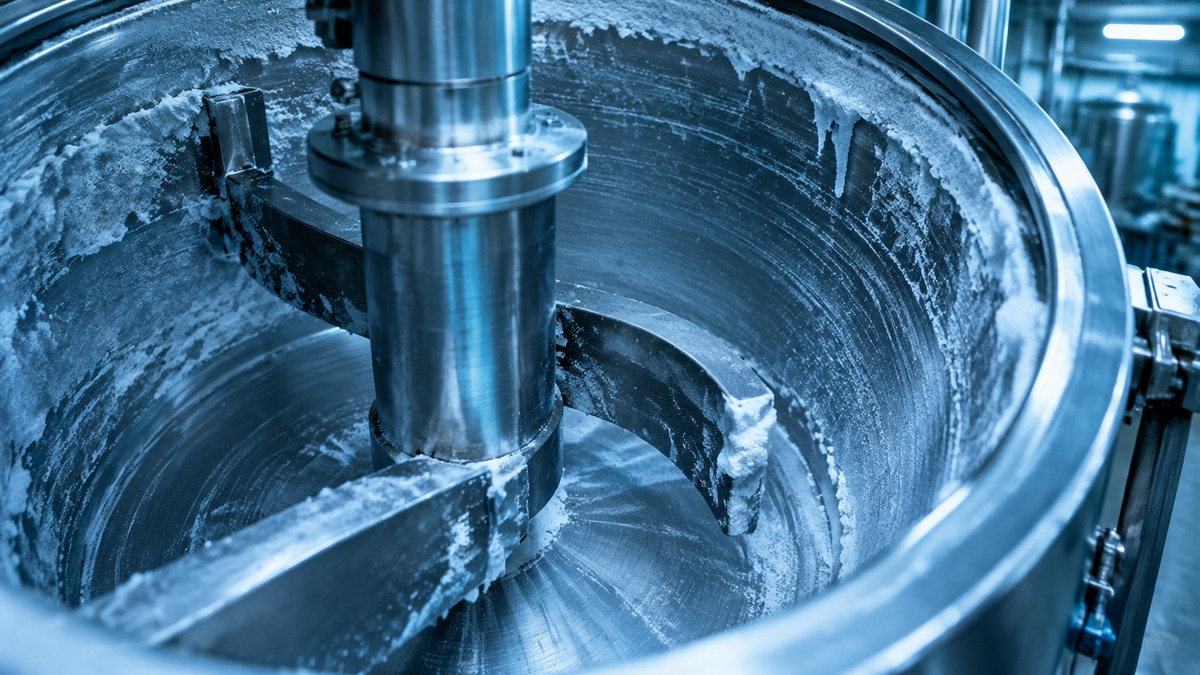 Continuous scraped-surface freezing places constant shear and thermal stress on soft-serve mixes.
Rheology for Overrun, Stand-Up and Clean Dispense
The flow behaviour of the liquid mix and the frozen product governs both operating efficiency and presentation at the counter. Mixes stabilized with Guar Gum are pseudoplastic: apparent viscosity falls under the high shear found in mix pumps and the freezing cylinder, then rebuilds quickly at rest. More on this behaviour is covered in the Guar Gum glossary.
This shear-thinning, rapidly recovering profile lets the mix flow and aerate easily, typically supporting overrun in the 40% to 80% range, while the dispensed ribbon regains enough body to hold sharp peaks in a cone or cup.
- Pumping and aeration: lower apparent viscosity under shear aids mix transfer and efficient air incorporation.
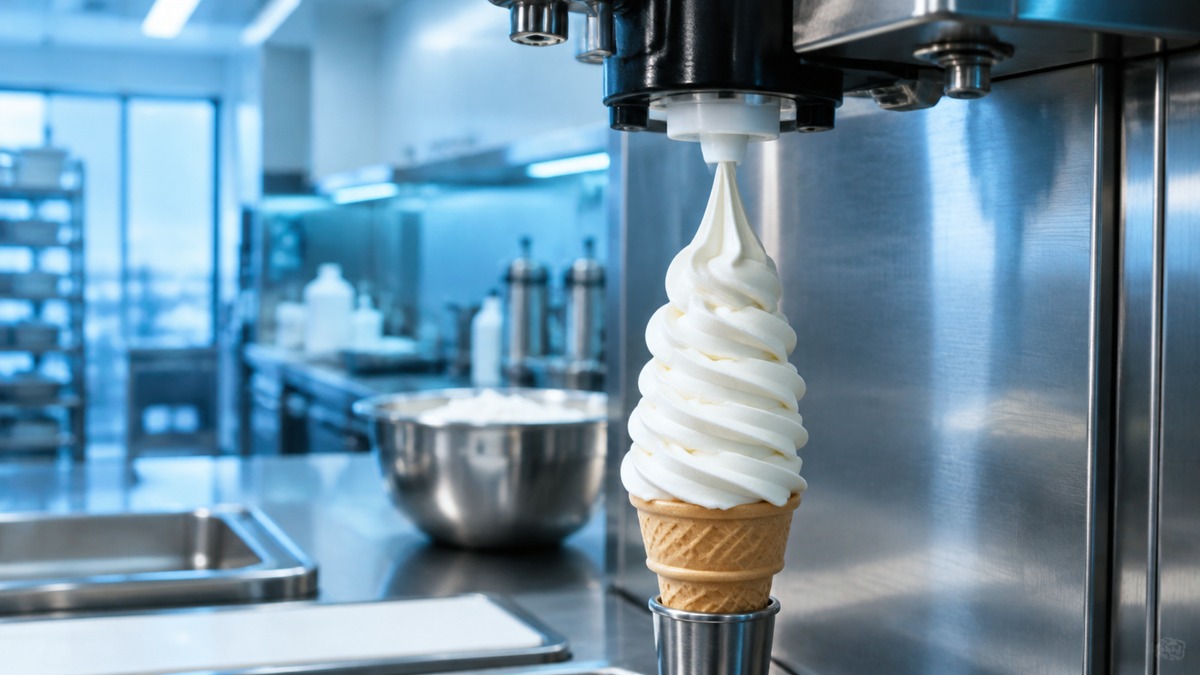
- Peak retention: fast viscosity recovery after the draw valve produces defined, high-standing swirls that resist slumping.
- Drip-free cut-off: a balanced viscoelastic structure prevents tailing and stringing from the star valve, keeping drip trays clean and portions consistent.
- Meltdown resistance: a weak hydrogel frame holds melting serum within the foam and fat matrix, slowing drips during consumption.
Synergistic Blends, Usage Levels and Batching Practice
Guar Gum is a Superior serum thickener, but used alone at higher levels in milk it can show thermodynamic incompatibility with casein micelles, leading to wheying-off in refrigerated liquid mix. A small addition of kappa-carrageenan, often in the region of 0.01% to 0.02% of mix, forms a weak complex with kappa-casein that keeps proteins in suspension. Blending with cellulose gum or xanthan gum can further build body and allow lower total stabilizer inclusion; see how these hydrocolloids differ on the Guar Gum vs xanthan gum page.
For soft-serve mixes in the 4% to 10% milk-fat range, low-fat frozen yogurt bases and many non-dairy soft-serve formulations, typical usage of 200 mesh food-grade Guar Gum is 0.10% to 0.25% of total mix weight when used alone, or roughly 0.08% to 0.15% within a multi-gum system. Final levels should always be confirmed through pilot trials on the target freezer.
- Pre-blend dry: mix fine 200 mesh Guar Gum with sucrose or skim milk powder to separate particles and avoid fish-eyes.
- Disperse under shear: add the dry blend to milk under high-shear agitation at around 45°C to 50°C to allow full hydration.
- Then process: proceed to pasteurization and two-stage homogenization, commonly in the 150 to 200 bar range, followed by ageing.
- Verify consistency: rely on batch-level viscosity and microbiological data, as documented in B.D. Guar quality procedures.
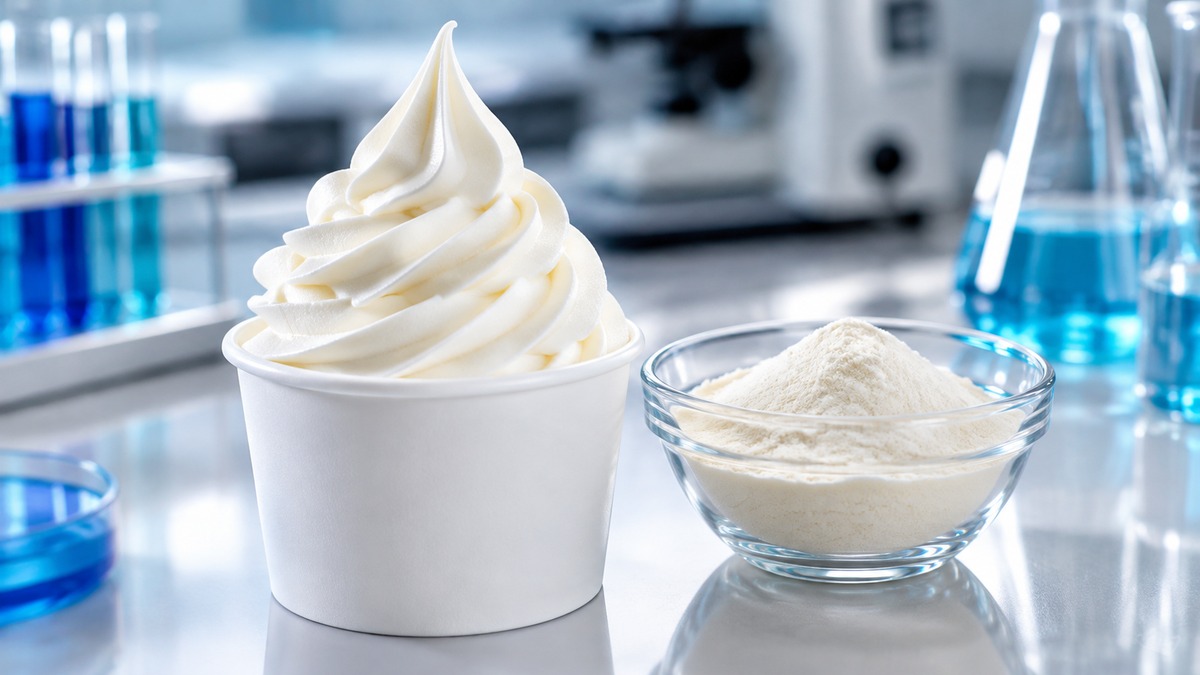 Balanced viscoelastic structure supports sharp swirl peaks and clean nozzle cut-off.
Regulatory Status and Clean-Label Positioning
Guar Gum (E412) is a plant-derived food additive recognized under CODEX Alimentarius standards and permitted in frozen desserts in major markets including the European Union and the United States. For 2026 brands pursuing simpler ingredient declarations, it offers a familiar, natural stabilizer that replaces more processed alternatives without sacrificing performance.
- Natural origin: derived from the endosperm of the Cyamopsis tetragonoloba seed.
- Certified supply: food-grade HICOL® grades produced under ISO 22000 and FSSAI-certified systems, with Halal and Kosher options.
- Traceable sourcing: raw material grown in Gujarat and Rajasthan, supported by B.D. Guar sustainability commitments.
Key Takeaways
- Emulsion protection: Guar Gum thickens the serum phase and buffers fat globules against shear, preventing churning and greasy freezer barrels.
- Ice crystal control: hydroxyl-driven water binding and an entangled polymer network keep ice crystals small through idle periods and heat shock.
- Clean dispense: pseudoplastic flow with rapid recovery gives easy pumping, good overrun, sharp peaks and drip-free cut-off.
- Smart blending: pairing with kappa-carrageenan prevents wheying-off, while CMC or xanthan blends can reduce total stabilizer usage.
- Practical dosage: 0.10% to 0.25% of 200 mesh Guar Gum alone, or about 0.08% to 0.15% in multi-gum systems, pre-blended with dry ingredients.
Frequently Asked Questions
How does Guar Gum stop soft-serve from turning icy?
Iciness develops when unfrozen water migrates and refreezes onto existing crystals during idle time and temperature swings. Guar Gum binds this water through hydrogen bonding and forms a polymer network that slows its diffusion to crystal surfaces. The result is smaller average crystal size and a smoother texture, even after repeated heat-shock events in the machine.
Why is kappa-carrageenan often paired with Guar Gum in dairy mixes?
Used alone at higher levels, Guar Gum can be thermodynamically incompatible with casein micelles, causing visible whey separation in refrigerated liquid mix. A very small addition of kappa-carrageenan interacts with kappa-casein to hold the protein matrix in suspension, eliminating wheying-off without changing the frozen texture or the dispensing performance.
What causes fat churning in soft-serve machines?
Constant scraping by beater blades can rupture the protective membrane around milk-fat globules, letting free butterfat merge into grains and coat the cylinder. Guar Gum raises serum viscosity and acts as a steric buffer, reducing destructive collisions. This keeps the emulsion intact, protects heat transfer at the barrel wall and maintains smooth machine operation.
What is the recommended Guar Gum dosage for soft-serve mixes?
Typical inclusion for 200 mesh food-grade Guar Gum is 0.10% to 0.25% of total mix weight when used as the main stabilizer, and around 0.08% to 0.15% within a blended stabilizer system. Optimal levels depend on fat content, total solids and freezer design, so pilot trials are recommended before scale-up.
To build a soft-serve mix with stable emulsions, fine ice structure and Superior clean dispensing, explore the HICOL® food-grade range on the products page or contact the B.D. Guar technical team at sales@bdguar.com for samples and formulation support.