Synthetic Carpet Backing: Optimizing Latex Sizing and Binding
Learn how Guar Gum thickens carpet-backing latex, spreads adhesive evenly, boosts tuft-lock strength and stops strike-through into face fibers.
Last updated:
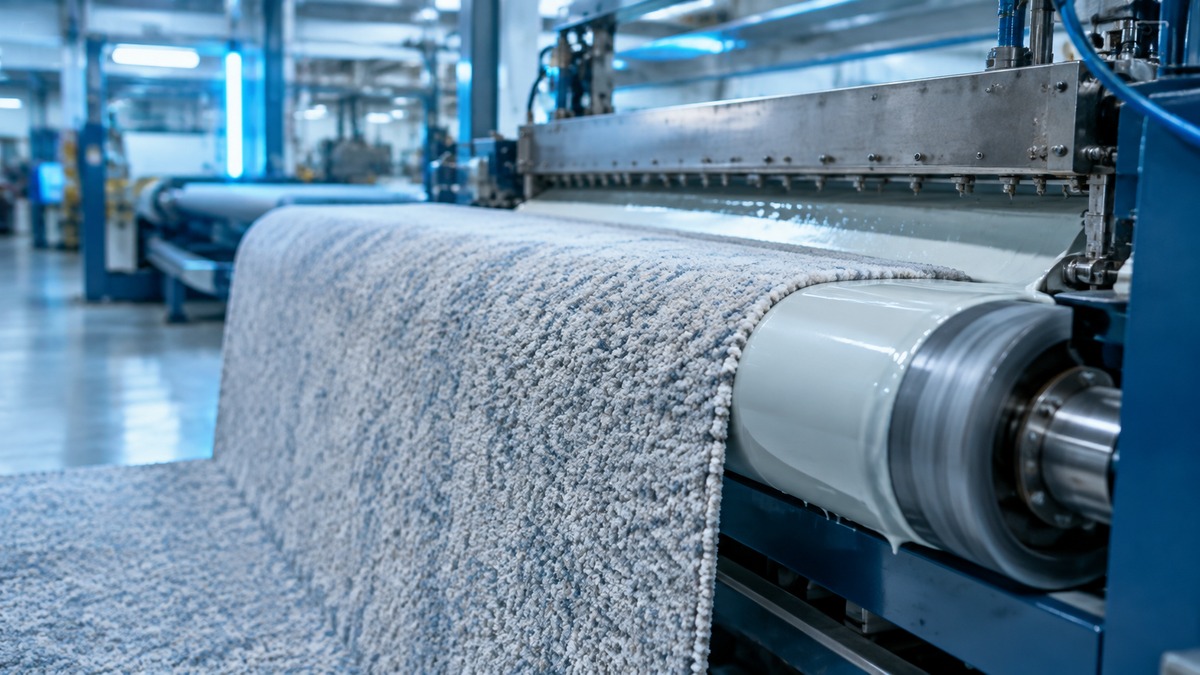
In 2026, Guar Gum for synthetic carpet backing has become a critical rheology tool for carpet manufacturing engineers balancing high-speed tufting lines, stricter indoor air quality expectations and rising durability demands. Formulating compound latex pre-coats with high-purity Guar Gum optimizes compound viscosity, ensures uniform adhesive spread across the primary backing, improves tuft-lock strength and prevents adhesive strike-through into face fibers, delivering a Superior finished carpet structure for residential, commercial and automotive markets.
Research Overview
Modern tufted carpet is a multi-layer composite: nylon, polypropylene or polyester face yarns stitched into a woven polypropylene primary backing, anchored by a carboxylated styrene-butadiene rubber (CSBR) or acrylic latex pre-coat, and laminated to a secondary backing. Industry studies indicate that the compound latex pre-coat is the single most important quality determinant, and that a non-ionic, pseudoplastic galactomannan thickener is one of the most effective ways to control how that pre-coat flows, wets and sets.
Why the Latex Pre-Coat Decides Carpet Quality
The pre-coat must coat every tuft stitch, penetrate the primary backing fibers, lock the face yarns in place and securely bond the secondary backing. Unthickened latex emulsions carrying high proportions of inorganic fillers such as calcium carbonate or hydrated alumina show low zero-shear viscosity and poor stability. Without a dedicated thickener, the liquid adhesive drains upward into the face fibers, a defect known as strike-through.
Strike-through hardens face yarns, ruins carpet hand, alters the appearance of dyed pile and wastes expensive latex. At the other extreme, inadequate or uneven adhesive spread results in weak tuft-lock, edge fraying and secondary backing delamination under foot traffic. Both failures trace back to the same root cause: poor control of compound rheology.
Natural Guar Gum, extracted from the seed endosperm of Cyamopsis tetragonoloba, addresses this directly. It is a high-molecular-weight polysaccharide built on a linear beta-(1→4)-D-mannose backbone with single alpha-(1→6)-D-galactose side branches at an approximate 2:1 mannose-to-galactose ratio. The dense population of hydroxyl groups forms an extensive hydrogen-bonded network in the water phase of the latex, a mechanism described in detail in the B.D. Guar Guar Gum glossary.
- Typical carpet composite: face yarn, woven polypropylene primary backing, CSBR or acrylic latex pre-coat, and a polypropylene, jute or foam secondary backing.
- Key failure modes: strike-through, weak tuft-lock, edge fraying, delamination, bowing and curl.
- Thickener requirement: low viscosity under application shear, high viscosity at rest, and full compatibility with filled, alkaline latex.
Rheological Dynamics: Shear-Thinning Flow and Strike-Through Prevention
The primary technical role of Guar Gum in carpet latex compounds is to regulate viscosity across the high-shear application step and the zero-shear resting phase. During application by lick roll, doctor blade or air-knife coater, shear rates can exceed 5,000 to 10,000 s⁻¹. Under that shear, the randomly coiled galactomannan chains align in the direction of flow, lowering apparent viscosity and allowing smooth, low-drag compound transfer and uniform film metering across wide carpet webs.
The moment the pre-coat is deposited on the primary backing, shear drops to near zero. Guar Gum rapidly re-establishes its entangled macromolecular network, so the compound stops flowing uncontrollably into face yarns or pooling in backing valleys. This high low-shear yield stress holds the latex at the primary backing interface, keeping pile soft and flexible while optimizing adhesive consumption per square meter.
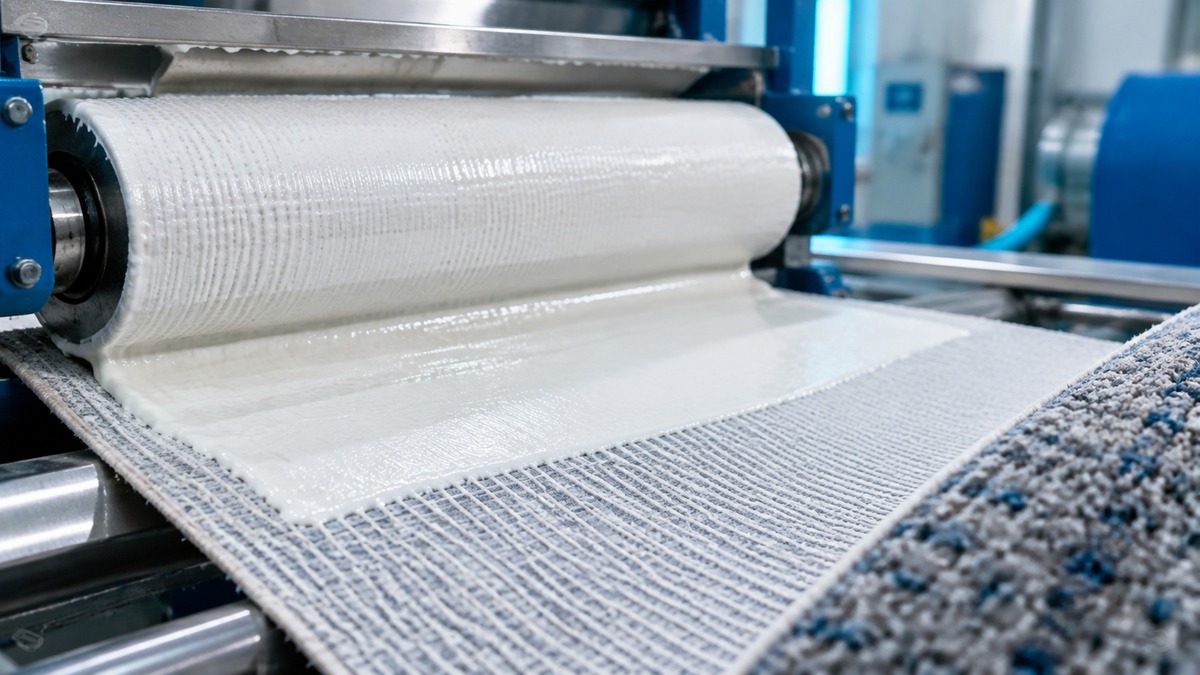 Shear-thinning Guar Gum allows latex compound to meter evenly across wide carpet webs, then sets in place to prevent strike-through.
- Pseudoplastic shear-thinning: easy pumping and roll transfer at application shear rates.
- Rapid viscosity recovery: the compound stays where it is applied, eliminating face fiber strike-through.
- Filler suspension: compounds commonly carry 150 to 250 parts calcium carbonate per 100 parts dry latex; hydrated Guar Gum provides a static yield point that keeps dense mineral particles from settling in storage tanks and applicator pans.
Formulators comparing hydrocolloid options can review performance differences on the B.D. Guar Guar Gum vs xanthan gum page.
Interfacial Binding Mechanics: Tuft-Lock and Delamination Resistance
Mechanical durability requires complete encapsulation of the tuft roots and a resilient adhesive bridge to the secondary backing. Tuft-lock, evaluated under ISO 4919 and ASTM D1335, measures the force needed to pull a loop or tuft from the backing. By controlling compound flow under roll or blade pressure, Guar Gum allows the latex to wet and wrap individual filament bundles at the tuft base, establishing strong mechanical anchoring after cure.
Secure lamination of the secondary backing depends on a uniform adhesive film with controlled wet tack. Guar Gum regulates open time and water retention in the wet latex film, preventing premature drying before the secondary backing is married to the pre-coat. The flexible galactomannan backbone also contributes toughness to the cured CSBR matrix, helping preserve tuft-lock under heavy commercial traffic and rolling caster wheels.
- Tuft root encapsulation: higher tuft pull-out force under ISO 4919 and ASTM D1335 testing.
- Controlled open time: better secondary backing adhesion and delamination resistance.
- Dimensional stability: homogeneous compound distribution and balanced moisture loss in the stenter reduce bowing, skew and edge curl.
- Bending fatigue endurance: a flexible film that resists cracking under repeated flexing.
Processing Kinetics: Applicator Stability, Foam and Drying Efficiency
Carpet backing formulas rely on high filler-to-polymer ratios for economic viability and flame performance. Because native Guar Gum is non-ionic, it remains compatible with heavily filled, high-pH CSBR and acrylic latex emulsions (pH 8.5 to 10.5), avoiding the coagulation, gel specks and viscosity drift that can occur when polyanionic synthetic thickeners interact with calcium ions.
Coating plants continuously pump and recirculate compound through applicator pans over multi-shift runs. Guar Gum holds viscosity steadily under this recirculation, giving consistent coat weights from the start of a shift to the end. Its structured hydrogel also immobilizes free water, supporting uniform steam release during curing at roughly 130°C to 160°C and helping prevent surface skinning, blistering and cratering.
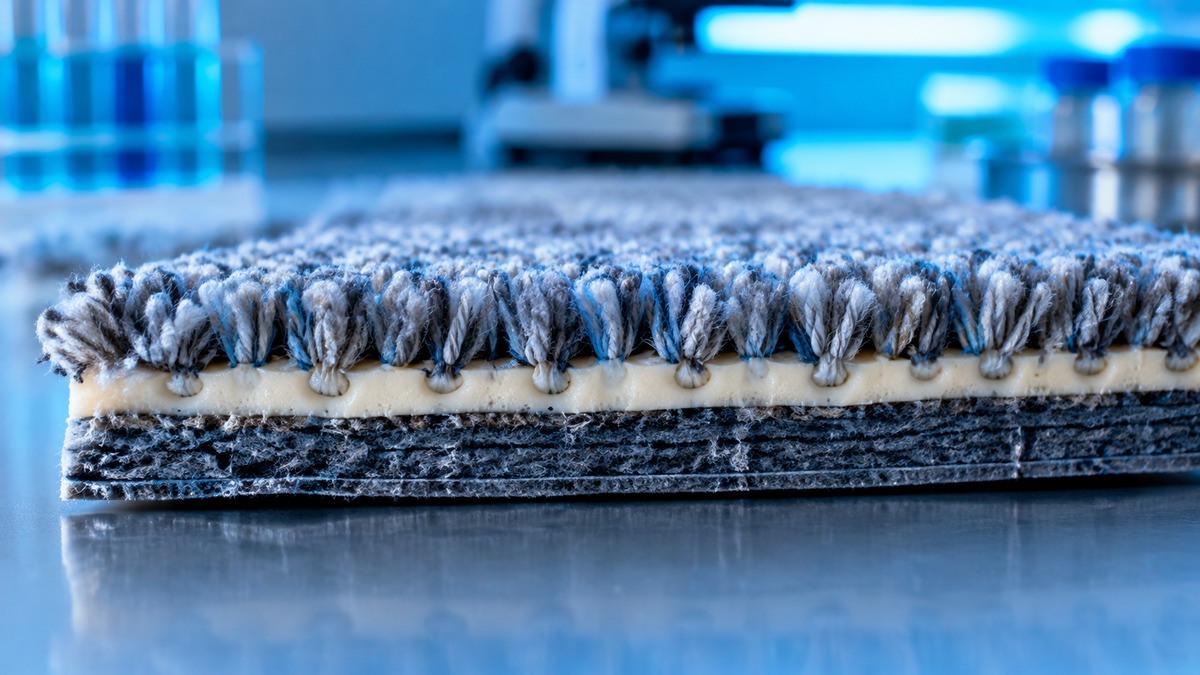 Uniform latex distribution supports strong tuft-lock, flat lay and even drying in the stenter oven.
- High-filler compatibility: stable in calcium carbonate filled, alkaline latex systems.
- Recirculation stability: constant coating viscosity over long production runs.
- Reduced air entrapment: controlled rheology helps release micro-foam whipped in by high-speed rolls.
- Drying efficiency: even moisture release reduces defects and supports lower energy use per square meter.
Formulation Guidelines, Grade Selection and Quality Control
For standard tufted broadloom and carpet tile backing compounds, recommended inclusion rates for 200 mesh technical Guar Gum typically range from 0.15% to 0.40% by dry weight of the compound (about 0.5 to 1.5 parts per hundred rubber). This dosage delivers yield stress, filler suspension and spreading behavior without over-thickening the compound or impeding roll transfer.
To prevent fish-eyes during batching, dry Guar Gum should be pre-blended with dry calcium carbonate filler or dispersed in water with a high-shear induction mixer before introduction into the latex. For high-temperature, high-pH or high-electrolyte coating lines, Hydroxypropyl Guar (HPG) offers improved thermal stability and salt tolerance, while Carboxymethyl Guar (CMG) provides anionic compatibility for specialized latex systems. Explore available grades on the B.D. Guar products page.
- Particle size: 200 mesh, with more than 98% passing, for fast and uniform hydration.
- Viscosity: 1% Brookfield viscosity typically 3,000 to 6,000 cP, matched to coater type.
- Moisture: below 10% for storage stability and accurate dosing.
- Consistency: batch-by-batch testing with a Certificate of Analysis, as outlined on the B.D. Guar quality page.
As a 100% plant-derived, biodegradable hydrocolloid, Guar Gum also supports carpet manufacturers working to reduce reliance on synthetic additives, in line with the commitments described on the B.D. Guar sustainability page.
Key Takeaways
- Superior rheology control: pseudoplastic shear-thinning with rapid viscosity recovery gives easy roll coating and a compound that stays in place.
- No face fiber strike-through: high low-shear yield stress holds latex at the primary backing, preserving pile softness and reducing adhesive waste.
- Stronger tuft-lock and lamination: complete tuft root encapsulation and controlled open time improve pull-out force and delamination resistance.
- Filler and alkaline compatibility: the non-ionic galactomannan backbone stays stable in heavily filled CSBR latex at pH 8.5 to 10.5.
- Efficient processing: steady viscosity under recirculation, reduced foam and even drying in the stenter oven.
- Bio-based additive: a plant-derived, biodegradable thickener that supports more sustainable carpet manufacturing.
Frequently Asked Questions
How does Guar Gum prevent latex strike-through into carpet face fibers?
Strike-through happens when liquid adhesive migrates up through the primary backing into the face yarns. Guar Gum thins under applicator shear so the compound spreads smoothly, then rapidly rebuilds high static viscosity once shear stops. That recovered structure holds the latex at the backing interface, keeping pile soft and avoiding wasted adhesive.
What is the typical inclusion rate of Guar Gum in carpet backing latex?
For 200 mesh technical-grade Guar Gum, typical usage ranges from 0.15% to 0.40% by dry weight of the latex compound, or roughly 0.5 to 1.5 parts per hundred rubber. The exact dosage depends on filler loading, coater type and target coat weight, so plant trials are recommended.
Why choose non-ionic Guar Gum over synthetic anionic acrylic thickeners?
Carpet compounds carry high calcium carbonate loadings at alkaline pH. Polyanionic synthetic thickeners can interact with calcium ions, causing viscosity drift, gel specks or coagulation. Native Guar Gum is non-ionic, so its viscosity is largely independent of ionic strength and pH, giving more stable batches and smoother runnability.
How does Guar Gum improve tuft-lock performance?
Tuft-lock depends on complete adhesive encapsulation of the tuft roots. Guar Gum provides controlled flow under blade or roll pressure so the compound penetrates each tuft stitch bundle, then locks around the fiber roots as shear relaxes. After drying, this forms a tough, flexible matrix that maximizes tuft pull-out resistance.
To optimize carpet backing latex sizing, eliminate strike-through and strengthen tuft-lock with a reliable supply of Superior technical-grade Guar Gum and HPG derivatives, contact the B.D. Guar technical team or write to sales@bdguar.com to request specifications, viscosity data sheets and trial samples.