Pet Food Retort Gelling: Hydrocolloid Interactions Under Heat
Learn how cold-soluble Guar Gum and heat-activated cassia gum combine to control viscosity, bind moisture, and prevent fat capping in retorted wet pet food.
Last updated:
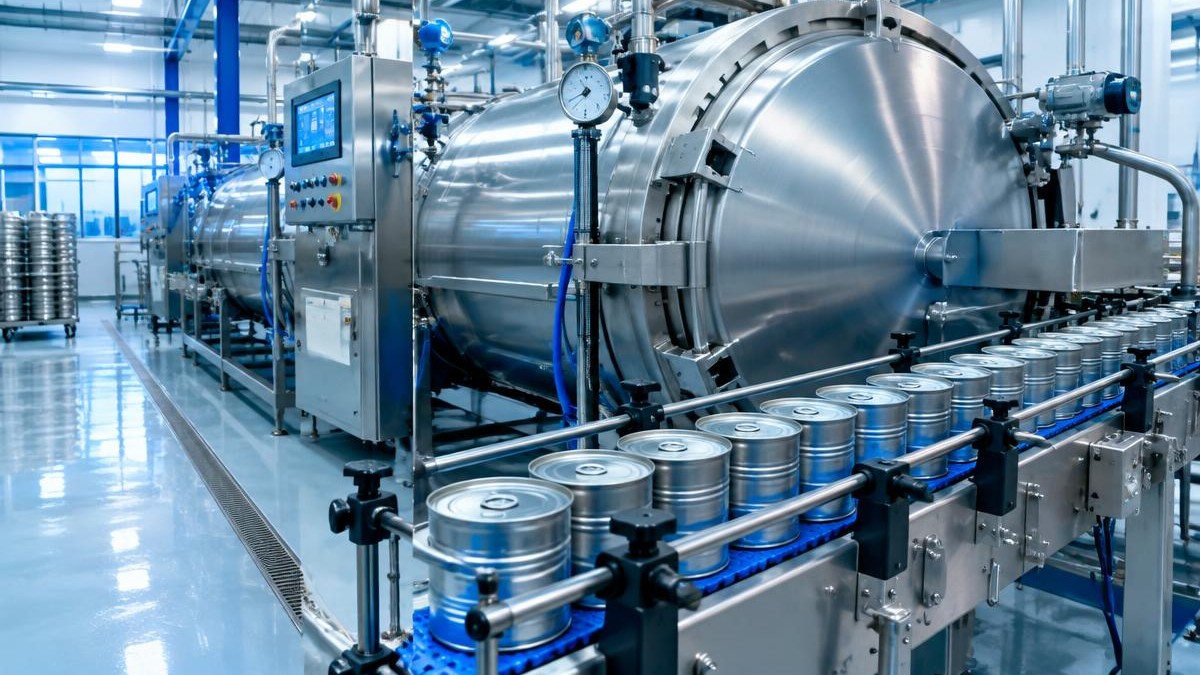
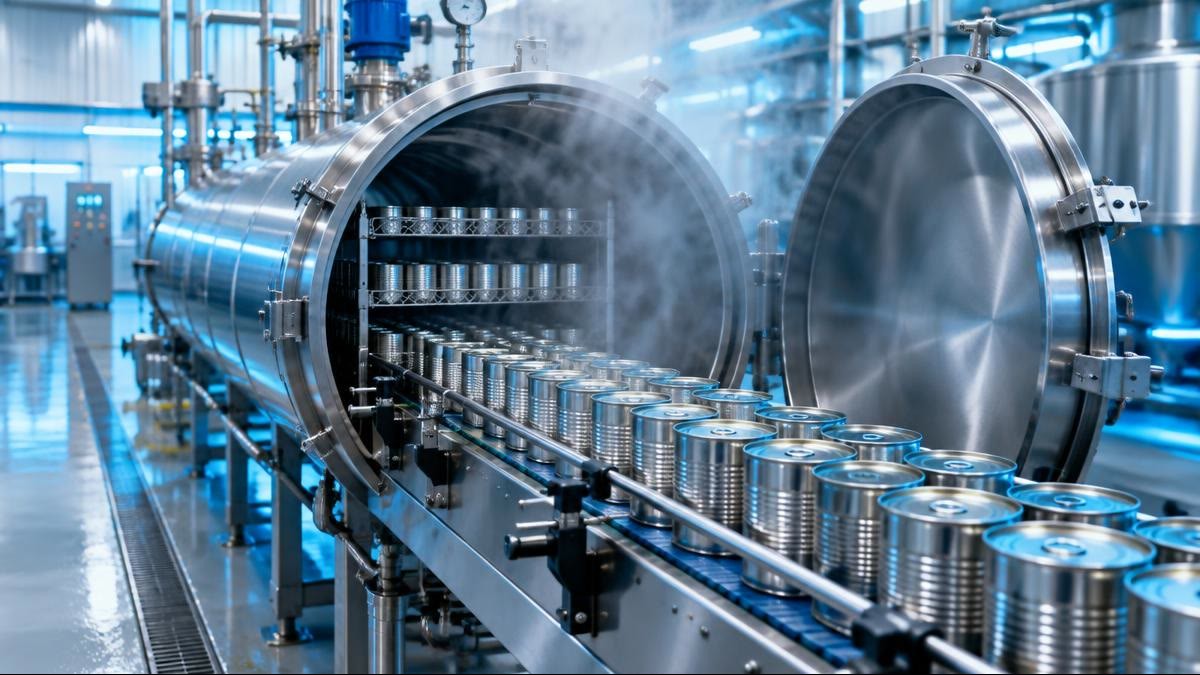
In the 2026 global wet pet food market, pet food retort gelling represents a critical technical focus for product safety and quality leads. As pet owners demand natural and clean-label canned and pouch formulations, manufacturers face severe thermal processing challenges. High-temperature retort sterilization at 121°C can cause phase separation, syneresis, and fat pooling. By combining cold-soluble Guar Gum with heat-activated cassia gum, formulators achieve Superior viscosity control during cold filling and robust gelation post-retort.
Research Overview
The global wet pet food industry in 2026 is growing on the back of humanization trends and strong preference for loaf, chunk-in-gravy, and chunk-in-jelly formats. Industry analyses, including those from IMARC, indicate continued expansion in pet food hydrocolloids and thickeners. Manufacturing quality wet pet food requires balancing fluid dynamics across two thermal regimes: cold filling at 15°C to 25°C and retort sterilization at 121°C for 20 to 45 minutes.
Hydrocolloids serve a dual role in canned and pouch production. During filling, the liquid phase must be viscous enough to suspend heavy meat pieces. After sterilization, the polymer system must survive extreme thermal stress, resist depolymerization, and cross-link on cooling into an attractive gel or thick gravy. Native galactomannans, specifically Guar Gum and cassia gum, have complementary molecular structures that meet both requirements. Industry studies indicate that pairing these plant polysaccharides creates a synergistic network that optimizes water binding, fat emulsification, and post-sterilization texture without synthetic stabilizers. Explore the full range on the B.D. Guar products page.
Cold-Fill Viscosity and Rheological Control with Guar Gum
Guar Gum is a non-ionic galactomannan extracted from the endosperm of the Cyamopsis tetragonoloba seed. It has a linear beta-1,4-linked D-mannopyranose backbone with single alpha-1,6-linked D-galactose branches on roughly every second mannose unit. This high galactose substitution (a 2:1 mannose-to-galactose ratio) creates steric hindrance that prevents tight inter-chain aggregation, making Guar Gum rapidly soluble in cold water.
For terminology, see the Guar Gum glossary. The main cold-fill functions are:
- Rapid cold-water hydration: Unlike heat-activated starches, food-grade Guar Gum hydrates in ambient aqueous phases without thermal energy. A 1% solution of high-viscosity Guar Gum yields cold-water viscosity of roughly 3,500 to 5,000 cps within minutes, creating immediate yield stress in the gravy phase before thermal processing.
- Suspension of heavy meat chunks: Extruded meat analogs, diced organ meats, and vegetable pieces settle quickly if the liquid vehicle lacks viscosity. Guar Gum maintains uniform particulate suspension through high-speed dosing, ensuring consistent piece-to-gravy ratios across containers.
- Pseudoplastic shear-thinning behavior: Under high shear during pumping, pipe transfer, and nozzle dosing, the polymer chains align with flow and apparent viscosity drops, allowing smooth filling without splashing. When shear stops inside the package, viscosity recovers and immobilizes the contents.
- Prevention of pre-retort phase separation: Filled containers often wait before autoclaving. Guar Gum prevents gravitational separation, creaming of free lipids, and sedimentation of insoluble minerals during these delays, protecting consistency across large batches.
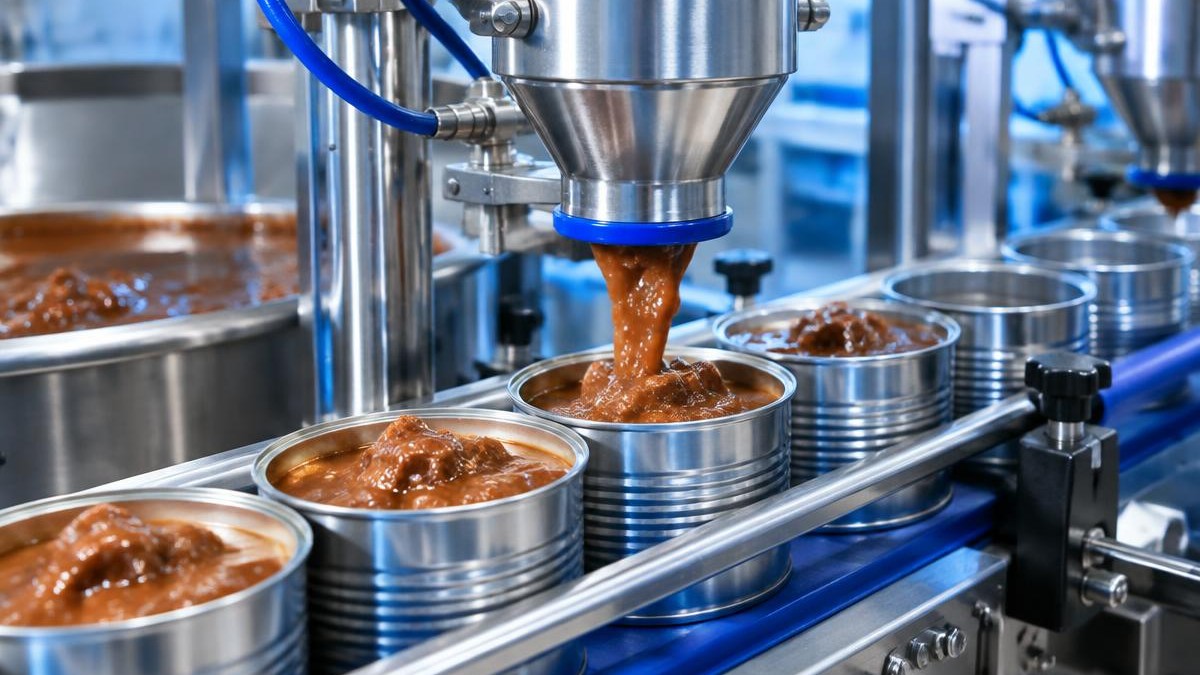 Cold-fill gravy dosing where Guar Gum viscosity keeps meat chunks uniformly suspended.
Thermal Synergies and Heat-Activated Gelation of Cassia Gum
While Guar Gum provides essential cold-fill viscosity, its branched structure does not form a firm, sliceable gel on its own. To create cohesive jellies, firm loaf matrices, or clear gels in retorted pet foods, formulators combine Guar Gum with cassia gum, a galactomannan derived from Senna obtusifolia or Senna tora seeds. A broader comparison of hydrocolloids is available on the compare page.
- Low galactose substitution and thermal solubility: Cassia gum has a linear beta-1,4-D-mannan backbone like Guar Gum but a lower galactose substitution, about a 5:1 mannose-to-galactose ratio. It is largely insoluble in cold water, but above roughly 80°C to 90°C during retort processing the chains uncoil and dissolve.
- Synergistic inter-chain association: As the product cools below about 50°C, unbranched mannose regions of cassia gum align with the Guar Gum backbone. The resulting hydrogen-bonded junction zones form a dense three-dimensional network. Industry studies indicate this produces a strong, elastic, thermally stable gel firmer than either hydrocolloid achieves alone at equivalent dosage.
- Post-retort gel rigidity and loaf firmness: In canned loaves, the combined gel binds ground meat particles, bone meal, and added fats into a sliceable mass that releases cleanly from container walls without sticky residue.
- Clear, glossy gravies and jellies: In chunk-in-jelly and pouch products, the synergy forms a transparent, sparkling gel around meat pieces. Industry studies indicate galactomannan blends maintain optical clarity after retort, avoiding the cloudy look associated with retrograded starches.
Moisture Binding, Fat Emulsification, and Phase Separation Prevention
Sterilization at 121°C stresses animal proteins and lipids severely. Proteins denature and expel bound water, while animal fats melt into free-flowing liquids. Without an effective entrapment system, the result is syneresis (water weeping), thick yellow grease caps, and soft product centers.
- Hydrophilic water entrapment: The dense hydroxyl groups along Guar Gum and cassia gum backbones hydrogen bond with free water. The cross-linked network immobilizes moisture within its porous matrix, holding total moisture of 80% to 85% without release and preventing syneresis during long warehouse storage.
- Steric lipid stabilization: The high continuous-phase viscosity from Guar Gum, combined with cassia gum gelation, forms a physical barrier around dispersed fat droplets, preventing coalescence and eliminating fat caps on cooling.
- Enhanced palatability and moisture retention: Locking water and dissolved flavor compounds evenly through meat and gravy preserves juicy texture and natural meat flavor, supporting feeding enthusiasm in dogs and cats.
- Protection against freeze-thaw stress: The flexible gel network absorbs the osmotic stress of ice crystal formation during cold-climate transport, preventing gel fracture and water release on thawing.
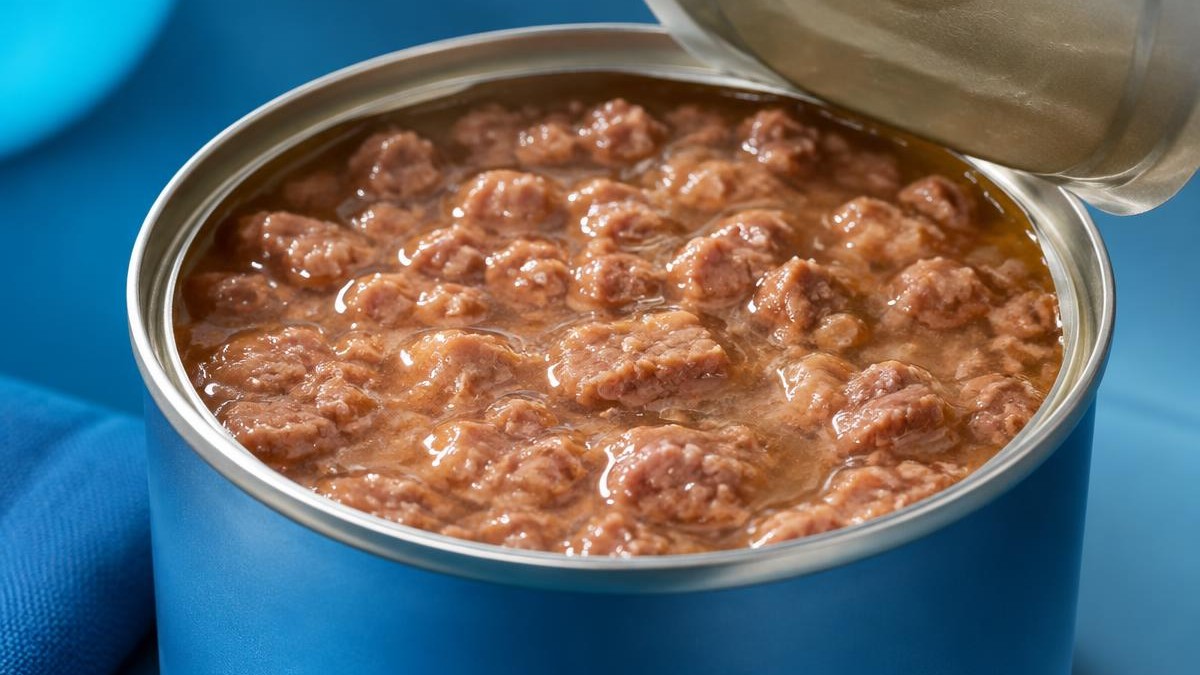 Retorted wet pet food with glossy gravy and no fat capping or water weeping.
Process Engineering and Regulatory Compliance for 2026 Sourcing
Optimal commercial performance requires precise dosage balancing, thorough pre-dispersion, and adherence to global feed safety regulations. Details on testing and certification are on the quality page.
- Dosage optimization and ratio control: Total hydrocolloid inclusion typically ranges from 0.4% to 1.2% by weight. For chunk-in-gravy, a 60% Guar Gum to 40% cassia gum blend at 0.5% to 0.8% total gives a pourable, glossy sauce that clings to meat. For firm loaves or chunk-in-jelly, a 40% Guar Gum to 60% cassia gum blend at 0.7% to 1.1% provides maximum gel hardness.
- High-shear dispersion protocols: To prevent unhydrated lumps (fish eyes), dry-blend the powders with other dry ingredients such as mineral mixes or plasma proteins before adding to liquid tanks. High-shear in-line mixers ensure rapid, uniform hydration.
- Global regulatory compliance: Guar Gum is recognized under EFSA feed additive frameworks, US regulatory guidance, and CODEX Alimentarius (INS 412). Cassia gum is authorized under EFSA feed additive rules and CODEX (INS 427), provided it meets strict purity specifications for anthraquinone impurities.
- Star Export House quality assurance: A verified Indian manufacturer such as B.D. Guar Pvt. Ltd. applies rigorous raw material testing, batch-homogenizing silos, low-shear milling, and strict microbial control so every container delivers consistent viscosity and compliance with international pet food safety standards.
Key Takeaways
- Dual thermal functionality: Cold-soluble Guar Gum gives immediate cold-fill viscosity for suspension, while heat-activated cassia gum delivers a firm, cohesive post-retort gel.
- Synergistic gelation network: Association between cassia gum (about 5:1) and Guar Gum (2:1) forms a thermally stable gel stronger than either alone.
- Defect elimination: The galactomannan network immobilizes free moisture and traps rendered fats, eliminating syneresis, water weeping, and yellow fat capping.
- Enhanced sensory appeal: The blend preserves clarity, glossy gravy, and juicy meat texture for a Superior presentation when opened.
- Global regulatory safety: Sourcing food-grade Guar Gum from a Government of India-certified Star Export House supports compliance with EFSA, USDA, and CODEX mandates in 2026 supply chains.
Frequently Asked Questions
Why is Guar Gum paired with cassia gum rather than used alone in retorted pet foods?
Guar Gum has a highly branched structure (2:1 mannose-to-galactose) that gives exceptional cold-water viscosity but cannot form a firm stand-alone gel. Cassia gum has lower galactose substitution, is insoluble in cold water, and dissolves during retort heating. On cooling, the two polymers cross-link into a firm, elastic, thermally stable gel that holds chunks and loaves together.
How does Guar Gum prevent meat chunks from settling during pouch and can filling?
Guar Gum hydrates rapidly in ambient water, creating immediate cold viscosity and yield stress in the gravy. This holds meat analogs and vegetables in uniform suspension through the filling hopper and dosing tubes, so every container receives the same ratio of solids to liquid without settling.
What causes yellow fat capping in canned pet food, and how do galactomannans prevent it?
During retort at 121°C, animal fats melt and float to the top, forming a grease layer on cooling. Guar Gum and cassia gum build a continuous, high-viscosity network that sterically traps lipid droplets, keeping them finely dispersed and preventing oil coalescence.
Are Guar Gum and cassia gum approved for clean-label pet food formulations globally?
Yes. Both are natural, plant-derived hydrocolloids extracted mechanically from legume seeds without chemical synthesis, and both are recognized under EFSA, USDA, and CODEX frameworks, making them suitable for clean-label pet food lines.
To optimize wet pet food formulations, eliminate retort phase separation, and secure a certified supply of Superior Guar Gum for global manufacturing, partner with B.D. Guar Pvt. Ltd. Contact the technical sales team or email sales@bdguar.com to request samples, blending advice, and detailed specifications.