Retort Sterilization Stability: Thermal Hydrolysis in Canned Foods
Thermal hydrolysis can erase up to 80% of native hydrocolloid viscosity in the retort. Learn how Guar Gum, cassia gum and starches protect canned food texture.
Last updated:
In the 2026 global food preservation and commercial canning sector, retort sterilization stability is an essential technical focus for quality assurance managers and plant nutritionists. As canned vegetable, legume, soup, and ready-meal operations expand to meet global convenience demands, maintaining precise liquid viscosity through high-pressure thermal processing is vital. Formulating with carefully processed Guar Gum alongside cassia gum and modified starches establishes a resilient gel network that prevents thermal chain scission, eliminates syneresis, and secures a Superior canned product texture.
Research Overview
The commercial canning industry in 2026 operates under stringent microbiological safety standards and consumer expectations for clean-label textures. Market analyses from IMARC indicate continued growth in shelf-stable packaged foods, driven by automated retorts and demand for ready-to-eat formulations. While high thermal lethality ensures food safety, it also imposes chemical degradation on hydrocolloids, and unconditioned native gums often lose 60% to 80% of their viscosity during the cook phase. Research in Carbohydrate Polymers and J. Food Sci. shows that carefully processed Guar Gum grades combined with co-gelling agents resist this collapse. Learn more about our food-grade Guar Gum range.
To achieve commercial sterility and eliminate Clostridium botulinum endospores, low-acid canned foods (pH above 4.5) are processed in batch or rotary autoclaves at 115°C to 125°C under overpressures of 1.5 to 2.5 bar, with sterilization lethality values (F0) between 6 and 12 minutes. Guar Gum, extracted from the seed endosperm of Cyamopsis tetragonoloba, is a neutral polysaccharide of 1.5 to 2.5 million Daltons with a beta-(1-4)-D-mannopyranose backbone and single alpha-(1-6)-D-galactopyranose side branches at a 2:1 ratio. Aligned with FAO, USDA, EFSA, and CODEX Alimentarius frameworks, combining Guar Gum with cassia gum and crosslinked modified starches builds a thermoresistant hydrogel matrix that preserves viscosity and texture across a 24-month ambient shelf life.
Molecular Kinetics of Thermal Hydrolysis
Mitigating viscosity loss in high-temperature autoclaves requires an understanding of the molecular cleavage kinetics governing galactomannan polymers under saturated steam regimes.
- Thermally activated cleavage: At 121°C, thermal energy is sufficient to hydrolyze the glycosidic bonds linking mannose units. Random chain scission lowers weight-average molecular weight, hydrodynamic volume, and resting apparent viscosity.
- Steric protection from galactose side units: Alpha-(1-6)-linked galactose units shield neighboring glycosidic bonds from nucleophilic attack, giving carefully processed Guar Gum structural resistance to rapid depolymerization.
- pH and thermal buffering: Hydrolysis accelerates under acidic conditions. In low-acid matrices (pH 5.5 to 6.8) such as creamed corn and chowders, the neutral backbone of Guar Gum persists better than anionic polymers, and food-grade phosphate buffers suppress proton-catalyzed cleavage.
- Raw material refining: Refined endosperm splits processed by gentle thermo-mechanical dehusking preserve native molecular weight and maximize residual thickening power after sterilization. See our quality systems for details.
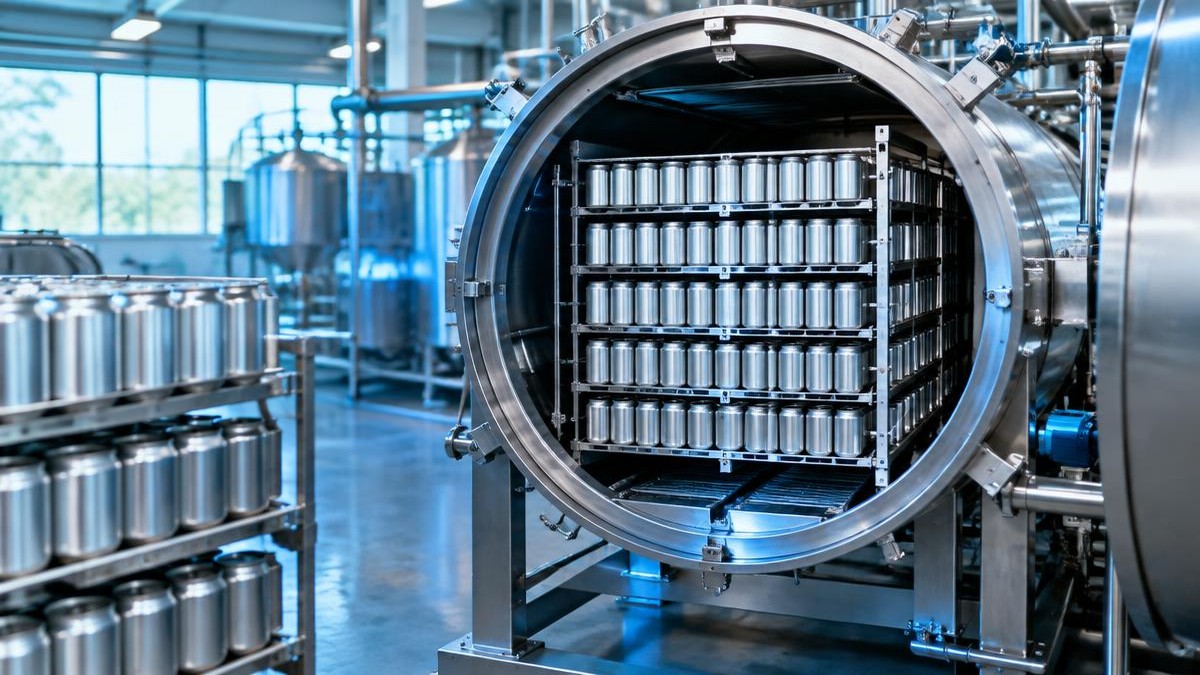
 Industrial retort sterilization subjects canned foods to 115°C to 125°C thermal regimes.
Synergistic Gelling Architectures: Guar Gum, Cassia Gum and Starches
Commercial canned food formulators prevent post-retort structural collapse by building multi-component hydrocolloid networks that compensate for individual thermal degradation pathways.
- Cassia gum synergy: Cassia gum, derived from Cassia tora, has a mannose-to-galactose ratio of about 5:1. Its unbranched mannan segments form firm, thermo-reversible junction zones with Guar Gum chains on cooling. A 2:1 or 1:1 Guar Gum and cassia gum blend co-crystallizes during cooling into a cohesive, elastic gel that restores lost viscosity.
- Crosslinked modified starches as scaffolds: Hydroxypropyl distarch phosphate and acetylated distarch adipate provide thermal and shear endurance. Starch gelatinizes between 65°C and 80°C, while Guar Gum occupies the aqueous phase between swollen granules, forming a mesh that prevents granule rupture during prolonged 121°C holding.
- Retrogradation suppression: During cooling and storage, amylose realigns and squeezes out water. Guar Gum acts as a macromolecular spacer between re-associating starch chains, binding free water by hydrogen bonding and eliminating syneresis, water pooling, and skinning.
- Heat-quenched elastic recovery: As containers cool from 121°C to 35°C, the combined network re-entangles into a firm, non-rubbery matrix that supports particulates and keeps a glossy appearance. Compare options on our hydrocolloid comparison page.
Heat Penetration and Processing Dynamics
Balancing sterilization lethality with finished product texture requires precise control over headspace convection and temperature-dependent viscosity transitions.
- Transient heat-thinning: Above 80°C, the apparent viscosity of Guar Gum decreases sharply. This reversible drop promotes convective circulation in the can, accelerating heat penetration to the thermal core and shortening the heating cycle.
- Prevention of wall scorching: Pseudoplastic flow keeps food solids circulating efficiently during ramp-up, eliminating localized overheating and preserving natural color and flavor.
- Rotary and agitating retorts: Shear-thinning behavior under mechanical rotation maximizes turbulence at lower process temperatures, reaching target F0 values in up to 25% less time than static retorts.
- Clean seam dosing: Shear-thinning rheology supports clean, drip-free piston filling at high line speeds, protecting hermetic seam integrity before containers enter the retort.
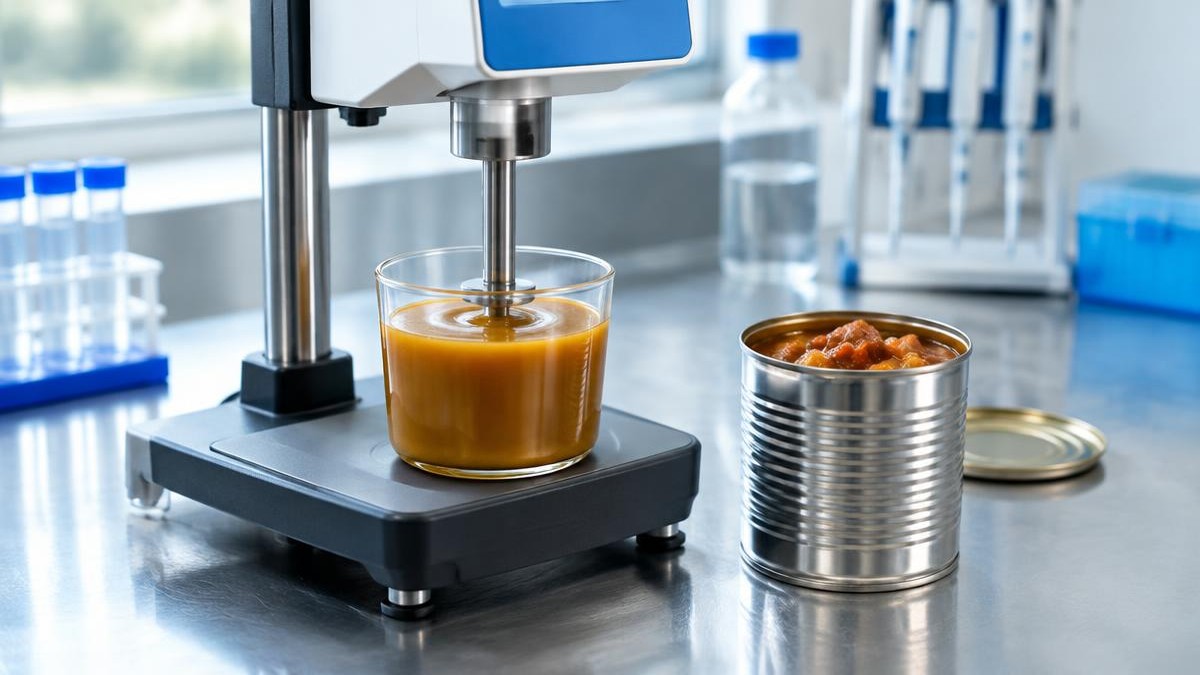 Consistent viscosity recovery after retort protects gravy and soup texture.
Texture Protection, Syneresis Prevention and Quality Assurance
Maintaining sensory quality across extended global distribution networks requires rigorous quality control and standardized testing.
- Elimination of serum weeping: By immobilizing free water within a hydrogen-bonded polymer mesh, Guar Gum prevents moisture migration and keeps soups, gravies, and beans homogeneous over 24 months of ambient shelf life.
- Particulate suspension: The zero-shear yield stress from the Guar Gum and cassia gum network keeps diced meats, vegetables, and pasta uniformly suspended instead of compacting at the base of the can.
- Bostwick and Brookfield QC: Laboratories evaluate pre-retort and post-retort viscosity using Bostwick consistometers and Brookfield rotational viscometers (Spindle 3 at 20 rpm, 25°C). Typical specifications call for a Bostwick flow of 6 to 12 cm per 30 seconds at 25°C after cooling and after 30 days of storage.
- Clean-label E412 compliance: Plant-derived and non-GMO, Guar Gum carries regulatory clearance under EFSA (E412) and USDA/FDA GRAS standards. Review the Guar Gum glossary for related terms.
Key Takeaways
- Superior thermal hydrolysis mitigation: Carefully processed, high-molecular-weight Guar Gum maintains functional viscosity through 121°C retort sterilization by resisting irreversible chain scission.
- Synergistic gel formulation: Blending Guar Gum with cassia gum (2:1 ratio) and crosslinked modified starches builds a resilient network that restores gel elasticity on cooling.
- Accelerated heat penetration: Reversible heat-thinning promotes convective heat transfer, shortening dwell times and preventing wall scorching.
- Syneresis control: Extensive hydrogen bonding prevents serum weeping, phase separation, and particulate compaction across a 24-month shelf life.
- Clean-label clearance: A plant-based, non-GMO hydrocolloid recognized under EFSA, USDA, and CODEX frameworks.
Frequently Asked Questions
Why does native Guar Gum lose viscosity during retort sterilization, and how can this be managed?
Above 100°C, thermal hydrolysis cleaves the glycosidic bonds along the mannan backbone, shortening chains and lowering viscosity. Formulators manage this by selecting high-purity, minimally sheared grades, buffering pH to 5.5 to 6.8, and blending with cassia gum and crosslinked starches that rebuild gel structure on cooling.
How does combining Guar Gum with cassia gum improve canned food texture?
Cassia gum has fewer galactose branches (5:1 versus 2:1), leaving open mannan segments that associate with Guar Gum during post-sterilization cooling. The result is a thermo-reversible, elastic gel that restores body, prevents syneresis, and provides a glossy gravy texture.
What is the recommended usage level for Guar Gum in retort canning?
In canned soups, sauces, and gravies, Guar Gum is typically used at 0.15% to 0.45% by weight of the liquid phase (1.5 to 4.5 kg per metric ton). A system with 0.20% Guar Gum, 0.15% cassia gum, and 1.5% to 2.5% modified starch supports filling control, rapid heat penetration, and full post-retort viscosity recovery.
How does Guar Gum optimize heat transfer in agitating and rotary retorts?
Guar Gum thins reversibly above 80°C, allowing liquid to flow freely under mechanical agitation. This creates vigorous convective currents that carry heat to the container core, shortening the cycle needed to reach target F0 values and reducing thermal damage to delicate vegetable and meat pieces.
To protect canned food textures against thermal hydrolysis and secure a reliable supply of Superior, high-purity food-grade Guar Gum, partner with B.D. Guar Pvt. Ltd. Contact the technical team or email sales@bdguar.com to request technical data sheets, pilot retort formulation guidelines, and trial samples.