The Science of High-Speed Mixing: Achieving Lump-Free Guar Dispersion
Learn how vortex addition, high-shear mixing, and dry-carrier pre-blending deliver lump-free Guar Gum dispersion and eliminate fish-eyes in food and industrial lines.
Last updated:
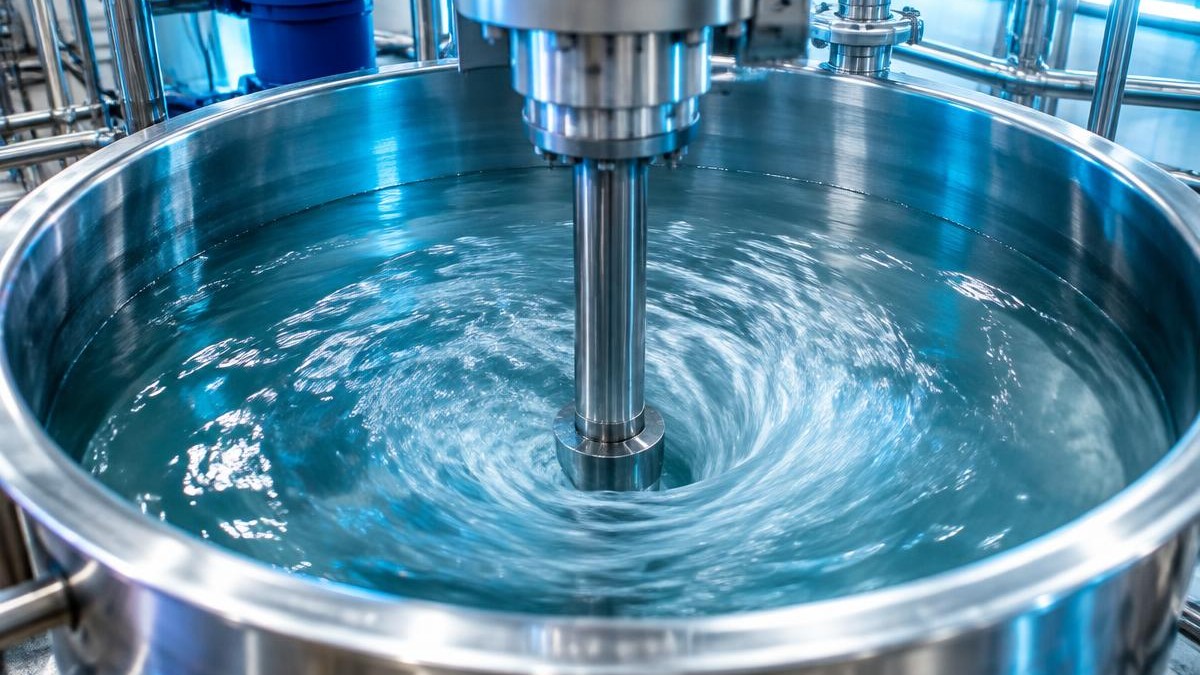
In the fast-paced 2026 global food and chemical manufacturing landscape, lump-free Guar Gum dispersion has become a fundamental operational priority for food plant operators and chemical process engineers. As industrial lines scale to meet strict throughput targets and clean-label quality demands, improper hydrocolloid hydration creates costly processing delays. Adding Superior, high-purity Guar Gum slowly into a high-shear vortex, or pre-blending it with dry carriers, isolates galactomannan particles, prevents fish-eye agglomeration, and delivers rapid, consistent viscosity development.
Research Overview
Market intelligence from IMARC indicates that demand for natural galactomannans, led by Guar Gum, continues to expand in 2026 because of its thickening efficiency per unit mass. Dissolution studies in Carbohydrate Polymers and J. Food Sci. describe how rapid surface hydration forms gel-encased lumps. Process control of shear, powder feed rate, and particle separation is therefore the key to seamless dispersion. Explore the B.D. Guar product range for suitable grades.
Hydrocolloid Dissolution Physics and the Fish-Eye Problem
Derived from the endosperm of Cyamopsis tetragonoloba, Guar Gum is a high-molecular-weight non-ionic polysaccharide (approximately 1.5 to 2.2 million Daltons) with a β-(1→4)-D-mannopyranose backbone and α-(1→6)-D-galactopyranose side chains at roughly a 2:1 ratio. Its dense hydroxyl groups give the polymer exceptional affinity for water, enabling cold-water swelling and high static viscosity. The chemistry behind this behavior is covered in the Guar Gum glossary.
That extreme hydrophilicity creates a well-known challenge during batch preparation. When dry powder meets water without sufficient shear or spatial dispersion, the outermost molecules hydrate instantly and form an impermeable, viscous gel membrane around an unhydrated core. Process engineers call these lumps "fish-eyes", and the air trapped inside prevents water penetration even under prolonged mild agitation.
Fish-eyes carry real operational consequences. Unhydrated lumps blind inline filtration screens, clog metering pumps, cause local viscosity variation, and waste material. Extended mixing to break clumps consumes excess energy and exposes sensitive actives or emulsion droplets to unnecessary shear. Fluid mechanics and polymer dissolution principles recognized by the FAO, USDA, EFSA, and CODEX Alimentarius support three controls: optimized shear, controlled powder addition, and dry-carrier pre-blending.
- Surface gelation seals the particle core and blocks hydration.
- Lumps blind screens and clog pumps, raising downtime.
- Prolonged re-mixing wastes energy and stresses formulations.
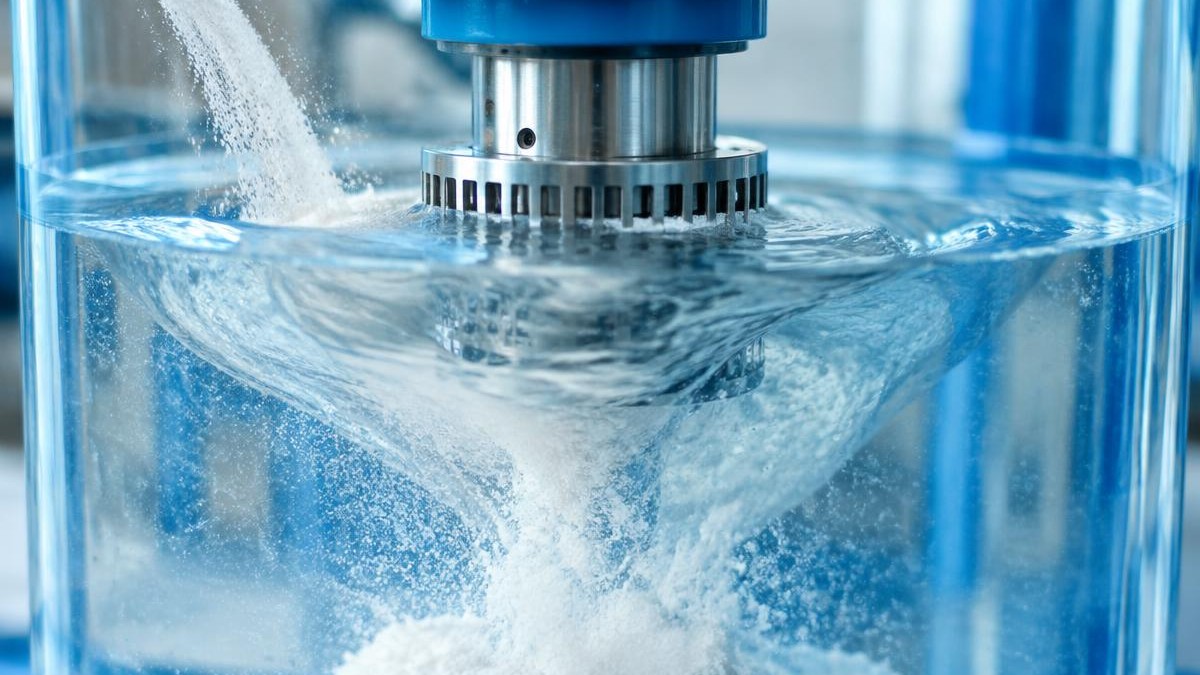 A controlled vortex draws Guar Gum particles below the liquid surface before surface gelation can occur.
Fluid Dynamics of Vortex Addition and High-Shear Mixing
Rapid, lump-free dispersion starts with understanding fluid dynamics inside the vessel and choosing suitable agitation equipment. Dry Guar Gum should be metered slowly into the deepest point of a high-energy vortex, where high rotational velocity creates strong shear stresses that pull individual particles beneath the surface before gelation begins.
Standard axial-flow turbines or anchor agitators often lack the localized shear needed to overcome particle-particle attraction. High-shear rotor-stator mixers or saw-tooth disperser blades generate local shear rates exceeding 10,000 to 50,000 s-1, shearing apart nascent agglomerates and surrounding them with water. For large-scale or semi-batch lines, inline liquid-ring powder induction systems such as eductors or venturi mixers eliminate manual bag dumping by drawing powder into a high-velocity liquid stream under vacuum.
- Vortex mechanics: meter powder into the deepest point of the vortex.
- Rotor-stator systems: local shear of 10,000 to 50,000 s-1 disrupts agglomerates.
- Inline induction: instant wetting before the stream enters the main tank.
- Feed rate control: a vibratory hopper or metering screw prevents surface rafts.
- Temperature: water at 20°C to 35°C optimizes initial wetting; excessive heat accelerates surface gelation.
Dry Carrier Pre-Blending Strategies for Particle Isolation
When high-shear induction equipment is unavailable, pre-blending dry Guar Gum with non-gelling solid carriers offers a reliable physical route to prevent agglomeration. Soluble crystalline solids such as granulated sucrose, dextrose, sodium chloride, or native starches act as physical spacers, stopping adjacent galactomannan granules from touching during initial water contact.
Industry studies indicate that a minimum dry carrier-to-Guar Gum ratio of 5:1, preferably 10:1, by weight is needed for complete particle isolation. As the blend enters the tank, the carrier dissolves rapidly and leaves separated Guar Gum particles suspended individually, allowing unhindered water penetration and uniform hydration. For dry-mix convenience foods, instant soups, and bakery formulations, pre-mixing into the bulk dry phase guarantees effortless hydration upon liquid addition.
Oil-containing systems such as dressings, sauces, and industrial emulsions allow a different route. Because Guar Gum does not hydrate in non-polar liquids, it can be pre-dispersed in vegetable oil or propylene glycol to form a smooth suspension that hydrates uniformly once blended into the water phase. Particle size should also match the carrier to prevent segregation during storage and conveying; 200 mesh Guar Gum suits fine sugar or salt blends.
- Use a 5:1 to 10:1 carrier-to-Guar Gum ratio by weight.
- Choose sucrose, dextrose, salt, or native starch as the spacer.
- Pre-slurry in oil or propylene glycol for non-aqueous systems.
- Match granulometry to prevent dry segregation.
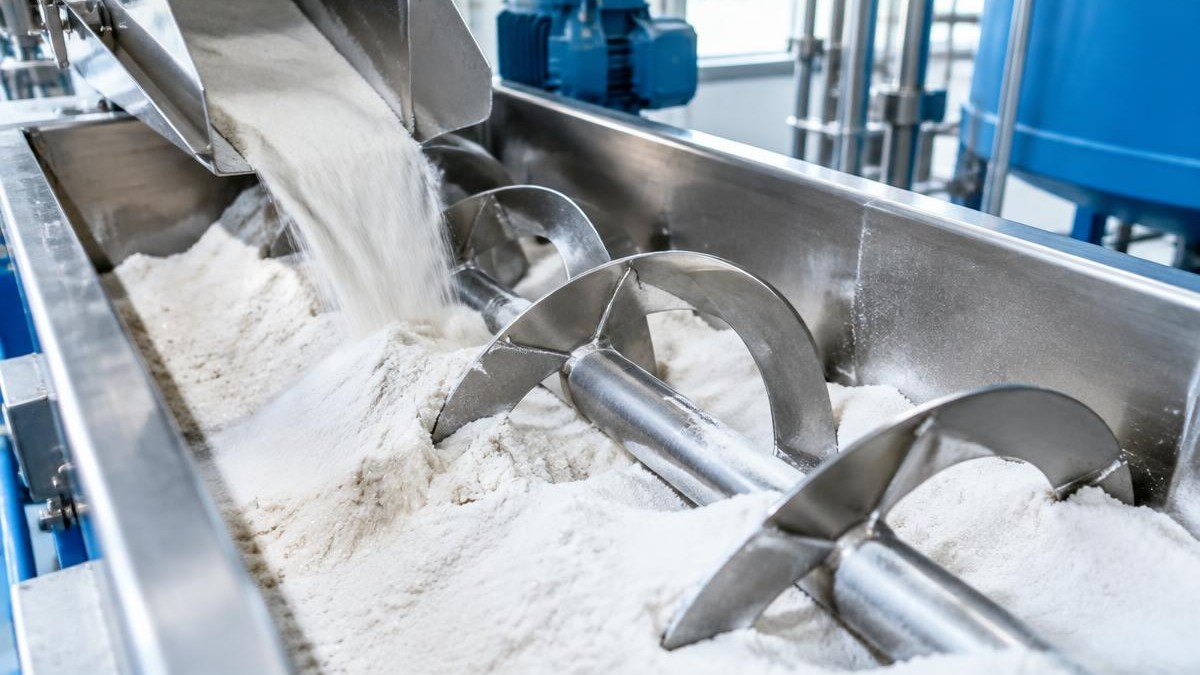 Dry carriers such as sugar or starch physically separate Guar Gum granules before hydration.
Rheological Evolution, Hydration Time-Scales, and Viscosity Profiling
Understanding time-dependent viscosity development lets engineers optimize batch residence times and prevent equipment overload. Hydration follows a biphasic curve: an induction phase of liquid wetting and polymer chain uncoiling, followed by a rapid viscosity build as galactomannan chains extend and entangle. See how grades compare on the product comparison page.
Standard 200 mesh Guar Gum typically reaches 60% of ultimate viscosity within 10 to 15 minutes and full peak viscosity in 1 to 2 hours at ambient temperature. Fast Hydration Guar Gum (FHGG), engineered with finer granulometry and controlled surface morphology, achieves over 85% to 90% of peak viscosity within 3 to 5 minutes, significantly shortening processing cycles.
Fully hydrated Guar Gum is pseudoplastic. High shear during pumping or mixing temporarily lowers apparent viscosity, protecting pump motors, and the fluid recovers its zero-shear viscosity once shear ceases to keep solids suspended. High concentrations of sugars, salts, or alcohol reduce free water activity and compete for hydration water, so Guar Gum should be fully hydrated in fresh water before concentrated solutes are added.
- Standard 200 mesh: about 60% viscosity in 10 to 15 minutes.
- FHGG: over 85% to 90% viscosity in 3 to 5 minutes.
- Hydrate before adding salts, sugars, or alcohol.
Troubleshooting Production Line Defects and Quality Assurance
Identifying root causes of hydration defects allows quality assurance teams to apply corrective action quickly. Fish-eyes appear as translucent, gel-encased spheres floating in the tank or trapped on strainer baskets, and the cause is invariably a localized high powder addition rate combined with insufficient shear. A broader view of quality control is available on the quality page.
- Screen blinding: a sudden rise in inline filter differential pressure signals unhydrated lumps; high-shear inline dispersers or pre-blended dry feeds resolve it.
- Foam generation: bottom-entry high-shear mixers, vacuum deaeration tanks, or food-grade antifoam agents stabilize fluid density and filling accuracy.
- Clean-in-place: warm water flushes at 60°C to 70°C followed by 1.0% to 1.5% NaOH wash remove residual hydrocolloid film from vessels and pipes.
Key Takeaways
- Vortex and shear control: adding dry Guar Gum slowly into the deep vortex of a high-shear mixer prevents surface gelation and fish-eyes.
- Carrier pre-blending: mixing Guar Gum with sugar, salt, or starch at a minimum 5:1 ratio isolates particles for lump-free hydration.
- Non-solvent pre-slurrying: dispersing Guar Gum in vegetable oil or propylene glycol creates a smooth slurry that hydrates uniformly in water.
- Hydration kinetics: 200 mesh or FHGG grades shorten cycle times, reaching over 85% viscosity in 3 to 5 minutes.
- Process assurance: powder induction equipment and controlled feed rates prevent screen blinding, pump strain, and downtime.
Frequently Asked Questions
What causes "fish-eyes" when mixing Guar Gum into water?
Fish-eyes occur when dry Guar Gum powder is added too quickly or with insufficient shear. The outer layer of each particle hydrates instantly, forming a dense gelled membrane that blocks water from reaching the dry powder core inside the lump.
What is the best ratio for pre-blending Guar Gum with dry ingredients?
Pre-blend Guar Gum with dry soluble carriers such as sucrose, salt, or starch at a minimum of 5 parts carrier to 1 part Guar Gum by weight. A 10:1 ratio provides even greater particle isolation and supports rapid, lump-free dissolution.
Can Guar Gum be pre-dispersed in oil before adding water?
Yes. Guar Gum does not hydrate in non-polar liquids such as vegetable oil or propylene glycol, so it can be pre-slurried without clumping. When the slurry is mixed into the aqueous phase, individual particles hydrate uniformly without forming lumps.
How does water temperature affect the hydration speed of Guar Gum?
Guar Gum hydrates effectively at ambient temperatures of 20°C to 25°C. Warmer water at 30°C to 40°C slightly speeds initial hydration, but excessively hot water with slow powder addition accelerates surface gelation and raises clumping risk without high shear.
To optimize liquid processing lines and secure a reliable supply of Superior, fast-hydrating Guar Gum, partner with B.D. Guar Pvt. Ltd. Contact the technical support team or write to sales@bdguar.com for detailed mixing guidelines, custom mesh specifications, and trial samples. Learn more about sustainable sourcing from Gujarat.