In-House R&D Testing: Consistent Viscosity in Every Batch
Brookfield viscosity, particle size, moisture and microbiology tested on every lot, with a full COA on every shipment from our Gujarat laboratory.
Last updated:
In the 2026 hydrocolloid market, in-house R&D testing of Guar Gum viscosity has become the cornerstone quality benchmark for quality assurance directors and formulation chemists. As food, pharmaceutical and industrial manufacturers enforce tighter rheological tolerances, raw material consistency is essential. B D Guar Pvt. Ltd. runs multi-tier testing in its Gujarat laboratory, covering Brookfield viscosity, particle size, moisture and microbiology, to deliver Superior performance across global supply chains.
Research Overview
In the 2026 specialty chemical and food additive landscape, supply reliability extends beyond availability to lot-to-lot consistency. Guar Gum is an agricultural polymer, and seasonal monsoon dynamics, soil composition and regional microclimates across Rajasthan and Gujarat all influence its properties. Industry studies indicate that buyers in North America, Europe and Asia now demand narrower functional specifications than ever before, which makes rigorous batch-level verification a purchasing requirement rather than an option. See our quality commitments for the full certification picture.
Why Batch Consistency Matters for Guar Gum
Unmonitored viscosity drift has direct operational consequences. In food manufacturing, inconsistent cold-water thickening alters texture, causes emulsion breakdown and triggers syneresis in sauce and dairy lines. In hydraulic fracturing, sub-standard hydration kinetics lead to poor proppant transport and premature fluid breakdown downhole.
Studies in Carbohydrate Polymers and J. Food Sci. describe galactomannans as functioning through high-molecular-weight chain entanglement. Guar Gum has a molecular weight of roughly 1.5 to 2.2 million Daltons, with a linear (1-4)-linked beta-D-mannopyranosyl backbone carrying (1-6)-linked alpha-D-galactopyranosyl side units at about a 2:1 ratio. Protecting the integrity of these chains requires continuous verification at the plant, guided by FAO, USDA, EFSA and CODEX protocols.
- Food lines: texture, emulsion stability and syneresis control depend on predictable viscosity.
- Oilfield fluids: hydration speed governs proppant transport and gel performance.
- Industrial uses: consistent rheology keeps pastes, slurries and coatings within process windows.
Brookfield Viscosity Profiling and Hydration Kinetics
Viscosity is the definitive functional indicator of hydrocolloid performance. Precision measurement uses standardized rotational viscometry to evaluate both the initial hydration rate and the ultimate equilibrium viscosity at defined time intervals.
- Rotational viscometry: Calibrated Brookfield RVT and RVDV digital viscometers run at a standard 20 rpm with Spindle 2 or 3. Solutions are prepared at 1.0% or 2.0% w/w in deionized water at a controlled 25 C, since viscosity is inversely related to temperature.
- Time-resolved hydration tracking: Standard grades are read at 15 minutes, 30 minutes, 1 hour, 2 hours and 24 hours. Fast Hydration Guar Gum (FHGG) for oilfield use is read at 3, 5 and 10 minutes to confirm rapid polymer uncoiling, with specifications targeting 80% to 90% of peak viscosity within 3 minutes.
- Shear-rate sensitivity: Because Guar Gum is pseudoplastic, testing from 0.5 rpm to 100 rpm verifies that the polymer thins under high shear during pumping or mixing and recovers its zero-shear viscosity at rest.
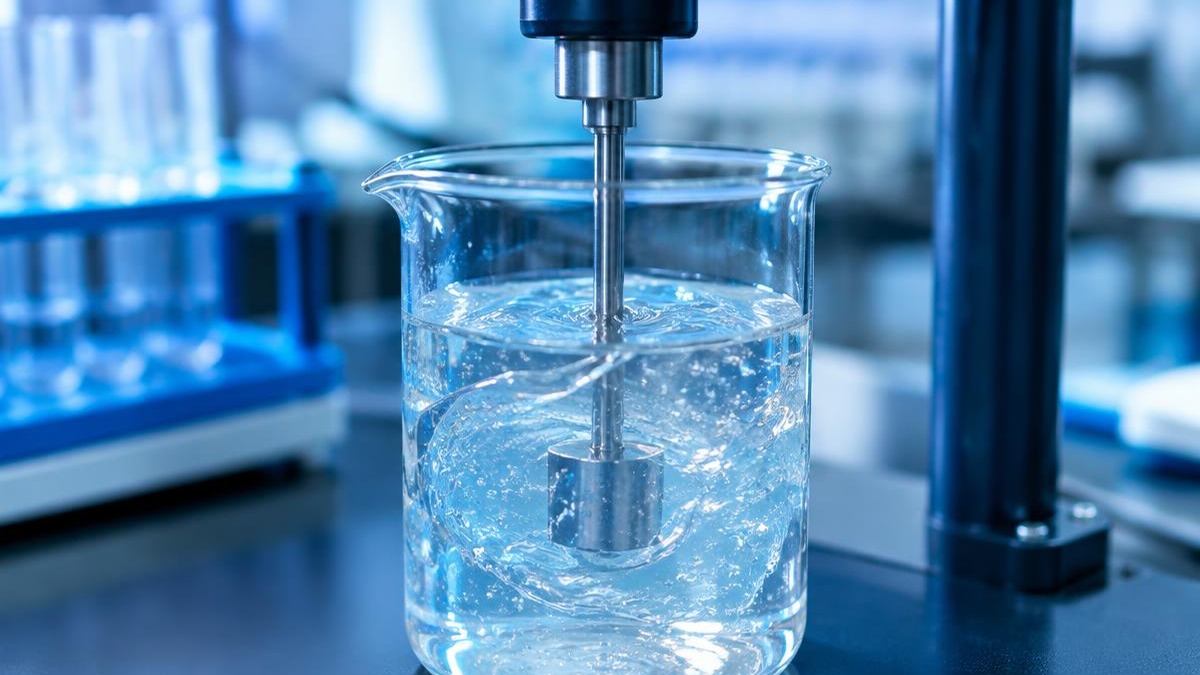 Brookfield viscometer testing of a Guar Gum solution under controlled temperature in the Gujarat laboratory.
Particle Size Distribution and Granulometry Control
Particle size distribution governs cold-water hydration velocity, dust generation, dissolution completeness and the prevention of visual defects in finished products. Custom grades are covered on our products page.
- Sieve analysis and laser diffraction: Automated sifting with ISO-compliant wire mesh sieves is supplemented by laser diffraction analysis. Standard grades are 100 mesh (150 microns), 200 mesh (75 microns) and 300 mesh (45 microns), with 200 mesh grades required to pass a minimum of 90% to 98% through the screen.
- Hydration velocity versus agglomeration: Finer meshes expose more surface area and hydrate faster, but without high-shear mixing they can form fish eyes. Granulometric testing balances rapid dissolution against dispersion stability.
- Application-specific selection: Instant soups, dressings and beverages call for ultrafine 200 or 300 mesh for smooth mouthfeel, while textile printing pastes and froth flotation favor coarser 100 to 150 mesh for fast dispersion in large tanks.
Moisture Control and Water Activity
Moisture is a critical chemical quality metric that affects powder stability, shelf life, handling and resistance to degradation during ocean transport.
- Loss-on-Drying and halogen analysis: Moisture is measured by gravimetric LOD at 105 C to constant weight and by rapid halogen moisture analyzers, with a commercial maximum of 10.0% to 12.0% by weight.
- Caking and hydrolysis prevention: Excess moisture promotes clumping in 25 kg bags and 1,000 kg bulk sacks, and at water activity above 0.65 it accelerates depolymerization of the galactomannan backbone and irreversible viscosity loss.
- Transit defense: Equilibrium moisture uptake testing at elevated humidity informs polyethylene liners and desiccant poles, so shipments arriving in Europe or North America match factory specification.
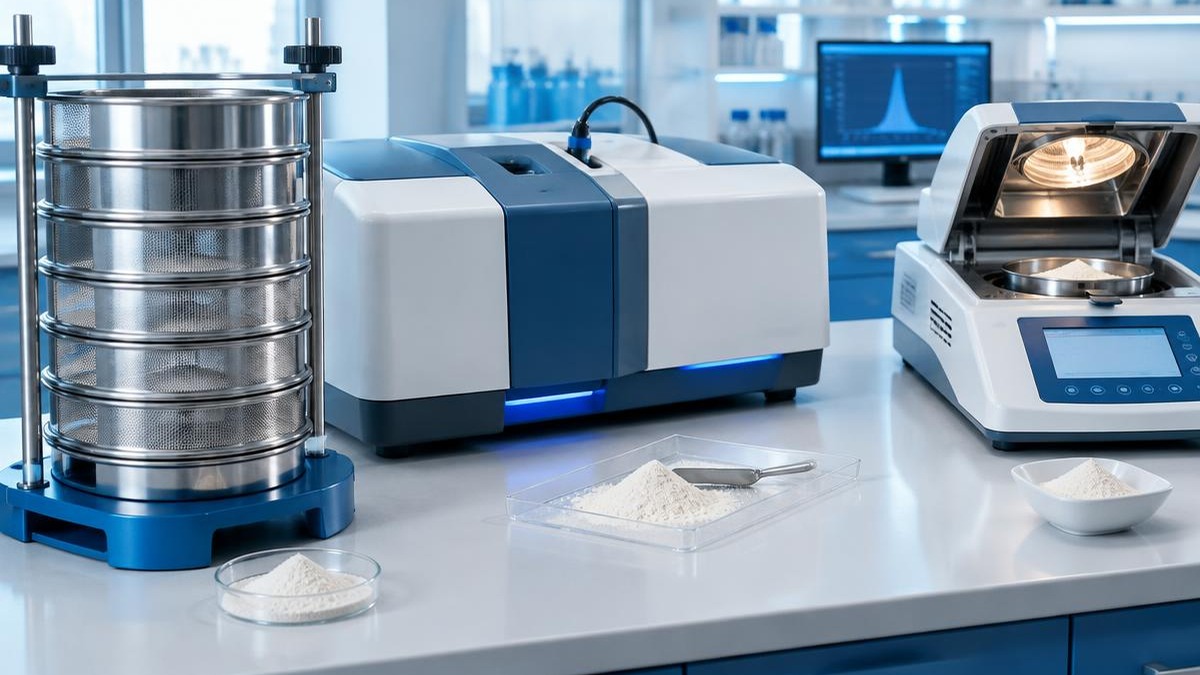 Sieve and moisture analysis stations used for particle size and moisture verification of each production lot.
Microbiological Safety and Contaminant Screening
As a natural polymer used in food, pharmaceutical and cosmetic applications, Guar Gum must meet regulatory mandates enforced by the US FDA, EFSA and CODEX Alimentarius.
- Microbiological assays: Every lot is screened for Total Plate Count (below 5,000 cfu/g), Yeast and Mold (below 500 cfu/g), Salmonella (absent in 25 g), E. coli (absent in 10 g), Staphylococcus aureus (absent in 10 g) and coliforms.
- Heavy metals: Atomic Absorption Spectroscopy and ICP-MS verify limits of Lead 2.0 ppm or below, Arsenic 1.0 ppm or below, Cadmium 1.0 ppm or below and Mercury 0.1 ppm or below.
- Residue screening: GC-MS testing for EU and North American markets confirms the absence of pesticide residues and Ethylene Oxide (ETO).
Batch-Level COA Transparency and the Gujarat Laboratory
Quality assurance culminates in batch transparency that links laboratory results directly to shipment documentation. Learn more about our company and facilities.
- Gujarat R&D laboratory: A fully equipped central testing facility in the heart of global guar processing, staffed by polymer chemists and quality assurance engineers using calibrated analytical instruments.
- Traceable COA generation: Every outgoing shipment, from 25 kg bags to 1,000 kg bulk sacks, carries a unique lot number and a Certificate of Analysis listing Brookfield viscosity, mesh size, moisture, pH, ash content and microbiological results.
- Certification compliance: Quality systems operate under ISO 9001:2015, HACCP, GMP, FSSC 22000, Kosher and Halal frameworks, and B D Guar is a Government of India Star Export House.
Key Takeaways
- Comprehensive verification: Every lot is tested for Brookfield viscosity, particle size, moisture and microbiology before dispatch.
- Precision viscosity control: Rotational viscometry at 25 C confirms exact profiles from fast-hydrating oilfield grades to high-viscosity food grades.
- Strict granulometry: Sieve analysis ensures 90% to 98% passage through 100, 200 or 300 mesh screens, balancing hydration speed with dispersion.
- Global safety compliance: Chemical and microbiological testing aligns with EFSA, US FDA GRAS, FAO, USDA and CODEX standards.
- Full traceability: A lot-specific COA from the Gujarat laboratory accompanies every shipment.
Frequently Asked Questions
How is Brookfield viscosity measured for Guar Gum quality control?
Viscosity is measured with calibrated Brookfield RVT or RVDV viscometers on 1.0% or 2.0% aqueous solutions at 25 C and 20 rpm. Hydration is recorded at set intervals, such as 3 minutes for Fast Hydration Guar Gum or 2 and 24 hours for food grades, to verify swelling and peak viscosity.
Why is particle size distribution critical for Guar Gum performance?
Particle size controls hydration speed and dissolution. Finer 200 to 300 mesh grades hydrate rapidly and give smooth texture in food and personal care products, while coarser 100 mesh grades disperse without clumping in large industrial and textile tanks.
What parameters are included in the Certificate of Analysis?
Each COA reports batch-specific Brookfield viscosity (cPs), mesh size percentage, moisture, total ash, pH, heavy metals (Pb, As, Cd, Hg) and full microbiological results including TPC, Yeast and Mold, E. coli and Salmonella.
How does B D Guar ensure compliance with international food safety regulations?
Testing in the Gujarat laboratory follows US FDA GRAS, EFSA, FAO, USDA and CODEX guidance. Lots are checked for heavy metals, pesticide residues, ETO and pathogens to support safe import into North American, European and Asian markets.
To obtain technical specifications or batch-specific Certificates of Analysis, contact the quality assurance team at sales@bdguar.com or browse our Guar Gum range.