Pet Food Gravy Syneresis: Preventing Phase Separation in Gravies
Guar Gum binds free moisture to stop syneresis in retorted pet food gravies, keeping texture thick, uniform and appealing across a 24-month shelf life.
Last updated:
In the competitive 2026 global wet pet food sector, pet food gravy syneresis is a defining technical priority for formulation technicians. Pet owners expect glossy, clinging, uniform gravy the moment a can or pouch is opened, so water pooling and serum expulsion are read as product failure. High-purity Guar Gum binds free moisture, holds viscosity through thermal retort, and delivers a consistently Superior feeding experience.
Research Overview
Pet care market analyses from IMARC indicate that canned and pouch wet pet food continues to outpace dry kibble, driven by pet humanization and moisture-rich diets. Retort cycles of 118°C to 125°C for 45 to 90 minutes stress starches and meat proteins, expelling water into the headspace. Natural Guar Gum, a galactomannan of roughly 1.5 to 2.2 million Daltons, counters this effect through dense hydroxyl hydrogen bonding with free water, as reported in Carbohydrate Polymers and J. Food Sci.
Free Moisture Immobilization and Polymer Network Thermodynamics
Syneresis is the spontaneous contraction of a gel network with expulsion of free water. Guar Gum has a linear beta-(1,4)-D-mannose backbone with single alpha-(1,6)-D-galactose branches at a 2:1 ratio, hydrating rapidly into a flexible hydrogen-bonded network that converts high-mobility water into bound, entrapped water.
- Hydroxyl hydrogen bonding: exposed hydroxyl groups on the mannose backbone and galactose side units immobilize free water within a continuous three-dimensional matrix.
- Retrogradation control: Guar Gum acts as a steric spacer between amylose and amylopectin chains, limiting the crystalline realignment that squeezes water out of starch-thickened gravies.
- Capillary balance: micro-capillary networks balance osmotic pressure between meat chunks and the surrounding sauce, preventing liquid pooling during transport vibration.
- Uniform water activity: a fully hydrated network avoids localized moisture pockets and surface condensation inside sealed pouches.
Together these mechanisms keep the continuous phase intact for a commercial shelf life that can exceed 24 months. Formulators can review grade options on the products page.
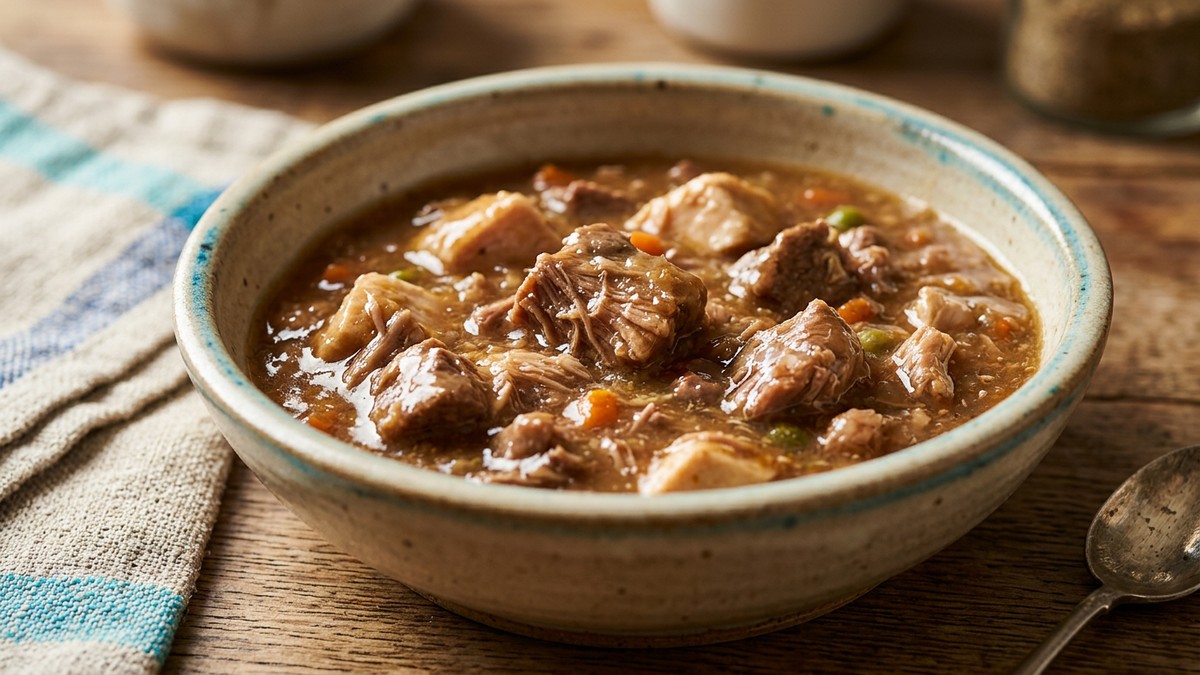
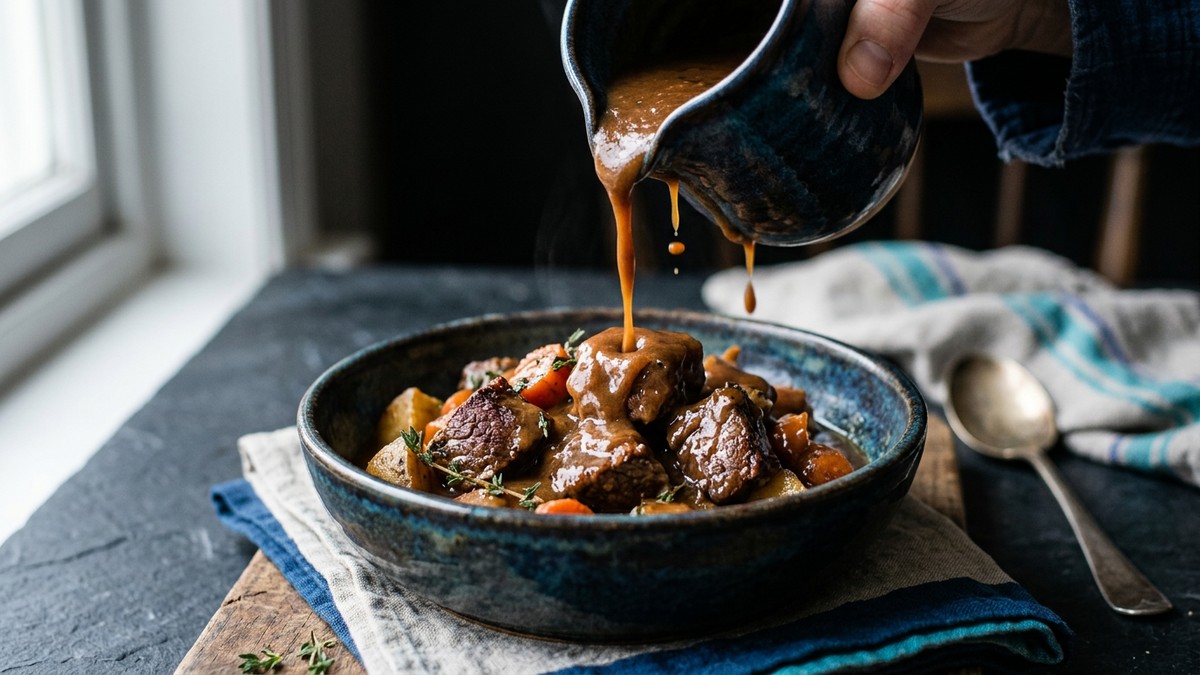
 Uniform, glossy wet pet food gravy with no serum separation after retort sterilization.
Thermal Retort Stability and Viscosity Restoration Kinetics
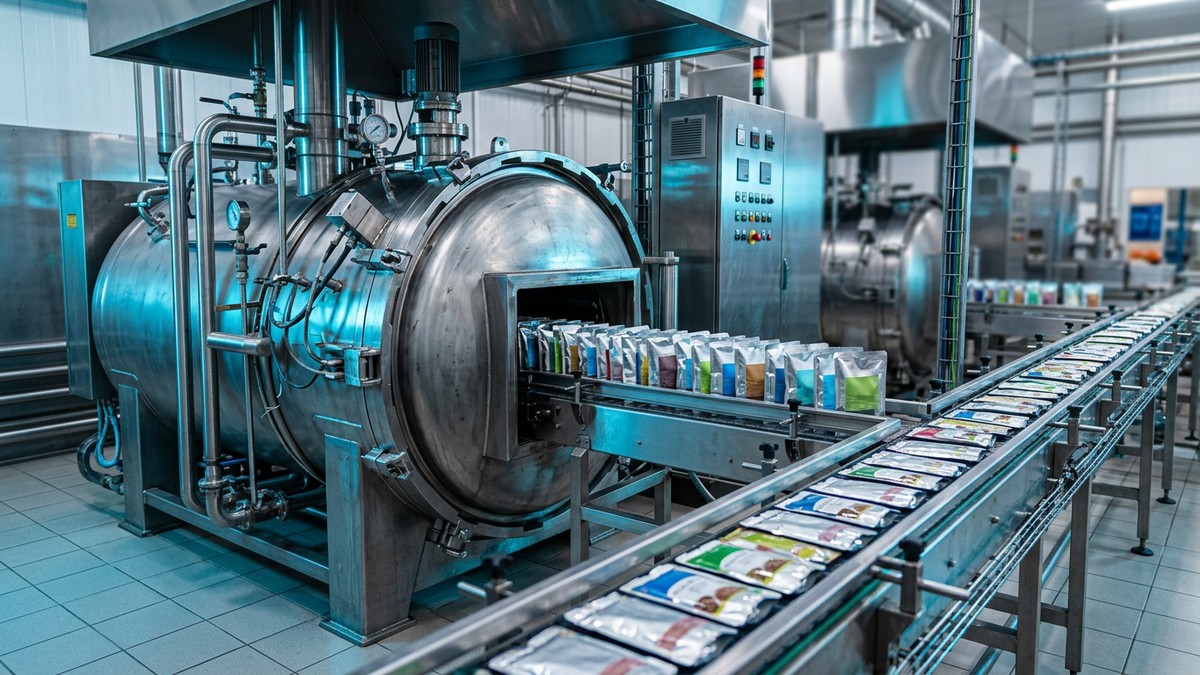
Retort sterilization is the most demanding phase in wet pet food canning, requiring hydrocolloids that survive extreme heat without irreversible breakdown.
- Transient heat thinning: apparent viscosity falls as temperatures pass 80°C to 100°C, improving convective heat transfer and helping reach F0 values of 6 to 10 minutes without overcooking outer meat surfaces.
- Protection against hydrolytic cleavage: at pH 5.8 to 6.8 the galactose side branches shield the mannan backbone from scission during holds at 121°C.
- Viscosity recovery: during cooling from 121°C to 35°C the galactomannan chains re-entangle, forming an elastic, non-brittle network that locks water into the gravy phase.
- Clean filling: shear-thinning flow gives drip-free, non-stringing dosing, reducing gravy contamination of can flanges and pouch seal zones.
This behavior is a function of consistent particle size and purity, which are verified batch by batch under the quality program.
Emulsion Stabilization, Chunk Cling, and Sensory Feeding Appeal
Beyond stopping phase separation, a gravy must coat meat chunks, suspend solids and present well in the bowl.
- Fat suspension: although not a surfactant, the high low-shear viscosity of Guar Gum traps rendered fat droplets such as chicken fat, salmon oil and tallow, preventing grease rings and creaming.
- Pseudoplastic cling: the gravy flows smoothly under shear, then restores viscosity at rest to coat each chunk rather than pooling as thin broth.
- Chunk suspension: static yield stress prevents chunk flotation or compaction, giving identical chunk-to-gravy ratios in every serving.
- Lickability: a smooth, succulent texture, rather than a rubbery gel, supports bowl clearance, consistent with sensory findings reported in J. Food Sci.
 Meat chunks held in uniform suspension by a hydrated Guar Gum network.
Synergistic Systems, Dosage Levels, and Processing Guidelines
Complete syneresis prevention depends on correct blending, dosing and dispersion. Comparative data are available on the Guar Gum vs xanthan gum page.
- Synergistic blends: Guar Gum with xanthan gum at 2:1 or 3:1 raises resting yield stress and freeze-thaw stability, while combinations with carrageenan produce thermo-reversible loaf matrices that eliminate serum weeping.
- Inclusion rates: 0.15% to 0.50% of finished gravy (1.5 to 5.0 kg per metric ton) of 200 mesh Guar Gum for chunk-in-gravy; 0.30% to 0.75% with synergistic agents for loaf and terrine formats.
- Dispersion: dry-blend the powder with starches, mineral premixes or palatants, or inject it into an in-line high-shear venturi disperser, to avoid fish-eye clumps.
- Clean label: Guar Gum is authorized as E412 in the EU and under USDA/FDA GRAS guidelines, giving a plant-based, non-GMO declaration. See the glossary for terminology.
Key Takeaways
- Complete syneresis control: hydroxyl hydrogen bonding binds free moisture and prevents serum weeping and headspace pooling across a 24-month ambient shelf life.
- Retort stability: reversible thermal thinning aids heat penetration at 121°C, followed by rapid viscosity recovery on cooling.
- Uniform chunk cling: pseudoplastic flow gives clean pouch evacuation and thick, glossy coverage in the bowl.
- Fat suspension: lipid droplets stay immobilized in the aqueous network, avoiding oily surface rings.
- Clean-label thickener: a 100% plant-derived, non-GMO alternative to synthetic stabilizers, recognized by EFSA, USDA, FAO and CODEX frameworks.
Frequently Asked Questions
What causes gravy syneresis in canned and pouched wet pet food?
Free water separates from the hydrocolloid and starch network during post-retort cooling and storage. Typical triggers are starch retrogradation, heat-induced meat contraction that releases intracellular fluid, and breakdown of low-grade binders at 118°C to 125°C. The expelled water pools on top or in container corners.
How does Guar Gum prevent moisture separation in retorted gravies?
Guar Gum is a high-molecular-weight galactomannan with abundant hydroxyl groups. These form hydrogen bonds with water, converting free water into bound water inside a three-dimensional viscoelastic mesh that resists vibration and phase separation over extended shelf life.
What dosage of Guar Gum is recommended?
Chunk-in-gravy and pouch recipes typically use 0.15% to 0.50% by weight of finished gravy. Firm loaf, pate or terrine formats use 0.30% to 0.75%, often with xanthan gum or carrageenan for sliceability and serum control.
How should Guar Gum be mixed to prevent clumping?
Pre-blend the powder with other dry solids at roughly 1:4 or 1:5 before adding liquids, or use an in-line high-shear venturi educator. This avoids fish-eye lumps whose gelled shell leaves dry powder trapped inside.
To eliminate gravy syneresis and secure reliable supply of high-purity, food-grade 200 mesh Guar Gum, contact the B.D. Guar technical team at sales@bdguar.com to request data sheets, pilot batch guidelines and trial samples.