Microbiological Standards for Food-Grade Guar Gum: Ensuring Safety in Global Markets
How rigorous microbiological testing — Total Plate Count, yeast & mold limits, and pathogen absence — safeguards Food-Grade Guar Gum (E412) across global supply chains in the 2026 regulatory landscape.
Last updated:
Food-Grade Guar Gum (E412, guaran, galactomannan, goma guar, 瓜尔胶, صمغ الغوار) must comply with strict microbiological limits: Total Aerobic Plate Count ≤ 5,000 cfu/g (often ≤ 1,000 cfu/g for refined applications), yeast & mold ≤ 500 cfu/g, and absolute absence of Salmonella, E. coli, and Coliforms. These thresholds protect consumer safety and underpin the global trade of Guar Gum as a hydrocolloid in 2026.
Research Overview
Guar Gum is a highly versatile hydrocolloid derived from the seeds of the cluster bean (Cyamopsis tetragonoloba). Because the raw material grows in open agricultural environments in Rajasthan and Gujarat, it is naturally susceptible to microbiological contamination. In the 2026 global landscape — defined by tightening EU and FDA enforcement, reciprocal tariffs disrupting Indian exports, and supply-chain consolidation — the microbiological purity of Food-Grade Guar Gum has become a non-negotiable procurement criterion. This article details the international microbiological specifications, in-plant testing protocols, and Certificate of Analysis (COA) transparency that B D Guar Pvt. Ltd. (HICOL brand) maintains to keep global food manufacturers compliant.
What Microbiological Limits Apply to Food-Grade Guar Gum?
Food-Grade Guar Gum must comply with internationally harmonized microbiological specifications drawn from FDA 21 CFR 184.1339, EU Regulation 1333/2008 (E412), the JECFA monograph, and USP-NF. The headline limits are:
- Total Aerobic Plate Count (TPC): ≤ 5,000 cfu/g (refined grades restricted to ≤ 1,000 cfu/g)
- Yeast & Mold: ≤ 500 cfu/g (often ≤ 50 cfu/g for premium specifications)
- Salmonella: Absent in 25 g
- Escherichia coli: Absent in 10 g
- Coliforms: Absent in 1 g
- Staphylococcus aureus: Absent in 10 g
- Pseudomonas: Absent in 10 g
How Are Bacteriological Process Controls Performed?
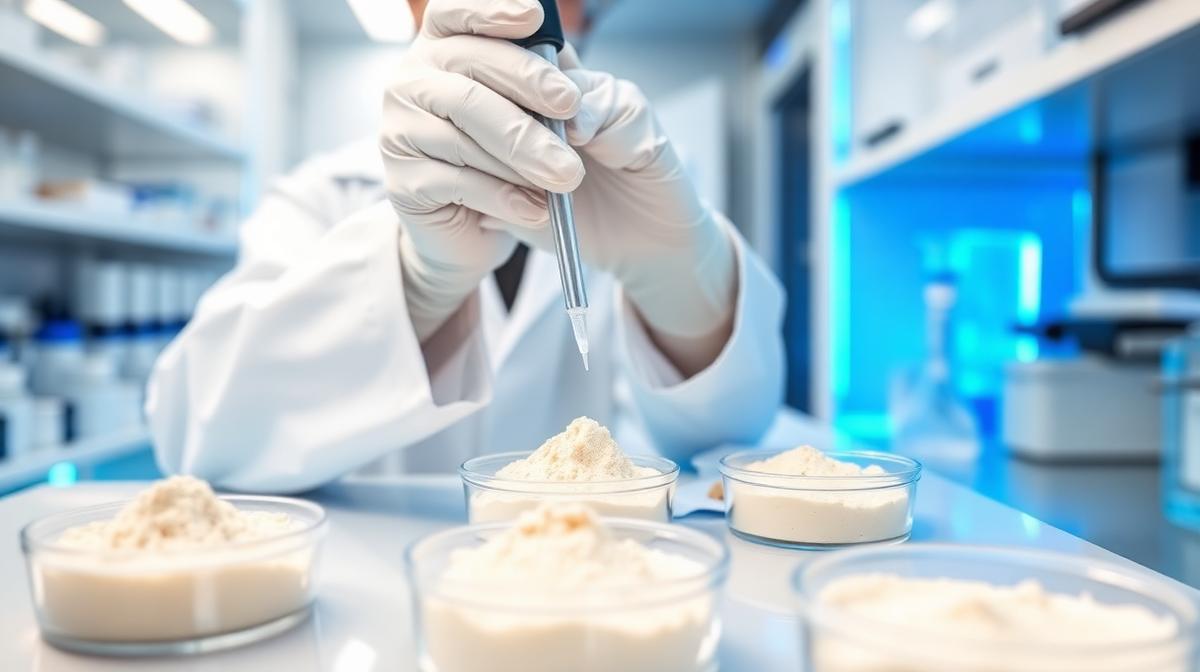
Reputable Guar Gum manufacturing facilities operate dedicated, well-equipped microbiological laboratories that run continuous bacteriological process controls. Every batch of Food-Grade Guar Gum is screened across three pillars:
- Quantitative enumeration — Standard Plate Count plus yeast and mold counts using selective agars.
- Pathogen screening — Targeted testing for Salmonella, E. coli, Staphylococcus aureus, and Pseudomonas.
- Aqueous paste stability — Confirming that the hydrated polymer remains microbiologically stable, since Guar Gum binds large quantities of water that could otherwise support microbial growth.
This rigorous protocol mirrors ISO 22000 food safety management requirements and aligns with the Codex Alimentarius General Standard for Food Additives (GSFA).
In-plant microbiological screening of Food-Grade Guar Gum batches.
Why Is Microbiological Quality Critical for Long Shelf-Life Foods?
Adherence to strict microbiological parameters is critical when Guar Gum is formulated into products with extended shelf lives — canned goods, packaged bakery items, dairy, sauces, and ready meals. Because Guar Gum is highly effective at binding water, a contaminated batch introduced into an aqueous food matrix creates an ideal environment for bacterial and fungal proliferation. The consequences include:
- Premature spoilage and rejection of finished goods
- Loss of texture and viscosity due to enzymatic depolymerization
- Severe public health risks from pathogen growth
- Costly recalls and reputational damage in regulated export markets
How Does the Certificate of Analysis (COA) Build Supply-Chain Trust?
For procurement professionals navigating the 2026 trade environment — where reciprocal US tariffs of 10–50% have compressed margins and intensified the cost of non-conformance — the Certificate of Analysis (COA) is the cornerstone of supplier verification. A transparent COA explicitly lists:
- Batch-specific TPC, yeast and mold counts
- Confirmed absence of all required pathogens
- Chemical specifications (galactomannan ≥ 80%, moisture ≤ 12%, ash ≤ 1.5%, AIR ≤ 3%)
- Heavy metals, ETO residues, and pesticide screening results
- ISO 9001:2015 / ISO 22000 / FSSAI / Halal / Kosher certifications
This transparency is fundamental to building trust across an increasingly fragmented global supply chain and ensuring full compliance with international food safety regulations.
The 2026 Regulatory & Supply-Chain Context
Three converging pressures define the 2026 landscape for Food-Grade Guar Gum buyers:
- ETO-free enforcement: EU and Asian authorities have escalated rejections of consignments with ethylene oxide residues, making microbiological control via thermal and mechanical methods (rather than fumigation) the only sustainable path.
- Tariff and freight volatility: Buyers can no longer afford rejected shipments, elevating the value of pre-shipment microbiological assurance.
- Supply-chain consolidation: Multinational food brands are reducing their approved supplier lists to vendors with documented, repeatable microbiological control systems.
Key Takeaways
- Food-Grade Guar Gum must meet TPC ≤ 5,000 cfu/g, yeast & mold ≤ 500 cfu/g, and pathogen-free status.
- Every batch should undergo Standard Plate Count, yeast/mold enumeration, and Salmonella / E. coli / Staphylococcus / Pseudomonas screening.
- Microbiological purity protects long shelf-life foods from spoilage, texture loss, and public health risk.
- A detailed Certificate of Analysis is the procurement professional's primary trust signal.
- The 2026 ETO-free, tariff-pressured, consolidation-driven landscape rewards suppliers with documented microbiological discipline.
Frequently Asked Questions
What is the maximum Total Plate Count for Food-Grade Guar Gum?
Commercial Food-Grade Guar Gum specifications cap Total Aerobic Plate Count at 5,000 cfu/g. For highly refined applications such as infant formula, dairy, and pharmaceutical-adjacent products, the limit is restricted to 1,000 cfu/g or lower.
Which pathogens must be absent in Food-Grade Guar Gum?
Salmonella, Escherichia coli, Coliforms, Staphylococcus aureus, and Pseudomonas must all be absent from Food-Grade Guar Gum batches destined for global food manufacturers, in line with FDA 21 CFR 184.1339 and EU E412 frameworks.
Why are yeast and mold counts important for Guar Gum?
Because Guar Gum hydrates rapidly and binds water, fungal contamination would proliferate quickly in aqueous food matrices, degrading viscosity and creating spoilage risk. Yeast and mold are typically capped at 500 cfu/g and often kept below 50 cfu/g.
What does a Certificate of Analysis (COA) for Guar Gum contain?
A Guar Gum COA lists batch-specific microbiological results (TPC, yeast & mold, pathogen screening), chemical specifications (galactomannan, moisture, ash, AIR, protein), and heavy-metal, ETO, and pesticide residue data — backed by ISO 9001:2015 and ISO 22000 certifications.
How does the 2026 regulatory landscape affect microbiological compliance?
EU and FDA enforcement against ethylene oxide residues has eliminated fumigation as a sterilization shortcut, forcing manufacturers to control microbiological load through cleaner mechanical, thermal, and process-hygiene methods. Combined with 2026 tariff pressure, the cost of a non-compliant shipment has never been higher.
How does B D Guar Pvt. Ltd. ensure microbiological compliance?
B D Guar Pvt. Ltd. (HICOL brand) operates an in-house microbiological laboratory at its Kalol, Gujarat facility, applying batch-level Standard Plate Count, yeast & mold, and pathogen testing across all 12,000 MT of annual capacity exported to 50+ countries. Every consignment ships with a transparent COA.
Related Resources
- Food Grade Guar Gum (E412) specifications and applications
- ETO-Free Guar Gum — 2026 Regulatory Landscape
- Complete Guar Gum Technical Data Sheet
- Quality Certifications — ISO 9001:2015, ISO 22000, FSSAI, Halal, Kosher
For COA-backed Food-Grade Guar Gum supply across global markets, contact our HICOL technical sales team or request specifications via our product catalog.
EU Regulation 2026/196: new microbiological criteria for E412 from 18 August 2026
Commission Regulation (EU) 2026/196 (adopted 28 January 2026, published 29 January 2026) formally introduces microbiological criteria for guar gum (E412) within the specifications in Regulation (EU) 231/2012, effective from 18 August 2026. In practice this means EU-facing E412 suppliers must be able to demonstrate — batch by batch — controlled Total Plate Count, yeasts & moulds and absence of key pathogens (Salmonella, E. coli) as part of the E412 specification itself, not merely as a customer-driven expectation. For a full compliance overview, see our dedicated EU 2026/196 Compliant & ETO-Free Guar Gum landing page.
Does EU 2026/196 introduce specific microbiological limits for guar gum?
Yes. Regulation (EU) 2026/196 amends Regulation (EU) 231/2012 to add formal microbiological criteria for guar gum (E412) — including Total Plate Count, yeasts & moulds and pathogen absence — applicable from 18 August 2026. Prior to this amendment, microbiological expectations for E412 were driven largely by downstream customer specifications rather than by the EU additive specifications directly.
How does 2026/196 change what a Guar Gum COA should contain for EU buyers?
From 18 August 2026, an E412 COA for the EU market should explicitly reference the microbiological criteria and the updated purity/heavy-metal limits introduced by Regulation (EU) 2026/196, alongside ethylene oxide / 2-chloroethanol results at the 0.1 mg/kg EU limit of quantification. B D Guar issues 2026/196-aligned COAs and a signed non-ETO declaration with every HICOL® consignment.