Low-Fat Mayonnaise Formulations: Creamy Mouthfeel with Natural Hydrocolloids
Discover how Guar Gum's pseudoplastic rheology replicates fat-droplet creaminess in reduced-oil mayonnaise, with mesh-size and dosage guidance for developers.
Last updated:
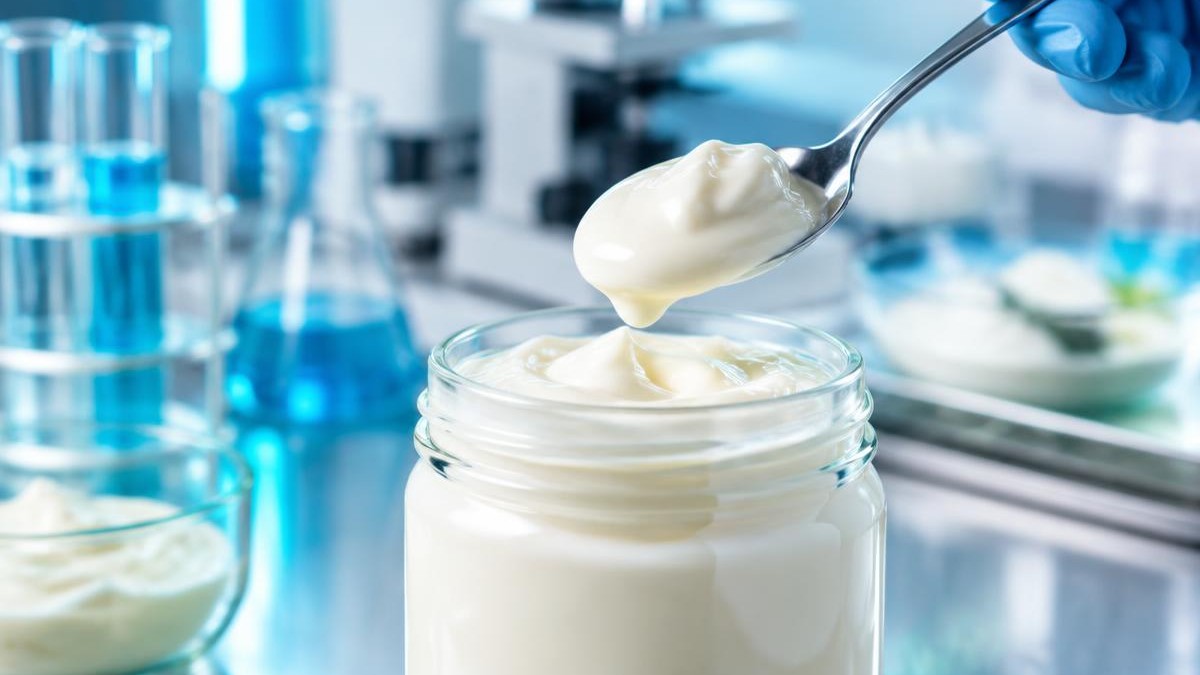
In the highly competitive 2026 global condiment market, low-fat mayonnaise formulations represent an essential innovation focus for condiment and sauce developers. Driven by shifting consumer health preferences, clean-label mandates and rising vegetable oil costs, manufacturers must reduce oil content while preserving the rich, spoonable texture of full-fat spreads. High-purity Guar Gum lets formulators build cold-swelling aqueous matrices that mimic fat-droplet sensory behavior and stabilize low-pH emulsions.
Research Overview
According to IMARC market analysis, demand for reduced-calorie, low-fat and vegan mayo alternatives has driven double-digit growth across North American and European retail in 2026. Full-fat mayonnaise relies on 70-80% oil droplets packed into a tight viscoelastic network. Cutting oil to 25-45% drops droplet concentration below close-packing, causing thin body, phase separation and syneresis. Peer-reviewed work in Carbohydrate Polymers and J. Food Sci. identifies galactomannans as an effective, clean-label structural solution. See our product range for food-grade grades.
Pseudoplastic Flow Kinetics and Fat-Mimicking Rheology
Guar Gum consists of a beta-1,4-linked D-mannopyranose backbone with alpha-1,6-linked D-galactose branches in a 2:1 ratio. Its high molecular weight binds large amounts of free water through hydrogen bonding, building a structured continuous phase. Replicating the mouthfeel of densely packed fat globules requires careful control of rheology across shear regimes.
- Zero-shear viscosity and yield stress: A 0.2-0.4% dosage of high-viscosity Guar Gum builds a hydrogen-bonded water matrix that keeps low-fat mayonnaise heaped on a spoon and suspends particles and air during long storage.
- Oral shear thinning and lubricity: At oral shear rates of 10-100 reciprocal seconds, apparent viscosity drops rapidly, mimicking the melting sensation of oil droplets and giving a smooth, non-pasty breakdown.
- Reduced starch pastiness: Pairing low starch levels with Guar Gum lowers total starch solids, avoiding the heavy, gummy texture of starch-only systems.
Industry studies indicate that this shear-thinning profile is the main reason Guar Gum outperforms many modified starches in sensory panels of reduced-oil spreads.
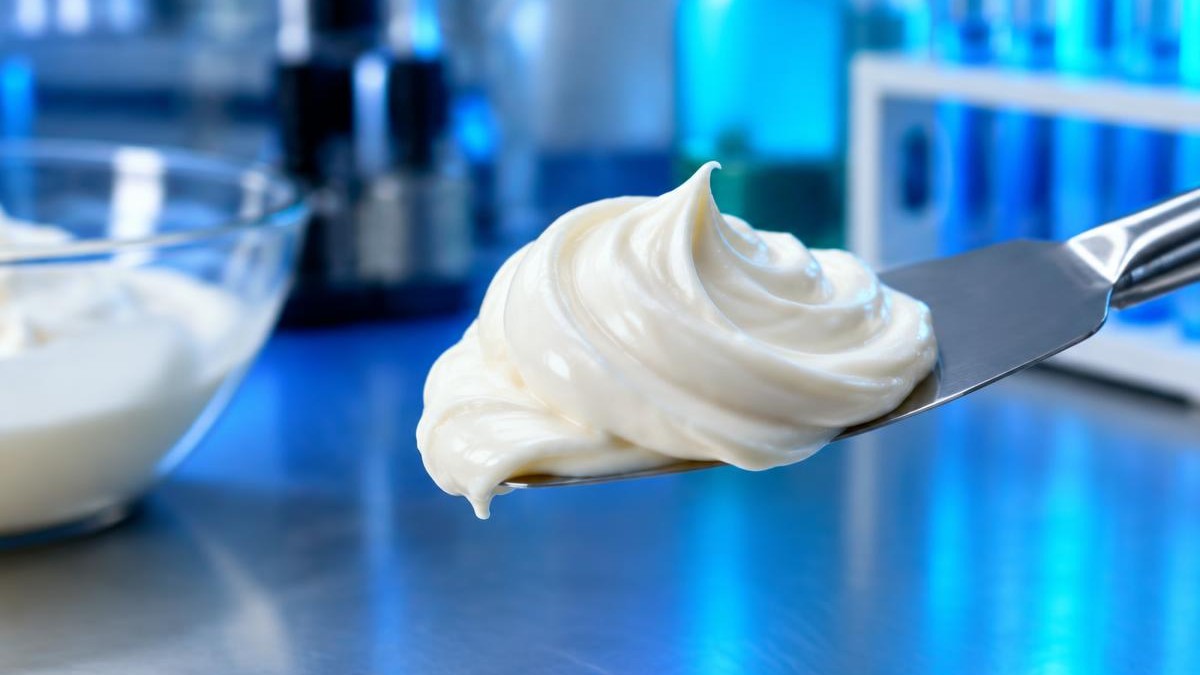 Smooth, spoonable reduced-oil mayonnaise structured by Guar Gum.
Mesh Size Optimization and Rapid Hydration Control
Particle size distribution directly dictates hydration rate, processing performance and final smoothness in high-speed condiment lines.
- 200 mesh for silky smoothness: Fine particles dissolve rapidly in cold water without dry agglomerates or fish eyes, giving a velvety emulsion that feels like an oil-rich spread.
- Controlled hydration in high-speed blenders: 200 mesh Guar Gum reaches 80-90% of peak cold-water viscosity within minutes, stabilizing the aqueous phase before oil addition and aiding droplet breakup during homogenization.
- Coarser mesh options: Continuous lines that need delayed viscosity for deaeration or acid blending can use 100 mesh or custom mesh sizes, preventing premature pumping resistance.
Custom milling is available; review the full Guar Gum glossary for hydration terminology.
Synergistic Hydrocolloid Systems and Acid Stability
Mayonnaise is a demanding environment: high salt, pH 3.5-4.2 from acetic acid or lemon juice, and high-shear processing.
- Guar Gum and Xanthan Gum synergy: Blends at 1:1 to 3:1 ratios combine Guar Gum''s cold-water viscosity and lubricity with Xanthan Gum''s weak-gel yield stress and acid tolerance, forming a viscoelastic network that resists syneresis under temperature swings. Compare options on our Guar Gum vs Xanthan Gum page.
- Stability across low pH: As a non-ionic galactomannan, Guar Gum resists charge neutralization in vinegar solutions, supporting stable viscosity across a 12-month shelf life under CODEX and EFSA benchmarks.
- Flavor release: Rapid shear thinning releases egg, mustard and vinegar notes immediately, without the flavor binding seen in some starches and synthetic thickeners.
Processing Protocols, Emulsification and Shelf-Life Stability
Correct addition sequence during high-shear processing is essential for emulsion stability.
- Sequential cold-phase hydration: Hydrate Guar Gum in the aqueous phase (water, vinegar, sugar, salt) before oil introduction, so the continuous phase reaches maximum water-binding capacity.
- Inhibiting syneresis during temperature cycling: The dense hydrogen-bond network traps water during freeze-thaw and warm storage, preventing serum separation.
- Commercial dosage benchmarks: Industry studies indicate inclusion rates of 0.15-0.35% by weight in reduced-fat (30-50% oil) mayonnaise, and 0.4-0.6% in spreads under 15% oil when combined with microcrystalline cellulose or native starches.
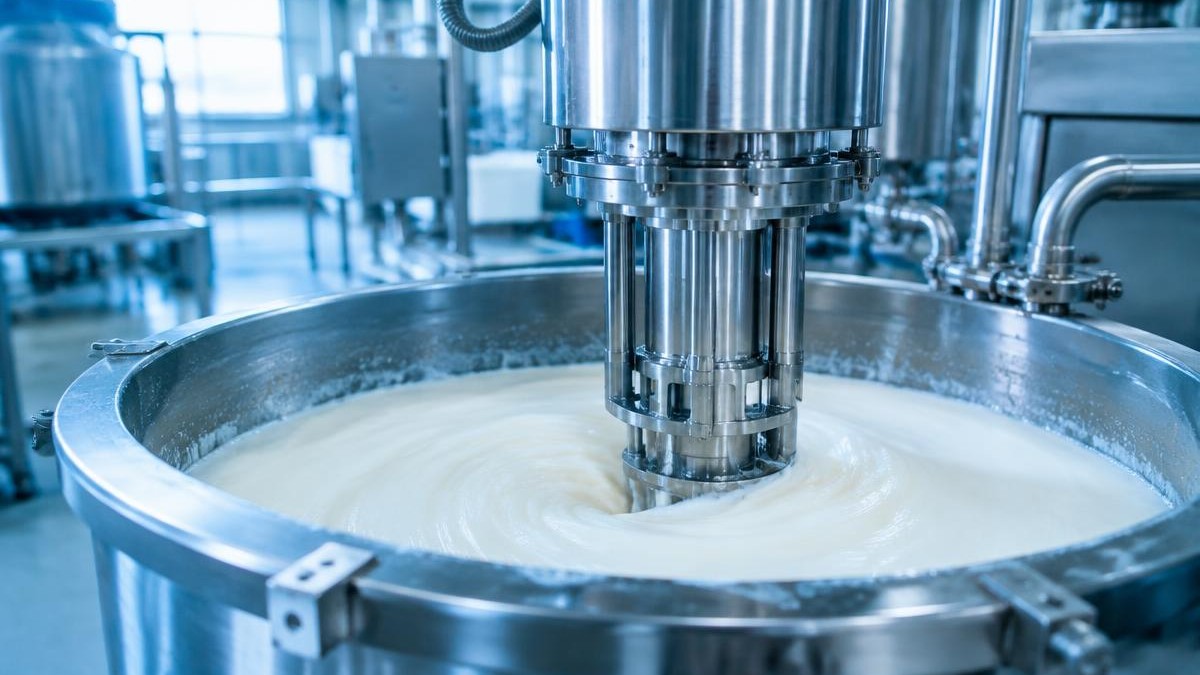 High-shear processing of a hydrated Guar Gum aqueous phase before oil addition.
Key Takeaways
- Fat-mimicking rheology: Pseudoplastic shear thinning mirrors the oral breakdown and creaminess of oil droplets.
- Smooth texture via particle sizing: 200 mesh Guar Gum hydrates rapidly without agglomeration or grittiness.
- Synergistic yield stress: Guar Gum with Xanthan Gum at 1:1 to 3:1 prevents phase separation, creaming and syneresis in low-pH dressings.
- Uncompromised flavor release: The non-ionic, rapid-breaking matrix avoids the taste masking of modified starches.
- Regulatory and clean-label compliance: Plant-derived food-grade Guar Gum meets USDA, FAO, CODEX and EFSA expectations.
Frequently Asked Questions
How does Guar Gum replicate the creamy mouthfeel of oil in low-fat mayonnaise?
Guar Gum combines high molecular weight with pronounced pseudoplastic rheology. At rest it builds a structured water phase that gives thick, spoonable body. Under oral shear its viscosity drops instantly, providing the smooth lubricity, coating and rapid breakdown characteristic of full-fat oil droplets.
What mesh size of Guar Gum should be used in low-fat mayonnaise and salad dressings?
A 200 mesh fine powder is recommended for low-fat mayonnaise and smooth sauces. Fine particles hydrate rapidly in cold water without clumps or fish eyes, ensuring a homogenous, silky texture with no gritty sensation.
Can Guar Gum withstand the acidic pH of mayonnaise formulations?
Yes. Guar Gum is a non-ionic galactomannan, so hydration does not depend on ionic charge. Its viscosity remains stable across typical mayonnaise pH levels of 3.5-4.2 and high salt concentrations throughout extended shelf storage.
What is the recommended inclusion rate of Guar Gum in reduced-fat spreads?
In reduced-fat mayonnaise with 30-50% oil, inclusion typically ranges from 0.15% to 0.35% by weight. In ultra-low-fat or fat-free spreads under 15% oil, 0.4-0.6% is typically blended with starches or cellulose to achieve a firm, spoonable body.
To optimize low-fat condiment formulations, eliminate syneresis and achieve a Superior creamy mouthfeel with natural galactomannans, partner with B.D. Guar Pvt. Ltd. Contact the technical team at sales@bdguar.com to request custom mesh samples, rheological specification sheets and tailored hydrocolloid blending support.