Guar Gum Derivatives in Personal Care: From Shaving Gels to Silkier Shampoos
Discover how Guar Gum derivatives transform shampoos, conditioners, shaving gels and lotions with Superior slip, conditioning and natural sensory feel in 2026.
Last updated:
The 2026 personal care landscape is being reshaped by a single demand: clean, biodegradable, and high-performance formulations. At the center of this shift sit Guar Gum derivatives in personal care, a family of plant-based hydrocolloids that deliver conditioning, viscosity control, and Superior sensory performance across shampoos, conditioners, shaving gels, lotions, and creams. As regulators tighten polymer disclosure rules and consumers reject synthetic carbomers, cosmetic chemists are formalising Guar Gum as the default natural rheology and conditioning system.
Research Overview
This article unpacks how cationic, hydroxypropyl, and carboxymethyl Guar Gum derivatives function inside hair care, shave systems, and skincare emulsions. It maps the 2026 cosmetic hydrocolloid market, summarises published rheology and substantivity data from peer-reviewed sources such as Carbohydrate Polymers and International Journal of Cosmetic Science, and benchmarks Guar Gum against carbomer, xanthan, and silicone-based conditioning agents. Procurement and R&D readers will see how grade selection, viscosity targets, and certifications translate into shelf-ready performance.
The 2026 Cosmetic Hydrocolloid Market and Why Guar Gum Is Winning
According to IMARC Group market commentary, the global natural cosmetic ingredients market is projected to expand at a healthy single-digit CAGR through the late 2020s, with hair care and skincare absorbing the majority of plant-derived hydrocolloid volume. Brands are responding to three converging pressures in 2026: EU microplastic restrictions on intentionally added synthetic polymers, accelerating clean-beauty certification programmes, and reciprocal tariffs that have repositioned India as the dominant supply origin for cosmetic-grade Guar Gum.
Guar Gum derivatives meet this moment because they are biodegradable, plant-derived, and chemically tunable. Through controlled etherification of the galactomannan backbone, manufacturers tailor charge density, solubility, and viscosity to fit anionic surfactant systems, oil-in-water emulsions, or non-ionic gels. The result is a single feedstock that replaces multiple synthetic polymers across a brand portfolio.
- Cationic Guar (Guar Hydroxypropyltrimonium Chloride): the workhorse conditioning polymer for shampoos and 2-in-1 systems.
- Hydroxypropyl Guar (HPG): non-ionic thickener for clear gels, serums, and sulphate-free cleansers.
- Carboxymethyl Guar (CMG): anionic thickener for toothpaste, depilatory creams, and oxidative hair colour bases.
- Native food-grade Guar Gum: used in natural shampoo bars and powdered dry-shampoos for clean-label positioning.
For procurement teams comparing grades, the Compare Guar Gum Grades tool maps viscosity, mesh, and application fit across cosmetic-relevant specifications.
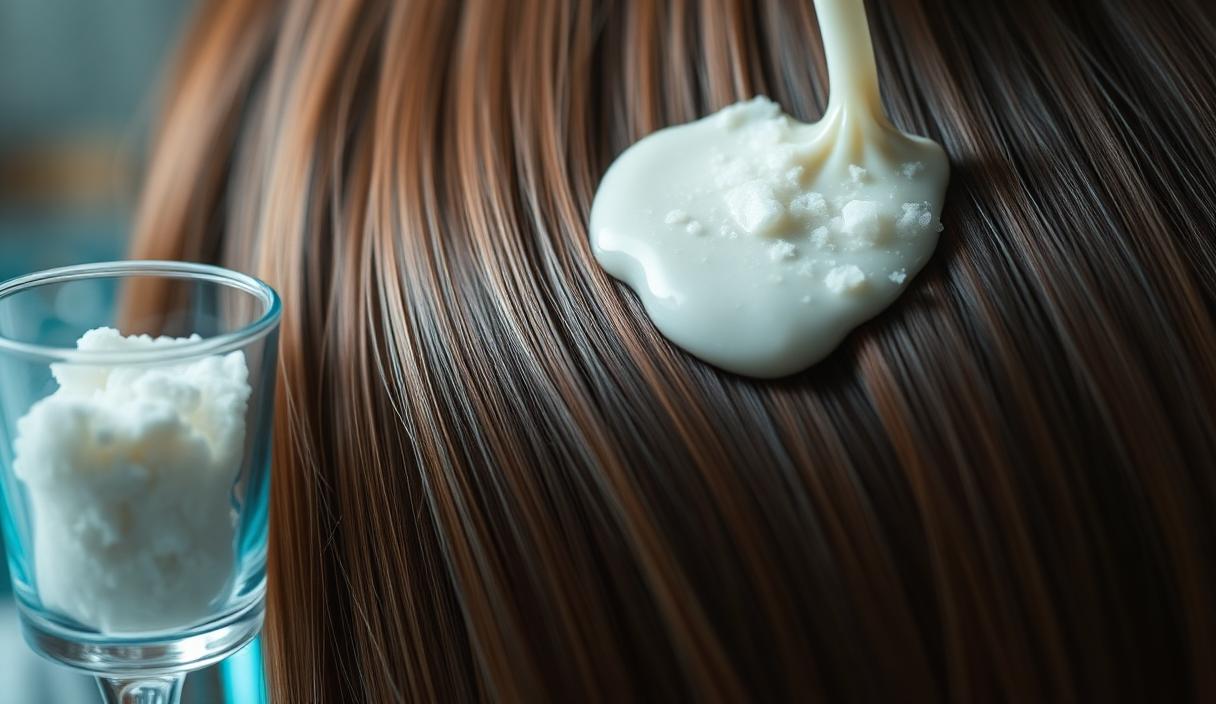 Cationic Guar derivatives deposit on damaged hair cuticles to deliver measurable conditioning and reduce static.
Shampoos and Conditioners: How Cationic Guar Builds Silky, Anti-Static Hair
Cationic Guar Hydroxypropyltrimonium Chloride is the most-used natural conditioning polymer in shampoos worldwide. Its quaternised nitrogen groups carry a permanent positive charge that complexes with anionic surfactants such as sodium lauryl ether sulphate during dilution at the point of rinse. Research published in the International Journal of Cosmetic Science has repeatedly demonstrated that this coacervation mechanism deposits a thin, lubricious film on the negatively charged, damaged regions of the hair cuticle, lowering wet- and dry-comb friction.
The practical formulation benefits are well documented:
- Wet detangling: coacervate films reduce combing force, with peer-reviewed studies reporting 30 to 60 percent friction reductions versus surfactant-only controls.
- Anti-static performance: the residual cationic film neutralises triboelectric build-up on dry hair, a critical claim for fine-hair shampoos in 2026.
- Silicone replacement: high-charge-density cationic Guar enables silicone-free conditioning claims without sacrificing slip.
- Colour retention: film deposition seals raised cuticles after oxidative dyeing, extending shade life in colour-care lines.
Grade selection is governed by molecular weight and degree of substitution. Low-molecular-weight, high-charge-density grades are preferred for 2-in-1 shampoos where deep conditioning is needed in a single step, while high-molecular-weight, low-charge grades suit daily-use clarifying shampoos that must rinse cleanly.
Shaving Gels, Skincare Emulsions, and Clear Hair Stylers
Hydroxypropyl Guar (HPG) and native Guar Gum dominate the non-ionic side of personal care. In transparent shaving gels, HPG builds the high-yield-value, shear-thinning rheology that lets a pea-sized dose lather instantly under a wet razor while holding firm in the palm. Unlike carbomer, HPG remains effective across a wide pH window (4 to 10) and tolerates electrolytes from added humectants and pH adjusters without viscosity collapse.
In skincare, Guar Gum derivatives stabilise oil-in-water emulsions by thickening the continuous aqueous phase and parking the suspended oil droplets in a weakly structured network. Published rheology work in Carbohydrate Polymers shows that even small additions of HPG (0.2 to 0.6 percent) raise low-shear viscosity by orders of magnitude while preserving the high-shear thinning behaviour that consumers experience as light, fast spreading. The sensory outcome is a lotion that feels rich on application yet absorbs without tackiness — a profile that purely synthetic acrylate thickeners struggle to match.
- Shaving gels: 0.4 to 0.8 percent HPG for clear, shear-thinning, electrolyte-tolerant gels.
- Body lotions: 0.1 to 0.3 percent HPG as a co-thickener with cellulose gums for natural slip.
- Sheet-mask serums: 0.3 to 0.6 percent HPG for a substantive, non-sticky film that aids active delivery.
- Hair gels and curl creams: blends of HPG and cationic Guar for hold plus conditioning in one base.
Formulators moving away from carbomer-only systems often consult the Guar Gum vs Xanthan Gum comparison and the Technical Glossary when locking in rheology targets.
 Hydroxypropyl Guar builds yield-value rheology that stabilises emulsions across a wide pH and electrolyte window.
Guar Gum vs Carbomer and Synthetic Conditioners: A 2026 Benchmark
The decisive 2026 question for personal care R&D is no longer "does the natural option work" but "where does Guar Gum outperform the synthetic incumbent." On most cosmetically relevant metrics, the answer favours Guar Gum derivatives.
- Sensory profile: Guar-thickened systems deliver a cushiony, biopolymer slip that consumer panels consistently describe as more skin-like than the slightly tacky, glassy feel of carbomer gels.
- Electrolyte tolerance: HPG holds viscosity in the presence of salts and AHAs where carbomers require careful neutraliser balancing.
- pH flexibility: Guar derivatives function from pH 4 to pH 10 without re-neutralisation steps.
- Environmental profile: Guar Gum is fully biodegradable, an advantage as EU and ASEAN regulators advance restrictions on intentionally added synthetic polymers.
- Supply security: Indian Guar Gum derivatives are insulated from petrochemical feedstock volatility and benefit from 2026 tariff repositioning toward Indian exporters.
Where carbomer still wins — ultra-clear, water-thin essence gels at very low use levels — formulators are increasingly using hybrid Guar-acrylate systems that cut synthetic polymer load by 50 to 70 percent while preserving optical clarity. Manufacturers seeking compliant cosmetic-grade supply can review the certifications portfolio on the Quality & Certifications page.
Sustainability, Sourcing, and the 2026 Supply Picture
Personal care brands now treat ingredient origin as a marketing asset. Guar is a rain-fed legume cultivated across Rajasthan, Haryana, and Gujarat, with cultivation cycles that improve soil nitrogen and require minimal irrigation compared to most industrial polymer feedstocks. FAO data on legume-based cropping systems supports the position that Guar is among the lowest-water, lowest-input natural polymer crops available at industrial scale.
India supplies the overwhelming majority of global cosmetic-grade Guar Gum derivative volume in 2026, and ETO-free production has become a non-negotiable cosmetic-buyer specification. Vertically integrated suppliers that control splits-to-derivative conversion — rather than re-selling third-party powder — can certify residual solvent, microbiology, and pesticide profiles in line with EFSA and FDA cosmetic ingredient expectations. B D Guar's direct-from-farmer procurement model is detailed on the Sustainability page.
Key Takeaways
- Cationic Guar is the natural conditioning standard: peer-reviewed studies confirm measurable wet- and dry-comb friction reductions in shampoos.
- HPG replaces carbomer in shaving gels and emulsions: wider pH window, electrolyte tolerance, and Superior sensory profile.
- Hybrid systems cut synthetic polymer load: Guar-acrylate blends reduce carbomer use by 50 to 70 percent while maintaining clarity.
- 2026 regulation favours biodegradable polymers: EU microplastic restrictions accelerate the shift to Guar Gum derivatives.
- India is the supply anchor: tariff repositioning and rain-fed cultivation make Indian Guar Gum the strategic 2026 sourcing choice.
- Grade matching drives performance: molecular weight, substitution, and viscosity must be specified to the application.
Frequently Asked Questions
Which Guar Gum derivative is best for sulphate-free shampoos?
Cationic Guar Hydroxypropyltrimonium Chloride with a moderate charge density and medium molecular weight delivers reliable coacervation even with milder anionic and amphoteric surfactants such as sodium cocoyl isethionate and cocamidopropyl betaine. Pair it with 0.2 to 0.4 percent HPG to rebuild lost viscosity without thickening salts.
Does Guar Gum cause buildup on hair?
Buildup occurs only when charge density is mismatched to use frequency. Daily-use shampoos should use lower-charge cationic Guar grades that deposit a thin, rinsable film. Weekly deep-conditioning treatments tolerate higher-charge grades. Properly specified Guar systems are easier to clarify than silicone-only conditioners.
Is cosmetic-grade Guar Gum hypoallergenic?
Cosmetic-grade Guar Gum derivatives have a long-standing safety record and are generally well tolerated. They are non-comedogenic, gluten-free, and free of common cosmetic sensitisers when sourced from ETO-free, low-microbial-count Superior suppliers. Allergen-conscious brands should still verify supplier specifications.
How does Guar Gum support clean-beauty claims in 2026?
Guar Gum is plant-derived, biodegradable, non-GMO when specified, and free of intentionally added microplastics, making it compliant with the most stringent 2026 clean-beauty and EU polymer restriction frameworks. It also supports vegan, halal, and kosher certifications when paired with appropriately certified processing.
To specify cosmetic-grade Guar Gum derivatives for your next personal care launch, request a sample, COA, and tailored viscosity grade through the B D Guar team on the contact page, or review the full hydrocolloid portfolio in the product catalog.