Developing Vegan Gummy Candies: Replacing Gelatin with Agar and Guar
Discover how food scientists in 2026 are replacing animal-derived gelatin with agar-agar and Guar Gum to create Superior vegan gummy candies with perfect chew and global distribution stability.
Last updated:
As the 2026 global confectionery market aggressively pivots toward plant-based and clean-label formulations, the challenge of developing vegan gummy candies has become a central focus for food scientists. Historically reliant on animal-derived gelatin, manufacturers are now transitioning to highly functional, halal, and vegan hydrocolloids to meet strict consumer demands. While agar-agar offers exceptional thermal stability, it fundamentally lacks the desired elastic chew of traditional gummies. By strategically incorporating Guar Gum as a synergistic texture modifier, formulators can engineer a Superior, resilient, and springy confectionery matrix that withstands the rigors of modern distribution.
Research Overview: The Physical Chemistry of Vegan Hydrocolloids
The global food hydrocolloids market is undergoing a profound transformation. According to data from IMARC and various industry studies, the demand for natural, plant-derived texturizers is surging as food manufacturers move away from gelatin — a by-product of the pork and beef industries — in response to the explosive growth of vegan, halal, and kosher dietary markets worldwide. In 2026, this shift is no longer a niche trend but a mainstream commercial imperative.
Gelatin's unique viscoelastic properties — its ability to form a reversible, thermoplastic gel that melts in the mouth and snaps back under pressure — have made it the gold standard for gummy confectionery for over a century. Replicating this complex physical behavior with plant-derived alternatives requires a sophisticated understanding of polysaccharide chemistry and rheology. The most effective solution identified by industry research is a synergistic binary system: agar-agar as the primary structural gelling agent, and Guar Gum as a secondary plasticizing and water-binding polymer. Together, they modify the rheology of the gummy candy, suppressing brittleness and imparting the desired cohesive, springy elasticity that closely mimics traditional gelatin.
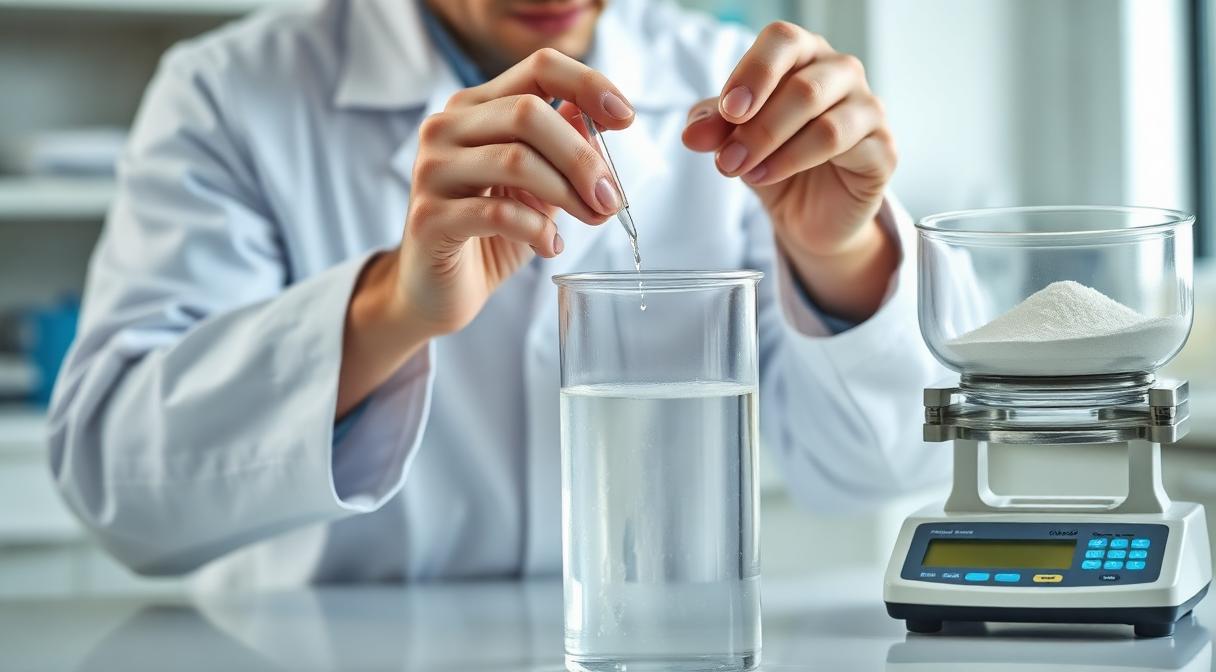 Modern confectionery laboratories use hydrocolloid synergy — combining agar-agar and Guar Gum — to replicate the elastic texture of gelatin-based gummies.
The Rheological Profile of Agar-Agar: High Stability, Brittle Yield
To successfully formulate a Superior vegan gummy, one must first understand the isolated physical properties of the primary gelling agent. Agar-agar is widely considered one of the most powerful natural gelling agents available to the modern food industry.
- Thermo-Reversible Gelling: Agar-agar requires significant thermal energy to dissolve, typically needing to be heated to temperatures approaching 90°C (194°F). Once fully solubilized, the fluid remains pourable until it cools to a specific setting point. As the temperature drops below 40°C, the agarose chains begin to coil and associate, rapidly forming a solid gel network.
- High Rupture Strength: The resulting agar gel possesses an extremely high yield stress and rupture strength. From a sensory perspective, when a consumer bites into an agar-only gummy, the candy fractures rather than stretching — producing a brittle, glassy break rather than the slow, cohesive pull characteristic of gelatin. This textural defect is the primary challenge for formulators.
- Exceptional Thermal Stability: Unlike gelatin, which begins to soften and melt at temperatures above 30°C — making it unreliable in warm retail environments — agar gels remain structurally firm and dimensionally stable at temperatures well above 80°C. This is an extraordinary commercial advantage for manufacturers distributing products in hot climates.
- Syneresis Tendency: When used in isolation over extended storage, agar gels can exhibit syneresis — the gradual expulsion of water from the gel matrix — causing gummies to weep liquid and degrade in texture. Guar Gum is the critical ingredient that resolves this challenge.
Guar Gum as the Synergistic Texture Modifier
Guar Gum, derived from the endosperm of the Cyamopsis tetragonoloba plant, is a galactomannan polysaccharide with an exceptionally high molecular weight, typically ranging from 1 to 2 million Daltons. This enormous polymer chain is responsible for its unparalleled water-binding capacity and viscosity-building efficiency. Research in J. Food Sci. highlights that this massive water-binding capacity immobilizes free water within the candy matrix.
- Plasticization of the Agar Network: When Guar Gum is incorporated into an agar gel system, its long, flexible galactomannan chains intercalate with the helical agarose network. This physical interference acts as a molecular plasticizer, disrupting the perfect crystalline packing of the agar helices. The result is a gel that retains its structural integrity and firmness but loses its brittleness, yielding a product with measurably higher elongation at break and a more gradual, cohesive failure mode — in sensory terms, a proper chew.
- Syneresis Elimination: By locking the moisture into a highly viscous pseudo-gel state, Guar Gum prevents the agar helices from contracting and expelling water, thereby eliminating syneresis and ensuring the gummy remains plump and structurally sound over extended storage periods.
- Flavor Release Kinetics: Unlike highly rigid gels that trap flavor compounds inside an impermeable molecular mesh, the flexible inclusion of Guar Gum allows for optimal flavor release. The slight dissolution of the galactomannan chains during mastication ensures that encapsulated fruit flavors, natural acids, and sweeteners are released rapidly and uniformly across the palate.
- Simulating Gelatin's Viscoelasticity: Food scientists utilize oscillatory rheometry to measure the viscoelastic properties of gel systems. Guar Gum's contribution shifts the agar gel's behavior from a purely elastic solid toward a more viscoelastic material, closing the functional gap with traditional gelatin systems and ensuring consumer acceptance.
Hydrocolloid Comparison Table: Setting, Melting, and Stability
A precise understanding of the thermal properties of each hydrocolloid is essential for formulation success. The following data, consistent with values cited in Carbohydrate Polymers and industry formulation guides, provides a practical reference for confectionery technologists.
| Hydrocolloid | Dissolution Temperature | Setting Temperature | Melting Temperature | Solubility | Stability in Hot Climate |
|---|---|---|---|---|---|
| Gelatin (Bovine) | ~50°C (122°F) | ~15–20°C (59–68°F) | ~30–35°C (86–95°F) | Cold/warm water soluble | Poor — melts at ambient temperature in tropical regions |
| Agar-Agar | ~90°C (194°F) | ~35–40°C (95–104°F) | ~80–85°C (176–185°F) | Hot water only | Excellent — stable well above ambient temperatures globally |
| Guar Gum | Ambient (cold water) | N/A (Non-gelling) | N/A (Non-gelling) | Cold/warm water soluble | Excellent — does not melt; continuously binds water, preventing high-temperature syneresis |
By utilizing this plant-based system, confectionery brands can confidently export their vegan gummy products to regions with scorching climates — the Middle East, Southeast Asia, and Latin America — without the prohibitive costs of end-to-end refrigerated cold-chain logistics. The Guar Gum ensures that even at elevated ambient temperatures, the free moisture within the candy remains tightly bound, preventing gummies from sweating or sticking to packaging material.
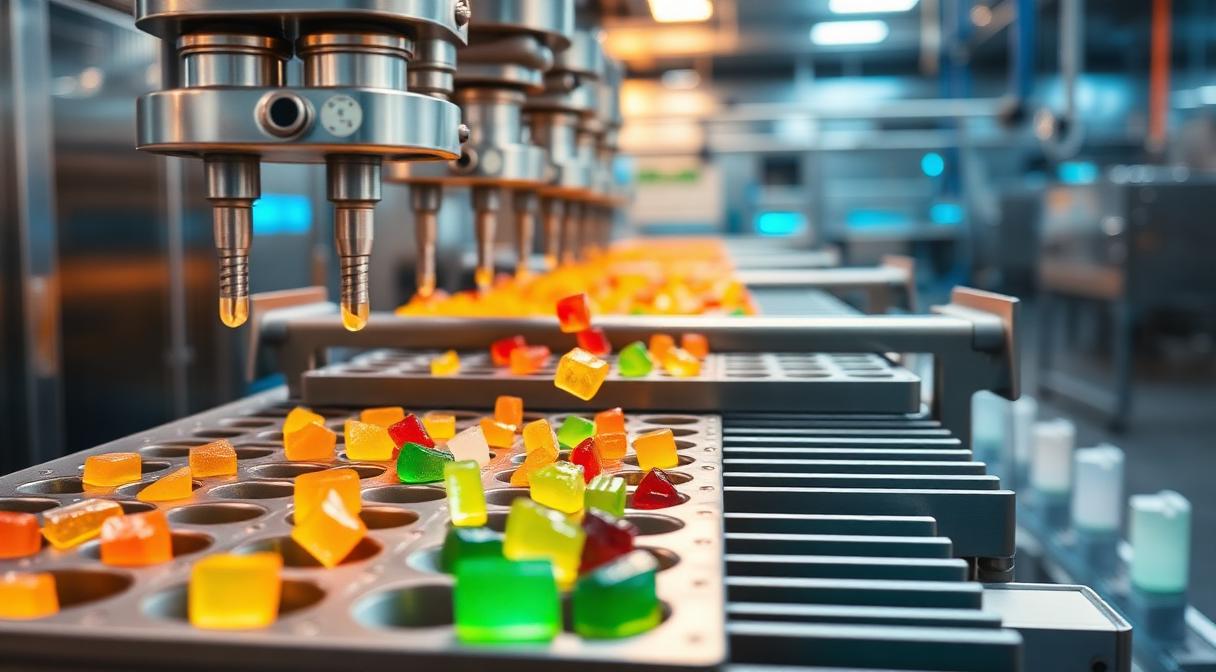 High-speed confectionery depositing lines in 2026 are optimized for the pseudoplastic flow behavior of Guar Gum and agar systems, enabling efficient production of vegan gummies at scale.
Processing Mechanics: Depositing and Extrusion Efficiency
Transitioning from gelatin to an agar and Guar Gum system requires specific adjustments to the manufacturing and cooking process. Modern 2026 confectionery facilities rely heavily on high-speed starch mogul systems or starchless depositing lines to mass-produce gummy candies. The rheological behavior of the hydrocolloid system has a direct and significant impact on production efficiency, yield, and waste.
- Viscosity Management at High Temperature: Agar solutions cooked at high sugar concentrations (typically 75–80° Brix) exhibit a pronounced increase in viscosity as they cool toward the setting temperature. Guar Gum, when incorporated into the hot mass, contributes an additional layer of pseudoplastic viscosity. This combined rheological profile must be carefully managed so that the candy mass flows cleanly through the depositing nozzle while remaining sufficiently viscous to hold its deposited shape before setting.
- Optimal Hydrocolloid Ratios: Industry studies indicate that an effective starting baseline for a vegan gummy utilizes approximately 1.5% to 2.5% agar-agar by total formulation weight, serving as the primary structural backbone. To this, 0.2% to 0.6% of finely milled, high-viscosity Guar Gum is added. This ratio provides enough galactomannan to successfully plasticize the agar helices without overwhelming the structural integrity of the gel. Too little Guar Gum results in an unpleasantly hard, brittle product; too much results in a gummy that is overly soft, pasty, or difficult to demold.
- Acidulation and pH Tolerance: Gummy candies require the addition of citric acid or malic acid to provide tartness, lowering the pH to a range of 3.2 to 3.8. Both agar and Guar Gum demonstrate excellent stability in these acidic environments. However, acid must be added at the lowest practical temperature (typically just before depositing) to prevent premature hydrolysis of the agar network.
- Mold Release and Demolding: The pseudoplastic nature of Guar Gum facilitates smooth, accurate extrusion through high-speed depositing nozzles, actively preventing product tailing and ensuring perfectly formed candies. The dimensional stability of the agar gel ensures rapid setting and clean demolding from starch trays.
For manufacturers seeking Superior quality hydrocolloids for their vegan confectionery lines, the functional grade and particle size of Guar Gum are critical specification parameters. A fully hydrated, finely milled, high-viscosity Guar Gum ensures consistent batch-to-batch performance and prevents undissolved particles that could cause textural defects in the final product. Learn more about how Guar Gum compares to other hydrocolloids in confectionery applications.
Key Takeaways
- Synergistic System Required: Neither agar-agar nor Guar Gum alone can replicate the full sensory profile of gelatin in gummy confectionery; the binary system leverages the structural strength of agar and the plasticizing, water-binding power of Guar Gum to achieve a Superior texture.
- Optimal Starting Ratios: Industry studies support a formulation baseline of 1.5–2.5% agar-agar and 0.2–0.6% Guar Gum by total weight, adjusted based on target texture, sugar content, and processing parameters.
- Thermal Stability Advantage: Agar gels are structurally stable well above 80°C, eliminating the cold-chain dependency of gelatin and enabling cost-effective distribution to hot-climate markets including the Middle East, South Asia, and Latin America.
- Syneresis Control: Guar Gum's exceptional water-binding capacity locks free moisture inside the candy's aqueous phase, preventing the agar network from contracting and weeping water over time, ensuring vastly extended shelf life.
- Optimized Manufacturing Efficiency: The shear-thinning properties of Guar Gum facilitate smooth, accurate extrusion through high-speed depositing nozzles, preventing product tailing and ensuring perfectly formed candies at industrial scale.
- Clean-Label and Regulatory Compliance: Utilizing Guar Gum provides manufacturers with a 100% natural, plant-derived ingredient that aligns with 2026 consumer demands for vegan, halal, and clean-label dietary profiles recognized by EFSA and FAO.
Frequently Asked Questions
Why can't agar-agar be used alone for vegan gummy candies?
Agar-agar alone forms an incredibly strong but rigid gel. Without a plasticizer such as Guar Gum, the resulting candy will have a firm, brittle texture that shatters when chewed — entirely lacking the soft, bouncy, and cohesive pull characteristic of traditional gelatin-based gummies. Guar Gum is the critical ingredient that transforms agar's brittle gel into a pliable, consumer-acceptable confectionery texture.
What is the main advantage of the agar and Guar Gum system over gelatin for hot-climate distribution?
Gelatin gummies begin to soften and melt at temperatures above 30–35°C, requiring refrigerated logistics in tropical or desert environments. Agar gels remain dimensionally stable at temperatures exceeding 80°C, and Guar Gum continuously binds free water even at elevated ambient temperatures. This combined thermal stability removes the dependency on an unbroken cold chain, dramatically reducing distribution costs and product loss for manufacturers exporting to the Middle East, Southeast Asia, and Latin America.
Are agar-agar and Guar Gum considered clean-label ingredients?
Yes. Both agar-agar and Guar Gum are 100% plant-derived polysaccharides with extensive safety dossiers. Guar Gum (E412) is approved by EFSA and is recognized as Generally Recognized As Safe (GRAS) by the FAO and USDA. Agar-agar (E406) carries equivalent approvals across global regulatory bodies. Both ingredients align fully with 2026 consumer demand for natural, clean-label, vegan, and halal-certified food products.
How does Guar Gum concentration affect the final gummy texture?
Guar Gum concentration is the primary lever for fine-tuning the textural profile of the vegan gummy. At the lower end of the recommended range (0.2%), the effect is subtle — reducing brittleness and improving moisture retention. At the upper range (0.6%), the plasticizing effect is pronounced, delivering a noticeably softer, more cohesive, and more elastic bite. Formulators are advised to benchmark Guar Gum concentration against a target texture profile using oscillatory rheometry and trained sensory panels before committing to large-scale production.
To develop vegan gummy confectionery formulations with consistent, Superior performance, the quality and functional specifications of your hydrocolloid inputs are paramount. Contact B D Guar Pvt. Ltd. to request technical data sheets, viscosity-certified samples, and expert formulation support for agar-Guar Gum gummy systems. Explore our full hydrocolloid product range to find the right grade for your application.