Retort-Stable Gelling: Guar Gum and Cassia Gum in Food Formulations
Pairing cold-soluble Guar Gum with heat-activated cassia gum builds a retort-stable gel that prevents oil separation and syneresis through 121°C sterilization.
Last updated:

In the 2026 global food processing sector, retort-stable gelling has become a defining strategy for shelf-stable meals, canned gravies, and wet pet foods. As clean-label convenience demand expands, retort processing managers must prevent phase separation during thermal sterilization at 121°C while maintaining precise cold-fill viscosity. Pairing cold-soluble Guar Gum with heat-activated cassia gum builds a Superior dual-action hydrocolloid system that holds structure, blocks oil separation, and guarantees post-sterilization quality across an extended commercial shelf life.
Research Overview
Retort food processing subjects packaged foods such as canned meats, gravies, soups, and wet pet foods to intense thermal sterilization between 121°C and 130°C under pressure, eliminating heat-resistant spores including Clostridium botulinum without synthetic preservatives. The extreme heat and shear challenge food emulsions: native starch matrices frequently undergo thermal degradation, causing viscosity loss, syneresis, and oil separation on cooling. To solve these defects, formulation scientists deploy specialized galactomannans in a synergistic Guar Gum and cassia gum system.
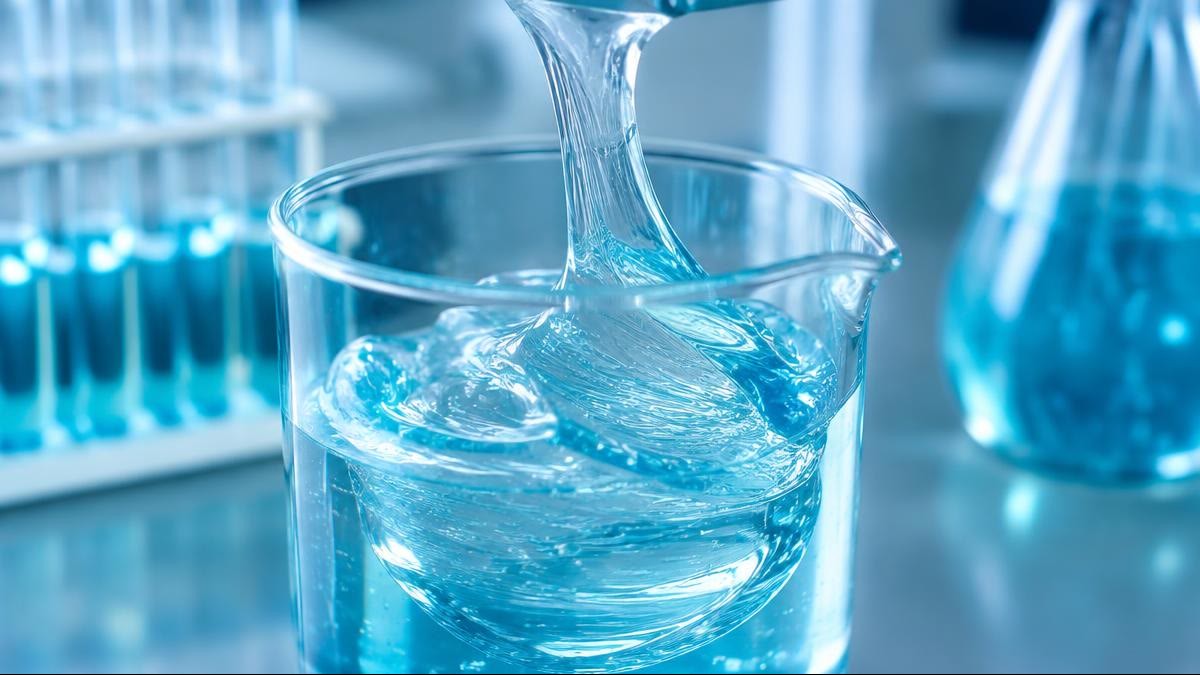 A Guar Gum and cassia gum blend maintains gel integrity through 121°C retort sterilization.
The Galactomannan Chemistry Behind the Synergy
Guar Gum, derived from Cyamopsis tetragonoloba seeds, is a high-molecular-weight polysaccharide built on a linear beta-1,4-linked D-mannopyranose backbone with alpha-1,6-linked D-galactose side branches in a 2:1 mannose-to-galactose ratio. This dense galactose substitution lets it hydrate rapidly in cold water, establishing immediate operational viscosity during batch mixing. Cassia gum, extracted from Cassia tora or Cassia obtusifolia, carries a sparser galactose substitution with a mannose-to-galactose ratio near 5:1, rendering it insoluble in cold water and requiring thermal energy above 80°C to unfold its linear mannan backbone.
According to industry studies and reports from IMARC and FAO, combining these two galactomannans produces a powerful synergistic network:
- During cold batch preparation, Guar Gum provides the yield stress needed to keep solids suspended and prevent splashing on high-speed lines.
- As filled containers reach 121°C, thermal energy solubilizes the cassia gum.
- On cooling post-sterilization, the unsubstituted mannan regions of cassia gum cross-link with Guar Gum chains, forming a thermally stable, elastic gel matrix that traps free moisture and emulsified lipids.
This mechanism underpins the full range of food-grade grades in the B.D. Guar product portfolio, engineered for high-temperature process stability.
Cold-Water Mixing Viscosity and High-Speed Line Mechanics
The initial stage of retort manufacturing requires precise rheological control before entering the sterilization chamber. Because native Guar Gum hydrates rapidly in cold water, it instantly builds high zero-shear viscosity that governs line performance.
- Particulate suspension: In canned stews, pet foods, and sauce-rich entrees, vegetables and meat chunks must stay uniformly suspended. As documented in Carbohydrate Polymers, a 1% aqueous dispersion of Guar Gum generates viscosities between 3,000 and 5,000 cP, delivering the yield stress that prevents heavy particulates from settling during batch holding.
- Shear-thinning flow: Cold Guar Gum solutions display pseudoplastic flow. Under pumping shear, entangled galactomannan chains align in the flow direction, reducing fluid friction so thick sauces transfer smoothly through factory piping.
- Splashing elimination: The body provided by cold-hydrated Guar Gum eliminates splashing during dosing, keeping package sealing surfaces clean and securing airtight container seals.
- Convective heat transfer: As temperatures approach 100°C inside the autoclave, Guar Gum viscosity temporarily thins, enhancing convective heat transfer to the cold spot and reducing required thermal exposure times.
Heat-Activated Synergistic Gelling at 121°C
The core functional transformation occurs when the Guar Gum and cassia gum combination undergoes thermal sterilization at 121°C under pressure. Cassia gum's 5:1 structure features extensive unsubstituted linear mannan regions that associate via hydrogen bonding at room temperature, keeping the polymer insoluble. When thermal energy exceeds 80°C to 100°C, these hydrogen bonds break, allowing water to fully hydrate the cassia backbone.
- Macromolecular cross-linking: As retorted containers cool below 60°C, the long mannan segments of cassia gum associate with the galactomannan backbone of Guar Gum. Research in Carbohydrate Polymers and J. Food Sci. shows this physical association forms a 3D junction-zone network, transitioning liquid sauce into a firm, elastic gel.
- Thermal breakdown resistance: Formulations relying solely on native starch or pure Guar Gum often suffer permanent viscosity loss under prolonged 121°C exposure. The binary blend instead uses retorting heat as an activation trigger, forming a heat-activated gel that resists structural breakdown.
- Dosing ratio control: A Guar Gum to cassia gum ratio from 1:1 to 3:1 yields a flexible sauce gel ideal for gravies, whereas higher cassia gum proportions produce a firmer loaf structure for pet foods. Inclusion levels range between 0.2% and 0.8% by weight for high cost efficiency.
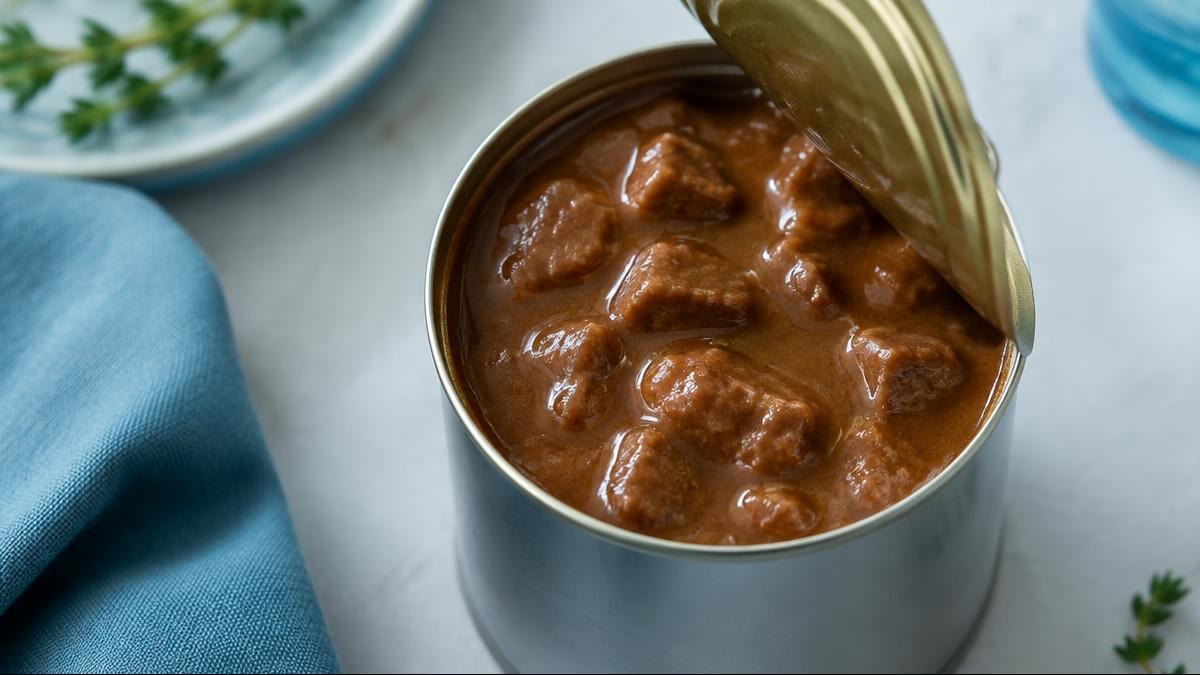 The galactomannan gel network prevents oil pooling and water weeping in high-fat retorted gravies.
Emulsion Preservation: Preventing Oil Separation and Syneresis
The primary quality benchmark for retorted sauces and gravies is preventing free oil pooling and water weeping across commercial shelf life. The Guar Gum and cassia gum matrix addresses both failure modes simultaneously.
- Emulsion stabilization: As fat melts at retort temperatures, un-stabilized oil droplets merge into large globules. The galactomannan gel increases continuous-phase viscosity and creates a steric barrier around lipid droplets, permanently preventing oil pooling.
- Syneresis suppression: Free hydroxyl groups along both polymers form extensive hydrogen bonds with water. Upon cooling post-retort, moisture is bound within the polymer mesh, completely inhibiting the gel contraction that squeezes out water.
- Gloss and clarity: Where synthetic thickeners impart a cloudy, pasty mouthfeel, the galactomannan network cures into a clear, glossy gel that thins smoothly during eating for clean flavor release.
- Particulate suspension: The elastic matrix holds discrete food pieces in stable three-dimensional suspension during static storage.
2026 Clean-Label Compliance and Regulatory Standards
In the 2026 commercial landscape, ingredient selection is governed by international food-safety regulations and consumer demand for transparent labeling. Both Guar Gum and cassia gum are 100% natural, plant-derived polysaccharides obtained through mechanical processing of legume seeds, satisfying clean-label requirements.
- Global regulatory acceptance: Under CODEX Alimentarius specifications, Guar Gum is designated INS 412 (E412 in the European Union), while refined cassia gum is codified INS 427 (E427). Both are approved food additives under parameters set by the FAO, EFSA, and US FDA.
- Low-anthraquinone refined standards: EFSA requires food-grade cassia gum to be purified so anthraquinone impurities remain below strict thresholds. Sourcing fully refined, Superior-grade cassia gum alongside high-purity food-grade Guar Gum guarantees compliance with European and North American import regulations.
- Cost efficiency: Where locust bean gum and high-acyl gellan gum face supply volatility and elevated costs in 2026, the synergistic blend delivers Superior gel strength at a fraction of the raw-material cost.
Every shipment is backed by documented purity data; see the B.D. Guar quality and testing standards and the company's sustainable sourcing practices for full traceability.
Key Takeaways
- Functional synergy: Blending Guar Gum and cassia gum combines rapid cold-water solubility with heat-activated gelling, creating a dual-action hydrocolloid system purpose-built for retort processing.
- Line efficiency: Cold-hydrated Guar Gum provides immediate viscosity during batch mixing, suspending solids, preventing splashing on high-speed lines, and securing clean seals.
- Heat-activated network: Retort processing at 121°C solubilizes cassia gum, whose mannan chains cross-link with Guar Gum on cooling to form a firm, heat-stable gel.
- Phase stability: The dense galactomannan gel traps free water and stabilizes lipid droplets, preventing syneresis and surface oil separation throughout shelf life.
- Clean-label compliant: Both botanicals are recognized under CODEX (INS 412 / INS 427) and EFSA standards, offering a Superior alternative to costlier hydrocolloids.
Frequently Asked Questions
Why is Guar Gum alone insufficient for retorted canned foods that require a firm gel?
Guar Gum is an exceptional cold-water thickener that builds viscosity during mixing, but it is a non-gelling galactomannan on its own. Under retort sterilization at 121°C, pure Guar Gum solutions thin out and do not set into a rigid gel on cooling. Combining it with cassia gum introduces heat-activated cross-linking that transforms the fluid into a firm gel post-sterilization.
How do cassia gum and Guar Gum interact at a molecular level?
Cassia gum has a sparser galactose substitution along its mannan backbone (about 5:1) than Guar Gum (about 2:1). Its unsubstituted mannan regions are insoluble in cold water. When heated to 121°C during retorting, cassia gum fully dissolves; as the product cools, those bare mannan segments align and bind with Guar Gum chains via hydrogen bonding, forming a strong three-dimensional gel matrix.
At what ratio should Guar Gum and cassia gum be blended for optimal retort performance?
The ratio depends on desired texture. For pourable gravies and sauces, a Guar Gum to cassia gum blend between 1:1 and 3:1 at a total dosage of 0.2% to 0.5% is recommended. For firm, cuttable loaf-style wet pet foods, a higher cassia gum proportion (such as 1:2 or 1:3) at 0.5% to 0.8% provides maximum gel strength.
Are Guar Gum and cassia gum approved for clean-label international exports?
Yes. Both are natural, plant-based ingredients extracted from agricultural seeds and carry approvals under CODEX Alimentarius (INS 412 and INS 427) and European Union standards (E412 and E427). Sourcing Superior-grade material ensures compliance with EFSA and US FDA purity criteria. Compare hydrocolloid options in the Guar Gum glossary.
To master retort rheology, eliminate oil separation, and achieve Superior, cost-effective texture in 2026 food formulations, partner with a global hydrocolloid specialist. B.D. Guar Pvt. Ltd. supplies food-grade Guar Gum and refined cassia derivatives engineered for high-temperature stability, rapid hydration, and clean-label compliance. Contact the technical support and sales team to request samples, review application protocols, and optimize your commercial formulation.