Managing Syneresis in Gels: How Guar Gum Stabilizes Agar & Carrageenan
Discover how Guar Gum and locust bean gum prevent syneresis in agar and carrageenan gels, locking in moisture across panna cottas, jams, custards and 2026-compliant formulations.
Last updated:
Quick Answer
How does Guar Gum prevent syneresis in agar and carrageenan gels?
Adding 0.1%–0.2% Guar Gum or locust bean gum to an agar or κ-carrageenan system inserts flexible galactomannan chains between the rigid helical junction zones. These chains act as physical spacers, halt over-contraction of the gel network, and immobilise free water through cis-hydroxyl hydrogen bonding — eliminating weeping in custards, jams, panna cotta and plant-based desserts throughout refrigerated shelf life.
For pastry chefs and food manufacturers, achieving the perfect gel is an art form. Whether formulating a delicate panna cotta, a fruit-rich jam, or a creamy custard, the visual appeal and mouthfeel of the product are paramount. However, these gelled desserts frequently fall victim to a common structural defect: syneresis. Understanding the chemistry behind syneresis — and how to prevent it using natural hydrocolloids like Guar Gum or locust bean gum (LBG) — is essential for maintaining moisture stability and visual integrity during refrigerated storage.
Research Overview
This article unpacks the molecular mechanism that causes agar and κ-carrageenan gels to weep, then explains how the addition of galactomannans such as Guar Gum and LBG reinforces the gel network at use levels as low as 0.1%–0.2%. We close with practical dosing guidance for culinary and industrial food formulators, framed against the 2026 regulatory and supply-chain landscape that is reshaping hydrocolloid sourcing across the EU, North America and Asia-Pacific.
The Science of Syneresis: Why Gels Weep
To understand why a gel leaks water, we must first look at how it forms. Gels are viscoelastic structures created when polymeric molecules cross-link to form "junction zones," building a three-dimensional network that traps liquid within its matrix. Gelling agents like agar-agar and κ-carrageenan are highly popular in the culinary world because they form firm, structured gels with clean release and bite.
However, the rigid networks formed by these specific polysaccharides are highly prone to structural instability over time. If the junction zones between the polymer chains continue to expand or grow slowly as the product sits in cold storage, the overall gel structure actively contracts. As the rigid network pulls tighter together, it physically squeezes out the water that was previously bonded within the matrix. This creeping separation of liquid from the gel is what the industry refers to as syneresis — visible as a watery film on top of a custard or a puddle inside a fruit-pectin jam jar.
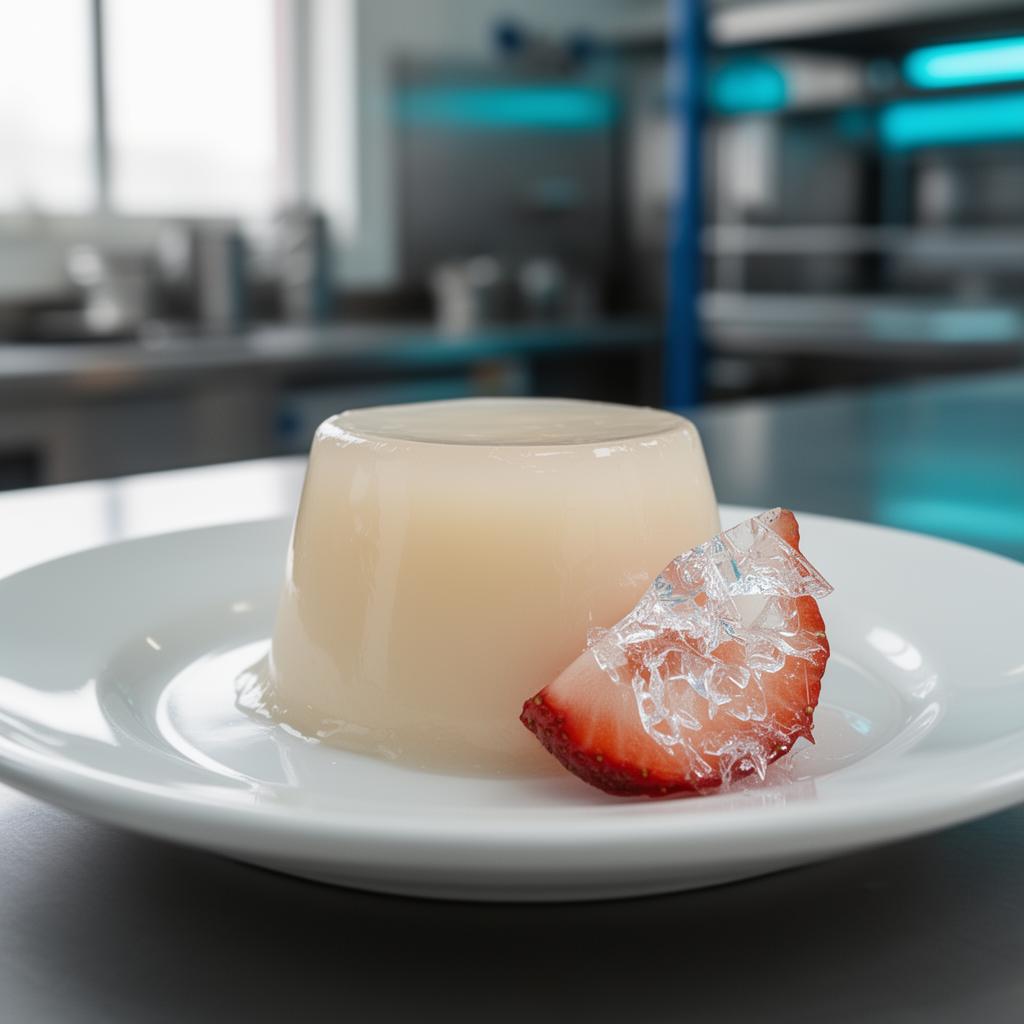
A Guar Gum stabilised dessert gel retains its glossy surface with no weeping after refrigerated storage.
The Solution: Galactomannans as Network Stabilizers
To prevent this continuous contraction, formulators introduce non-gelling thickeners into the recipe — most notably, galactomannans like Guar Gum and locust bean gum. While agar and carrageenan form rigid helical structures, Guar Gum and LBG consist of a linear mannan backbone with galactose side branches. When added to a gelling system, these gums perform a critical structural intervention:
- Network Reinforcement: The long, bare regions of the galactomannan backbone physically interact with the helical structures of agar and κ-carrageenan, weaving the network into a single cohesive matrix.
- The "Spacer" Effect: These flexible molecules slot in between the gelling helices and prevent the primary polymers from packing too tightly together, halting the over-contraction of the junction zones that causes weeping.
- Trapping the Moisture: Galactomannans have an exceptionally high affinity for water through their cis-hydroxyl groups, immobilising the aqueous phase firmly within the unorganised portions of the gel structure.
- Texture Preservation: Because the dose is so low, the gel retains the clean bite of agar or the elastic snap of κ-carrageenan without becoming gummy or pasty.
This synergy explains why almost every commercial fruit-prep, dessert gel and plant-based panna cotta on the 2026 market lists Guar Gum or LBG alongside its primary gelling agent on the ingredient panel. For a side-by-side comparison of these hydrocolloids and their performance characteristics, see our Guar Gum vs Xanthan Gum resource and the broader Compare Guar Gum Grades tool.
Application Guidelines for Culinary Professionals
To achieve a stable, weep-free product without altering the intended texture of the dish, precise dosing is required. Standard culinary practice dictates that adding a very small concentration — typically 0.1% to 0.2% of Guar Gum or LBG on total batch weight — is sufficient to stabilise the gel network. Industry studies indicate that Guar Gum is highly effective at preventing syneresis and managing moisture even when used at concentrations of 1% or less, making it one of the most cost-efficient stabilisers available to formulators.
Because Guar Gum hydrates rapidly in cold water, it is incredibly versatile and easy to incorporate into both hot and cold culinary processes. Best practice is to dry-blend the Guar Gum with sugar or another carrier before dispersing it into the liquid phase, which prevents lumping and ensures uniform hydration before the agar or carrageenan is brought up to its activation temperature.
Suggested Use Levels by Application
- Panna cotta & flan: 0.10%–0.15% Guar Gum with 0.4% agar
- Fruit jams & preserves: 0.15%–0.20% Guar Gum with pectin or κ-carrageenan
- Custards & pastry creams: 0.10% Guar Gum to lock in moisture during refrigeration
- Plant-based desserts: 0.15%–0.20% Guar Gum with κ-carrageenan to mimic dairy mouthfeel
- Fruit preps for yogurt: 0.10%–0.15% Guar Gum as a co-stabiliser with locust bean gum
2026 Outlook: Clean Label, Tariffs and Supply-Chain Resilience
The 2026 global hydrocolloid landscape is being reshaped by three converging forces: ETO-free regulations in the EU and Asia, reciprocal tariffs on imported gums from non-Indian origins, and consumer demand for short, recognisable ingredient lists. Guar Gum — an E412-approved, non-GMO, plant-derived galactomannan with deep traceability back to Rajasthan and Gujarat farms — fits all three trends simultaneously. Manufacturers reformulating to eliminate modified starches or animal gelatin are increasingly pairing agar or κ-carrageenan with Guar Gum to deliver the same syneresis-free performance with cleaner labelling and lower landed cost.
For procurement teams reviewing 2026 supply contracts, India's position as the source of more than 80% of global Guar Gum production offers tariff insulation and shorter, more transparent supply chains compared to alternative gum sources. Explore our product catalogue for food-grade specifications, or visit the technical glossary for definitions of every term referenced in this article.
Key Takeaways
- Syneresis is caused by junction-zone contraction in rigid agar and κ-carrageenan networks during cold storage.
- Guar Gum and LBG act as physical spacers, weaving between gelling helices and preventing over-tightening of the matrix.
- 0.1%–0.2% dosing is typically sufficient to eliminate weeping without altering the intended bite of the gel.
- Cis-hydroxyl groups on the mannan backbone immobilise free water and lock in moisture throughout shelf life.
- The 2026 clean-label, tariff and ETO-free environment favours Guar Gum as the stabiliser of choice for dessert and fruit-prep manufacturers.
Frequently Asked Questions
What exactly is syneresis in a food gel?
Syneresis is the gradual expulsion of water from a set gel as its three-dimensional polymer network contracts over time. It appears as a watery film on the surface of custards, a puddle inside a jam jar, or beads of liquid weeping from a slice of panna cotta — and it is one of the most common quality complaints in refrigerated dessert manufacturing.
Why are agar and κ-carrageenan particularly prone to syneresis?
Both agar and κ-carrageenan form gels through rigid double-helix junction zones that continue to aggregate and tighten after the initial set. As these zones grow, the network physically compresses, squeezing free water out of the matrix. The same rigidity that gives these gums their crisp bite also makes them structurally unstable without a co-stabiliser.
How much Guar Gum should I add to stop syneresis?
For most dessert applications, a use level of 0.1% to 0.2% Guar Gum on total batch weight is sufficient. Higher concentrations are unnecessary and can introduce a slightly gummy mouthfeel. Always dry-blend the Guar Gum with sugar or another dispersant before adding it to the liquid phase to prevent lumping.
Can locust bean gum (LBG) be used instead of Guar Gum?
Yes. LBG works through the same spacer mechanism and is in fact slightly more synergistic with κ-carrageenan because of its lower galactose substitution ratio. However, Guar Gum hydrates fully in cold water while LBG requires heating above 80°C, making Guar Gum the more practical and cost-efficient choice for most cold-set and ambient formulations in 2026.
Does Guar Gum affect the clarity or flavour of a gel?
At 0.1%–0.2% use levels, Guar Gum has negligible impact on flavour and only a very slight effect on optical clarity. It is tasteless, odourless, and contributes no calories. For applications requiring crystal-clear gels — such as fruit jellies or aspics — pair it with a refined food-grade Guar Gum and ensure full hydration before the gel sets.
Is Guar Gum compatible with 2026 clean-label and ETO-free requirements?
Absolutely. Guar Gum is a single-ingredient, plant-derived galactomannan (E412), non-GMO, allergen-free, and produced without ethylene oxide treatment when sourced from compliant Indian manufacturers. It satisfies EU, FSSAI, FDA, Halal, Kosher and Organic certifications — making it one of the most regulation-resilient stabilisers heading into the 2026 reformulation cycle.
Need help selecting the right food-grade Guar Gum for your dessert, jam or plant-based application? Contact our technical team for samples, specification sheets and formulation support tailored to your 2026 product pipeline.