Hydrocolloids in Plant-Based Dairy: Replicating the Mouthfeel of Milk
How Guar Gum and Locust Bean Gum close the textural gap in vegan milks, yogurts and ambient dessert cups across 2026 plant-based dairy markets.
Last updated:
Quick Answer
How do hydrocolloids replicate the mouthfeel of dairy milk in plant-based products?
Hydrocolloids such as Guar Gum and Locust Bean Gum (LBG) form hydrated polymer networks that thicken the aqueous phase, coat the oral cavity and mimic the lubricating impression of milk fat. They also suspend insoluble plant proteins, prevent syneresis in vegan yogurts and — through synergistic junction zones with xanthan or carrageenan — build the firm, heat-stable gels required for ambient dessert cups in 2026 plant-based dairy markets.
As plant-based diets continue to expand on health, ethical and environmental grounds, formulators of vegan dairy alternatives face one persistent obstacle: the textural gap between bovine milk and plant-protein systems. Oat, almond, soy and pea proteins simply do not deliver the lubricating creaminess of milk fat. In the 2026 landscape — shaped by ETO-free regulations, reciprocal tariffs on imported stabiliser blends and intense supply-chain repositioning toward Indian-origin hydrocolloids — Guar Gum and Locust Bean Gum have become non-negotiable tools for closing that gap.
Research Overview
This article examines how natural galactomannan hydrocolloids replicate the sensory profile of dairy in plant-based milks, yogurts, creamers and ambient dessert cups. It covers the rheological mechanisms behind fat mimicry, the stabilisation chemistry that prevents protein sedimentation and syneresis, and the synergistic gel networks that allow LBG to deliver heat-stable dessert structures suited to non-refrigerated distribution across emerging markets in India and Southeast Asia.
Simulating the Creaminess of Milk Fat
At a molecular level, hydrocolloids form intertwined three-dimensional networks that thicken the aqueous medium of a plant-based beverage, modifying its overall rheology to create a pleasant, rich mouthfeel. Because galactomannans carry a high density of hydroxyl groups, they have an exceptional affinity for water — binding moisture tightly and dramatically increasing the viscosity of the continuous phase.
This viscosity increase is what allows Guar Gum and Locust Bean Gum to mimic an oil or fat impression in the mouth. The hydrated polymer coats the tongue and palate, slows clearance from the oral cavity, and reproduces the lubricating, creamy sensation that consumers associate with bovine milk fat. In Superior fast-hydrating Guar Gum grades the effect is achieved at inclusion rates as low as 0.1–0.3%, making it one of the most cost-effective texturisers available to plant-based dairy formulators.
- Viscosity build: Guar Gum delivers 5,000+ cps at 1% concentration in cold water.
- Mouth-coating: Galactomannan films simulate the lubricating glide of milk fat.
- Clean label: Both gums are E-numbered (E412, E410), vegan, gluten-free and non-GMO.
- Synergy: Combined Guar + LBG + xanthan systems out-perform single-gum solutions.
Preventing Sedimentation and Syneresis
Plant-based milks are complex suspensions in which insoluble protein particles, fibre fragments and added micronutrients tend to settle at the bottom of the carton. Hydrocolloids correct this by raising the viscosity of the continuous phase to a threshold at which gravitational settling is suppressed and the emulsion no longer separates into distinct phases over shelf life.
In semi-solid applications — vegan yogurts, soft cheeses, cream-cheese alternatives and plant-based dessert spreads — hydrocolloids act as vital stabilisers against syneresis, the spontaneous expulsion of water from a gel. By locking free water into the polymer matrix, Guar Gum and LBG preserve a smooth, resilient body and uniform texture from production through to the consumer's spoon. Buyers comparing viscosity grades for these systems can review the technical specifications in our Guar Gum grade comparison.
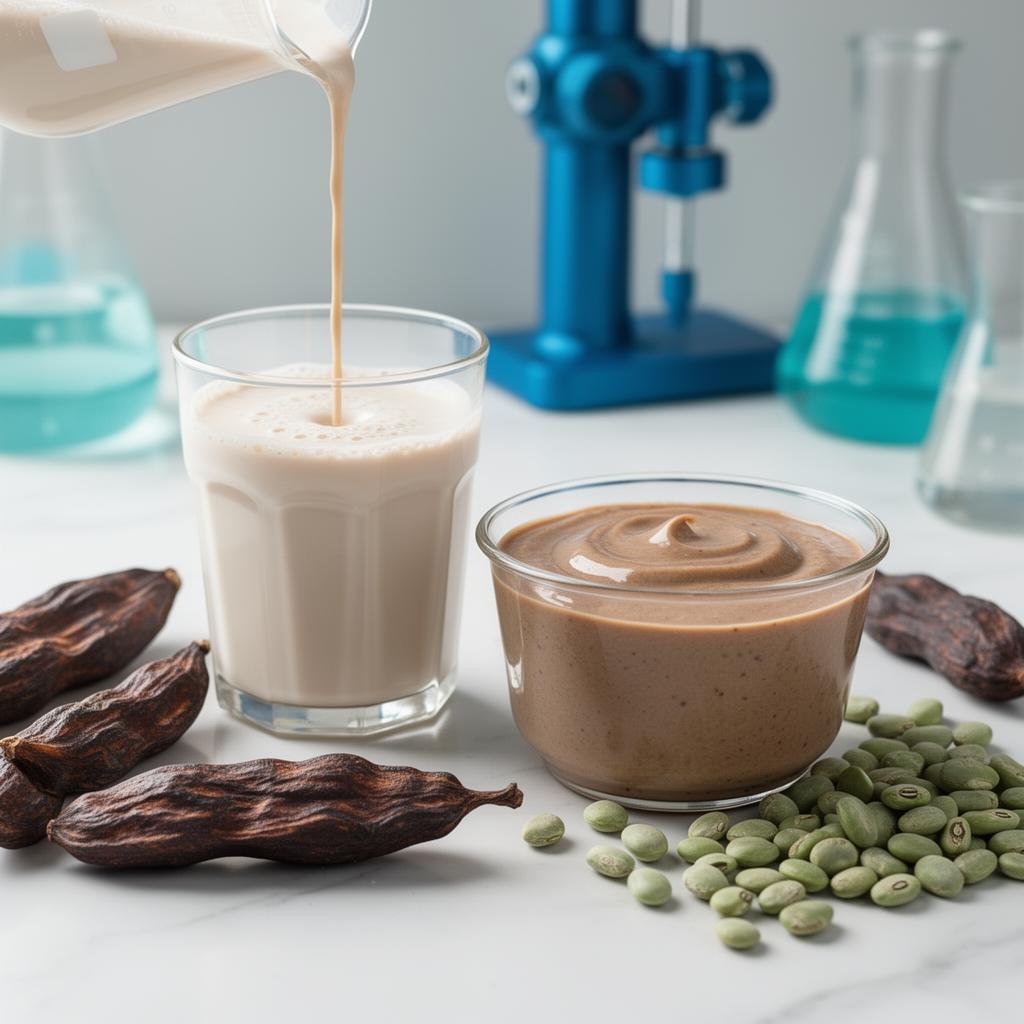
Guar Gum and Locust Bean Gum work together to deliver dairy-like creaminess, suspension stability and resilient gel structure in plant-based formulations.
Locust Bean Gum and the Rise of Stable Dessert Gels
Locust Bean Gum (LBG), extracted from the seeds of the Mediterranean carob tree (Ceratonia siliqua), plays a specialised role in Superior plant-based dessert formulations. Its unique molecular architecture makes it the hydrocolloid of choice for stable dessert cups — including ambient products distributed without cold chain in warm-climate markets.
Unlike Guar Gum, which hydrates rapidly in cold water, fine-grade LBG only partially dissolves at room temperature. Full hydration and maximum viscosity development require heating to 80°C–90°C. This high-temperature activation aligns perfectly with the pasteurisation or UHT step of dessert-cup manufacture, allowing the gum to deliver its functionality precisely when the thermal process demands it.
The molecule itself carries large "bare" regions on its mannan backbone — stretches without galactose side branches. These exposed zones allow LBG chains to physically interlock with helical regions of xanthan gum or carrageenan, forming durable junction zones. The synergistic interaction transforms a simple thickened fluid into an incredibly firm, three-dimensional gel network. Formulators wanting a deeper dive into these polysaccharide interactions can consult our Technical Glossary of Guar Gum and Hydrocolloid Terms.
Why This Matters for Ambient Dessert Cups
For ambient dessert cups intended for warm-climate or emerging-market distribution, the LBG-stabilised gel network is the entire reason the format is commercially viable. The robust junction zones immobilise the fluid phase, resist heat-shock during transport, and maintain a resilient, milk-like mouthfeel even when the product is stored outside refrigeration for extended shelf life.
- Thermal resilience: Junction zones survive ambient distribution temperatures.
- Texture retention: No collapse, no weeping, no protein settling.
- Clean-label declaration: Both E410 (LBG) and E412 (Guar Gum) are widely accepted.
- Cost efficiency: Synergistic blends reduce total hydrocolloid usage by 20–30%.
The 2026 Regulatory and Supply-Chain Context
Three structural forces are reshaping how plant-based dairy brands source their hydrocolloids in 2026:
- ETO-free compliance: Reinforced EU, FSSAI and CODEX limits on ethylene-oxide residues in stabiliser blends have eliminated several legacy suppliers from approved-vendor lists. Mechanically processed Indian-origin Guar Gum sits comfortably inside these thresholds.
- Reciprocal tariffs: Tariff escalations on imported European LBG-xanthan blends have widened the landed-cost advantage of integrated Indian hydrocolloid programmes that combine Guar Gum with imported LBG fractions.
- Supply-chain repositioning: Global plant-based dairy brands are diversifying away from single-origin stabiliser dependency, with Rajasthan and Gujarat together supplying more than 80% of the world's Guar production. Read more about our integrated approach on the sustainability programme page.
Application Map Across Plant-Based Dairy Categories
Different vegan dairy formats demand different hydrocolloid systems. The matrix below summarises Superior B D Guar recommendations for the most common 2026 product categories:
- Oat & almond milk: Guar Gum 0.05–0.15% + low-acyl gellan for suspension.
- Non-dairy creamers: Guar Gum + carrageenan for body and foam stability.
- Vegan set yogurt: Guar Gum + LBG + pectin for gel firmness and anti-syneresis.
- Plant-based cream cheese: Guar Gum + LBG + xanthan for spreadable, sliceable texture.
- Ambient dessert cups: LBG + xanthan or LBG + carrageenan for heat-stable gel cubes.
- Vegan ice cream: Guar Gum + LBG + carrageenan to control ice-crystal growth.
Procurement teams sourcing complete hydrocolloid systems for these applications can review the full B D Guar product catalogue covering Food-Grade Guar Gum, fenugreek gum, cassia tora gum, tamarind gum and xanthan gum.
Key Takeaways
- Fat mimicry: Hydrocolloids replicate milk-fat creaminess by thickening the aqueous phase and coating the oral cavity.
- Suspension stability: Increased viscosity prevents plant-protein particles from settling in cartons.
- Anti-syneresis: Galactomannan gels lock free water into the matrix and stop weeping in vegan yogurts.
- Synergistic gels: LBG's bare mannan regions form junction zones with xanthan or carrageenan to build firm, heat-stable structures.
- Ambient viability: LBG-stabilised dessert cups retain mouthfeel and structure without cold-chain distribution.
- 2026 sourcing edge: ETO-free, tariff-favourable Indian-origin Guar Gum strengthens plant-based dairy supply chains.
Frequently Asked Questions
Which hydrocolloid is most effective for replicating dairy mouthfeel in plant-based milk?
For cold-processed oat, almond and soy beverages, fast-hydrating Guar Gum is the most effective single hydrocolloid. It builds viscosity rapidly at 0.05–0.15% inclusion and delivers the mouth-coating, lubricating sensation that mimics milk fat. For UHT or pasteurised formats, formulators often combine Guar Gum with a small fraction of Locust Bean Gum to enhance the long-lasting creamy aftertaste.
Why does Locust Bean Gum require heating to function?
Fine-grade LBG features large "bare" mannan regions that are poorly soluble in cold water. Heating to 80°C–90°C is required to fully hydrate the polymer and develop maximum viscosity. This thermal requirement is actually advantageous in plant-based dessert manufacture because hydration coincides with the pasteurisation step, eliminating the need for a separate processing stage.
How do Guar Gum and Locust Bean Gum prevent syneresis in vegan yogurt?
Both gums build a continuous polymer network that physically traps free water inside the gel matrix. By immobilising the aqueous phase, the network resists the contraction and water expulsion that would otherwise occur during storage. In combination with pectin or xanthan, the system delivers a smooth, resilient body with no surface weeping across the full shelf life.
Can ambient (non-refrigerated) plant-based desserts maintain a dairy-like texture?
Yes. By using a synergistic LBG + xanthan or LBG + carrageenan system, formulators can build junction-zone gels that withstand ambient distribution temperatures common in India, Southeast Asia, the Middle East and Africa. The robust three-dimensional network prevents heat-shock collapse and preserves a luxurious, milk-like mouthfeel without requiring a cold chain.
Is Guar Gum compatible with high-protein plant-based formulations?
Yes. Guar Gum is non-ionic and remains stable across the pH range typical of plant-protein systems (pH 4–9). It does not interact destructively with oat, almond, soy or pea proteins, and in fact assists protein dispersion by suspending insoluble particles. Inclusion rates of 0.1–0.3% are typical for high-protein vegan beverages.
How does the 2026 ETO-free regulation affect hydrocolloid sourcing?
Reinforced EU, FSSAI and CODEX limits on ethylene-oxide residues have eliminated several legacy hydrocolloid suppliers from approved-vendor lists. B D Guar's mechanically processed, solvent-free Guar Gum programme is fully ETO-free by design, giving plant-based dairy brands a low-risk, tariff-favourable sourcing option for 2026 contracts.
To discuss custom Guar Gum, Locust Bean Gum or synergistic stabiliser blends for your plant-based dairy line, contact the B D Guar technical team for grade recommendations, samples and 2026 contract pricing.