Guar Gum in Ice Cream: Stabilizer Science and Formulation Guide
Why ice cream manufacturers use Guar Gum — control of ice crystal growth, freeze-thaw stability, overrun, mouthfeel, and the optimal Guar + LBG + carrageenan blend.
Last updated:
Quick Answer
Why is Guar Gum used in ice cream?
Guar Gum is the most cost-effective stabiliser in ice cream because its huge cold-water viscosity controls ice crystal growth, prevents whey separation during storage, slows meltdown on serving and gives the creamy mouthfeel consumers associate with premium frozen dairy. Typical inclusion is 0.1 to 0.25% of the mix, usually combined with a small dose of Locust Bean Gum or carrageenan to balance elasticity and protein binding.
Ice cream is one of the most demanding tests a hydrocolloid can face. The frozen, semi-solid matrix must resist ice crystal coarsening through freezer cycles, retain air cells during storage, deliver a clean meltdown on the spoon and feel smooth on the tongue. Guar Gum has earned its position as the workhorse stabiliser in industrial ice cream production because it solves several of these problems simultaneously, at a cost far below any synthetic alternative. As 2026 dairy brands tighten clean-label specifications, the role of natural galactomannan stabilisers has only grown.
Research Overview
This article covers the physical chemistry of ice cream stabilisation, why Guar Gum controls ice recrystallisation, the synergy with Locust Bean Gum and carrageenan, optimal dosage for industrial and artisan formulations, the impact on overrun and meltdown, and how to specify the right Guar grade for cold-blend or HTST-pasteurised lines.
The Physics of Smooth Ice Cream
Ice cream is essentially a partly frozen foam — a network of ice crystals, fat globules, air cells and unfrozen serum. Smoothness depends on keeping the ice crystals below roughly 50 microns. During storage, especially through retail freezer temperature fluctuations, smaller crystals tend to dissolve and re-deposit on larger crystals, a process called recrystallisation that turns smooth ice cream gritty. Stabilisers like Guar Gum dramatically slow this process by increasing the viscosity of the unfrozen serum phase, restricting water mobility and slowing the diffusion that drives crystal growth.
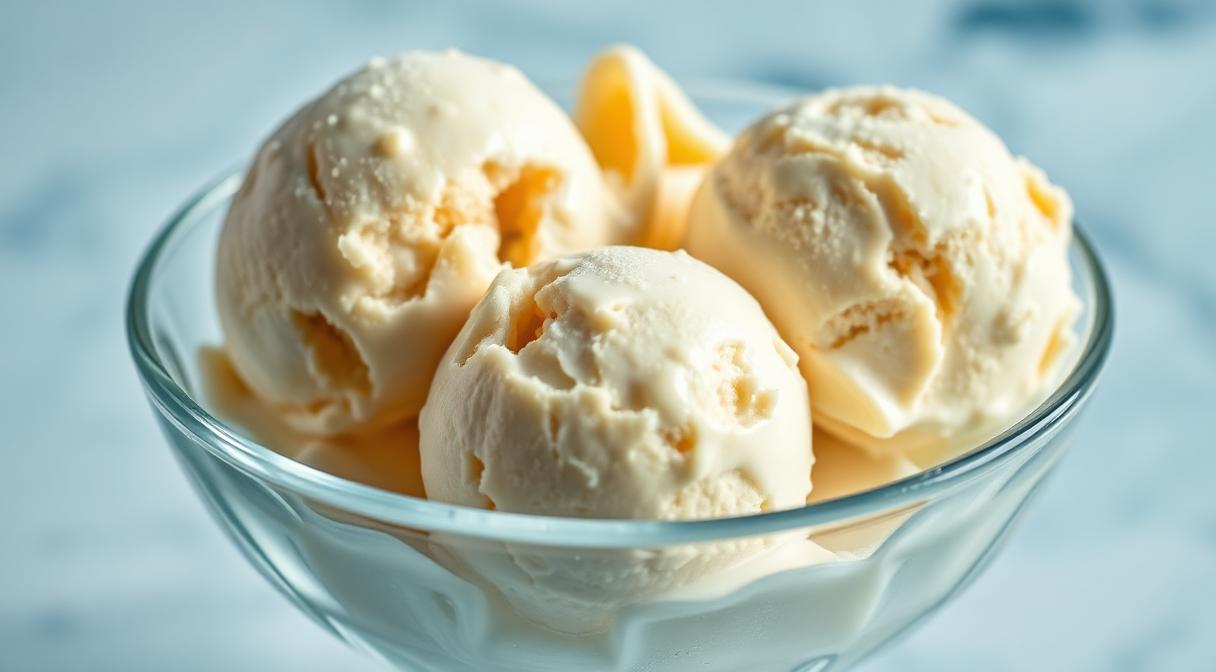 Smooth scoopable texture and clean meltdown are the visible result of correct stabiliser design — Guar Gum is the primary tool used to control ice crystal growth.
Why Guar Specifically
Guar Gum's cold-water solubility, very high molecular weight and pseudoplastic viscosity make it ideally suited to ice cream mix processing. The polymer can be incorporated during cold blending or before HTST pasteurisation and reaches its functional viscosity quickly. Once frozen, the hydrated polymer chains physically slow water migration, hold the serum phase as a thick syrup around the ice crystals and contribute to the creamy mouthfeel by elevating the apparent viscosity at the temperature of consumption. No equivalent natural polymer delivers this combination at the same cost per unit of viscosity.
Synergy with Locust Bean Gum and Carrageenan
A typical premium ice cream stabiliser blend combines Guar Gum, Locust Bean Gum and a small dose of κ-carrageenan. Guar handles the bulk viscosity at low cost. LBG adds elasticity and improves heat-shock resistance by interacting with itself during the freeze cycle. Carrageenan prevents whey separation in the mix by binding to milk casein. Removing any single component changes the texture noticeably. For value formulations, a Guar-only stabiliser at 0.20 to 0.25% gives acceptable smoothness with the lowest ingredient cost, and many emerging-market brands now run pure Guar systems successfully.
Dosage and Process Considerations
Industrial inclusion sits between 0.10 and 0.25% of the total mix weight. Higher doses produce overly chewy or rubbery texture and slow meltdown excessively. Lower doses fail to prevent ice crystal growth. The Guar should be dispersed thoroughly to avoid lumps — either pre-blended with sucrose at 5 to 10 parts sugar per part gum, or added through a high-shear inline mixer. For ageing, the mix should rest for at least four hours at 4 °C to allow full hydration before freezing. Cold-blend operations using fast-hydrating Guar grades can shorten this to one hour without sacrificing crystal control.
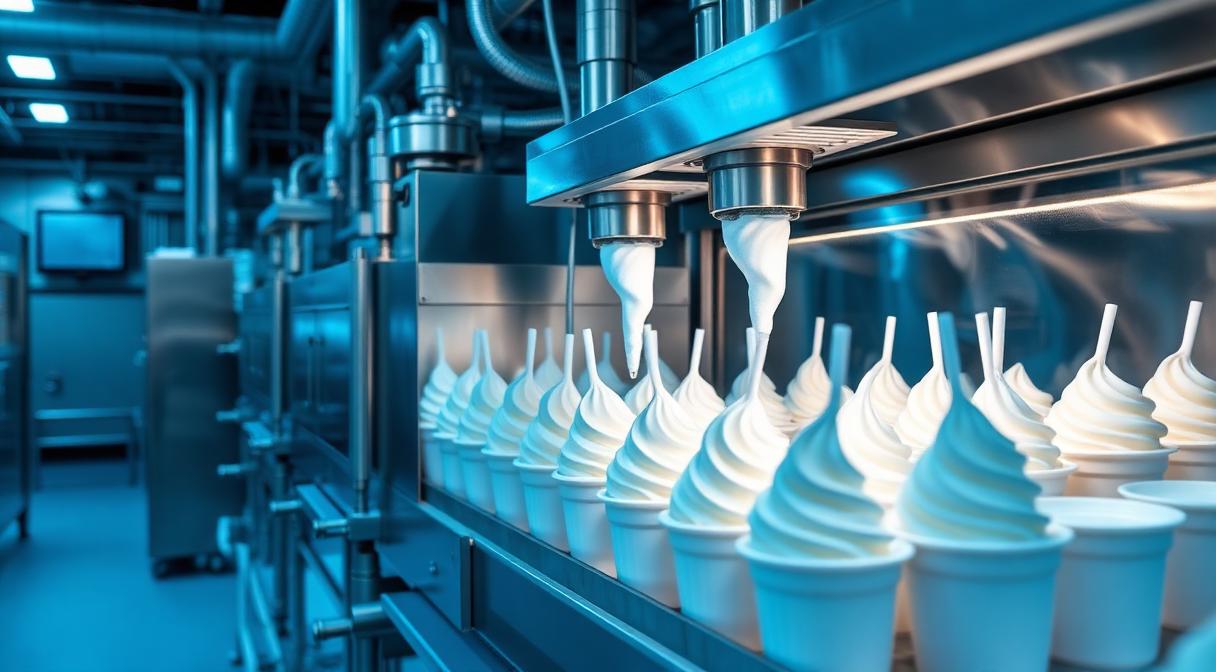 Continuous ice cream freezers depend on consistent batch-to-batch stabiliser performance — Guar Gum's reproducible viscosity is what makes high-volume production possible.
Overrun, Meltdown and Mouthfeel
Stabilisers do not control overrun — that is set by the freezer and the emulsifier — but they preserve it. A Guar-stabilised mix holds whipped air cells longer, both during storage and on the plate. Meltdown rate is slowed because the polymer network reduces the rate at which the unfrozen serum can drain away from the melting ice crystals. The eating experience consumers describe as "creamy" is largely the result of this slow drainage combined with the moderate cold-temperature viscosity contributed by the hydrated Guar.
Plant-Based and Sugar-Reduced Ice Cream
Plant-based frozen desserts based on oat, almond or coconut bases lack the casein-fat structure of dairy ice cream and therefore depend even more heavily on hydrocolloid stabilisation. Guar Gum typically increases to 0.30 to 0.40% in these systems, often combined with a small dose of modified cellulose for additional body. Sugar-reduced and keto formulations face the additional challenge of higher freezing-point depression failure — adding more Guar partially compensates by controlling the larger ice crystals that result from lower sugar content.
Frequently Asked Questions
What is the ideal Guar Gum dosage in ice cream?
Between 0.10 and 0.25% of the total mix is the working range. Premium brands typically run 0.15 to 0.20% in combination with a small percentage of LBG and carrageenan.
Can Guar Gum be used as the only stabiliser?
Yes, particularly in value and emerging-market formulations. The texture is slightly less elastic than a Guar-LBG blend, but ice crystal control and freeze-thaw stability are very good at 0.20 to 0.25% inclusion.
Does Guar Gum affect the flavour of ice cream?
No. At inclusion levels below 0.3%, Guar Gum has no detectable flavour and does not interfere with vanilla, chocolate, fruit or savoury flavour systems.
How does Guar Gum compare to xanthan in ice cream?
Xanthan produces a slightly more rubbery texture and a slower meltdown that consumers can perceive as gummy. Guar Gum gives a cleaner cold-eating mouthfeel and is preferred for traditional dairy ice cream. See the full comparison for details.
Is Guar Gum suitable for organic ice cream?
Yes. Certified organic Guar Gum is widely available, including from B D Guar's traceable rain-fed farms in Rajasthan and Gujarat. See our sustainability programme for sourcing detail.
For application trials, free samples and stabiliser blend recommendations for your ice cream line, contact the B D Guar applications team at /contact.