Hydrocolloids in Ceramic Slurries: Achieving the Perfect Mold
Discover how Guar Gum controls ceramic slip rheology, boosts green strength in unfired bodies, and prevents pigment settling for flawless glaze application.
Last updated:
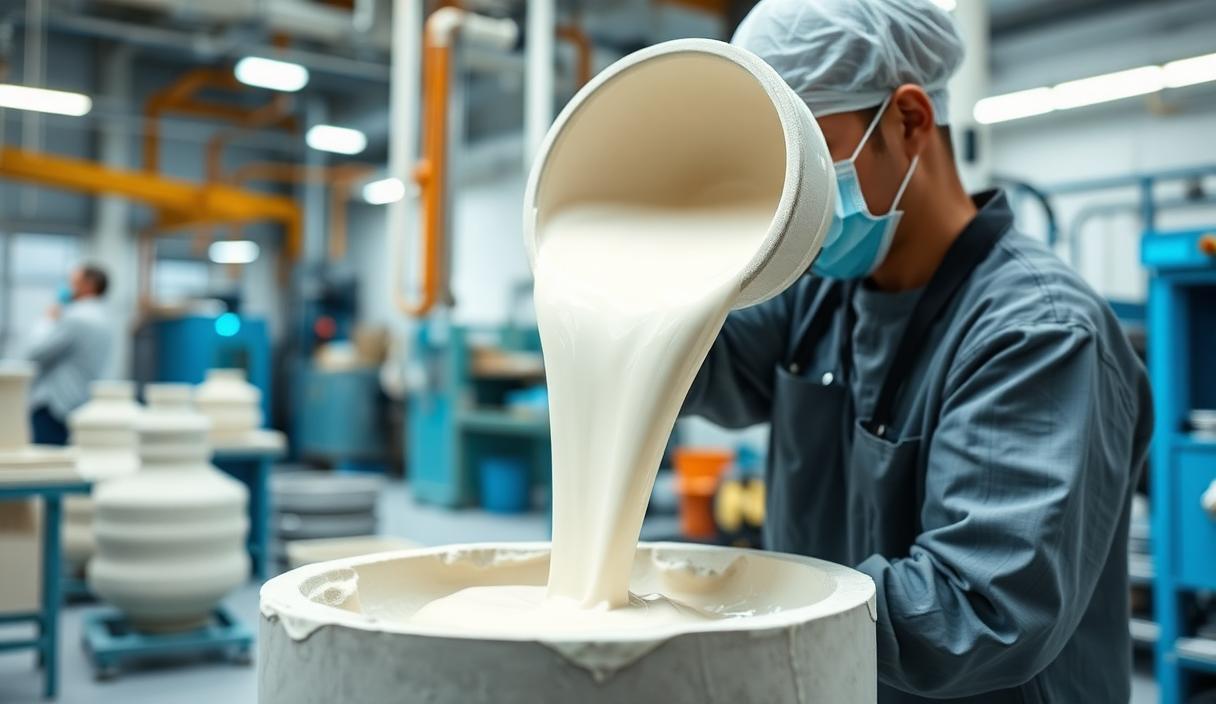
Guar Gum in ceramic slurries has become an operational imperative for advanced ceramic manufacturers navigating the precision-driven 2026 global landscape. The complex rheology of ceramic slips and glazes demands meticulous control to prevent structural defects long before the firing process begins. By integrating natural galactomannan polymers, manufacturers can modulate fluid viscosity, dramatically enhance the green strength of unfired bodies, and ensure flawless glaze application — delivering a Superior end product that meets the rigorous quality standards of the modern ceramics industry.
Research Overview
The manufacturing of both traditional and advanced ceramics fundamentally relies on the precise manipulation of multiphase fluid systems. Ceramic slips and slurries are highly concentrated suspensions of insoluble inorganic particles — such as kaolin, feldspar, silica, and rock dust — dispersed in a continuous water phase. Left uncontrolled, these dense mixtures settle rapidly, extrude poorly, and crack during drying. To govern the fluid mechanics of the system, formulation scientists and ceramic engineers depend heavily on high-molecular-weight polysaccharides that modify viscosity, suspend solids, and bind particles together.
Research published in Carbohydrate Polymers highlights that Guar Gum possesses an exceptional molecular architecture that makes it an ideal rheology modifier for heavy particulate suspensions. Guar Gum is a natural galactomannan extracted from the endosperm of the drought-resistant Cyamopsis tetragonoloba legume. Its polymer backbone consists of a long, linear chain of beta-1,4-linked D-mannopyranose units, with alpha-1,6-linked D-galactopyranose side branches occurring at a highly regular ratio of approximately 2:1. This specific branching density physically prevents the polymer chains from packing tightly into crystalline structures, allowing water molecules to rapidly penetrate and hydrate the polymer matrix at room temperature.
Once fully hydrated within a ceramic slurry, these massive galactomannan chains — frequently exceeding a million daltons in molecular weight — form an entangled, three-dimensional network throughout the aqueous phase. This network is the functional foundation of everything that follows: it suspends heavy mineral particles against gravity, imparts the cohesion that becomes green strength, and delivers the shear-responsive flow behavior that makes both casting and glazing possible. Understanding how this single polymer network behaves under different processing conditions is the key to eliminating defects across the entire production chain.
Guar Gum as a Binder and Plasticizer
In the plastic-forming and extrusion of ceramics, the unfired "green body" must possess enough mechanical strength to be handled, machined, and stacked without cracking or losing its shape. Guar Gum serves as an outstanding temporary binder and plasticizer, coating the microscopic ceramic particles and holding them firmly together through extensive hydrogen bonding. This cohesion is what transforms a fragile mass of mineral powder into a workable, machinable body that survives the journey from forming station to kiln.
- Green strength on demand: Guar Gum imparts the cohesion required for unfired parts to survive handling, carving, drilling, and glazing — directly reducing costly breakage rates and scrap on the production line.
- Shear-thinning extrusion: Under the extreme mechanical shear of the extrusion auger, the superentangled Guar Gum chains temporarily untangle and align in the direction of flow. Internal friction drops instantly, allowing heavy paste to extrude smoothly through the die without tearing. The moment the paste exits the die, shear returns to zero and the Guar Gum immediately recovers its highly viscous structure, preventing the freshly extruded part from slumping or deforming under its own weight.
- Controlled moisture migration: The drying phase is fraught with peril. If the outer surface dries and shrinks faster than the wet interior, severe differential shrinkage produces deep, unrepairable stress cracks. Because Guar Gum tightly binds water via hydrogen bonding, it regulates the evaporation rate so moisture is released uniformly, dramatically lowering the risk of drying cracks.
- Improved plasticity and workability: Acting as a lubricant between rigid mineral particles, Guar Gum improves the plasticity of the body, enhancing shape retention during pressing, molding, and hand-forming operations.
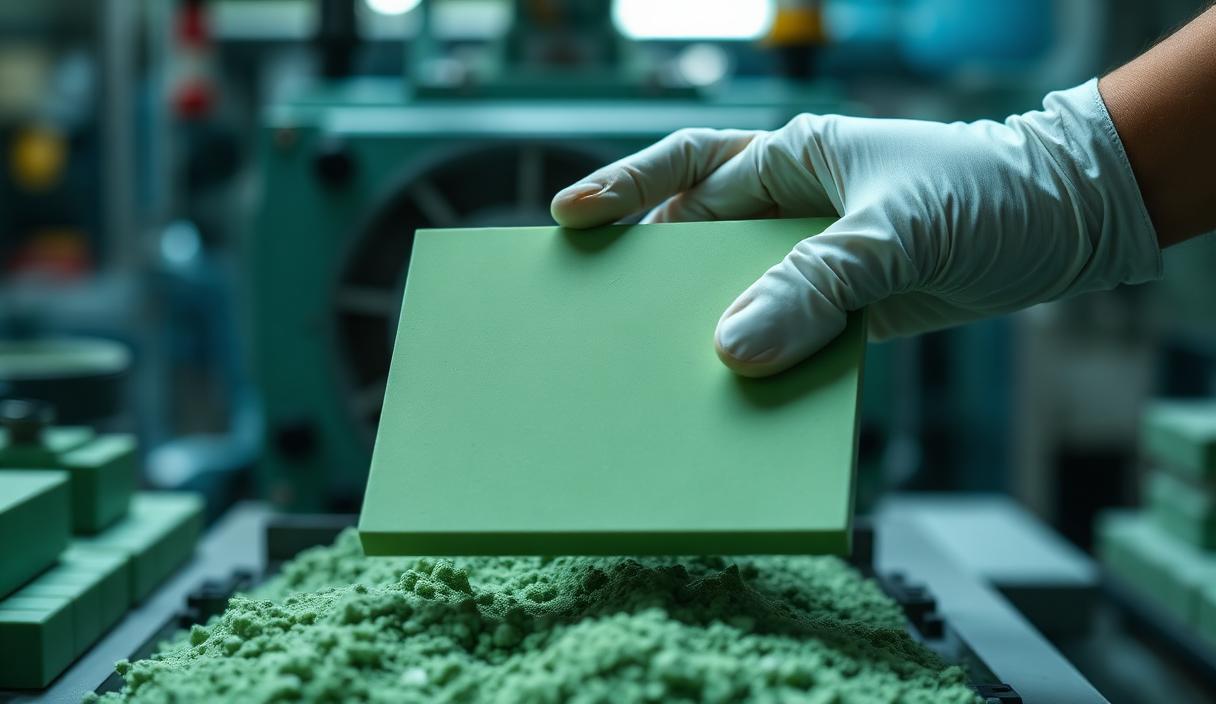 Guar Gum binds fine ceramic particles, providing the green strength that unfired bodies need to survive handling and machining.
The Role of Guar Gum in Ceramic Glazes
Ceramic glazes are fine suspensions of glass-forming minerals, frits, and colored pigments that must remain perfectly homogeneous in the vat and then be applied as a flawless, even film. A defect at the glazing stage — a streak, a run, a bare patch, or a color shift — is often only revealed after firing, when the piece is already a total loss. Guar Gum performs several indispensable functions across the entire glazing operation, from long-term vat stability to final fired-surface quality.
- Preventing pigment and particle settling: The viscous three-dimensional network created by hydrated Guar Gum suspends heavy pigment and frit particles evenly throughout the glaze. This prevents hard-pan settling at the bottom of storage vats and ensures consistent color and chemistry from the first piece glazed to the last.
- Flawless spray atomization: As glaze is forced through high-pressure spray nozzles, the shear-thinning Guar Gum polymers align and viscosity drops sharply, allowing the thick fluid to atomize into a fine, uniform mist. When the mist impacts the ware and shear stops, viscosity instantly recovers and the glaze "freezes" in place on vertical walls without running, dripping, or sagging.
- Smooth leveling and film formation: The plasticizing nature of Guar Gum reduces the surface tension of the glaze slurry, letting the liquid wet the porous bisque thoroughly and level out evenly before drying. This eliminates surface defects such as orange peel, pinholing, and bare spots, ensuring a brilliant, mirror-like finish after firing.
- Pre-fire adhesion: Guar Gum acts as an adhesive that keeps the dried, powdery glaze layer bonded to the ware during handling, stacking, and kiln loading, minimizing chipping and dusting before the piece is fired.
Because all of these functions rely on the same pseudoplastic behavior, a single well-selected Guar Gum grade can serve both dipping and spraying lines, simplifying inventory and standardizing quality across an entire glazing department.
The Physics of Shear-Thinning Rheology
The central reason Guar Gum performs so well across such different ceramic operations lies in its non-Newtonian, shear-thinning (pseudoplastic) behavior. At rest, the entangled polymer network holds high viscosity, locking particles in suspension. Under applied mechanical force — the auger, the pump, the spray nozzle — the chains disentangle and align, viscosity collapses, and the fluid flows freely. When the force is removed, the network re-forms almost instantly and viscosity recovers.
This dual behavior resolves what would otherwise be a contradiction in ceramic processing: manufacturers need a fluid thin enough to pump, extrude, and atomize, yet thick enough to suspend heavy solids and resist sagging at rest. Guar Gum satisfies both requirements simultaneously. Industry studies indicate that the same shear-thinning profile that allows a thick paste to extrude cleanly through a high-pressure die is what permits a glaze to spray as a fine mist and then hold firm on a vertical surface. Matching the viscosity grade and hydration rate to a specific line's shear conditions is therefore the practical lever that engineers use to dial in defect-free performance.
Selecting the Right Guar Gum Derivative
Industrial ceramic environments impose demands — aggressive electrolytes, multi-week vat storage, and widely varied mixing equipment — that often call for modified Guar Gum derivatives rather than native powder. Choosing the correct grade is central to reliable, defect-free production at scale.
- Compatibility with deflocculated slips: High-solids casting slips are heavily deflocculated with electrolytes that can destabilize natural gums. Non-ionic hydroxypropyl Guar Gum (HPG) maintains stable viscosity and consistent performance even in these aggressive, highly ionic chemical conditions.
- Combating microbial degradation: Industrial slurries and glazes are often prepared in massive multi-ton batches and stored for days or weeks. As a natural carbohydrate, native Guar Gum is a food source for spoilage bacteria and fungi, whose enzymes cleave the polymer chains and cause a sudden, catastrophic loss of viscosity along with foul-smelling gases. Hydroxypropylated or heavily etherified derivatives disguise the polymer backbone from bacterial enzymes, granting excellent biostability without overdosing the mixture with toxic synthetic biocides.
- Customized hydration kinetics: Depending on whether a processing line uses high-shear or low-shear mixing equipment, engineers can select fast-hydrating fine-mesh grades for rapid dispersion or controlled-hydration grades that resist lumping, ensuring smooth, lump-free incorporation every time.
- Flawless kiln burnout: As a natural carbohydrate composed only of carbon, hydrogen, and oxygen, Guar Gum reacts completely with kiln oxygen and burns out cleanly to water vapor and carbon dioxide. It leaves behind zero ash, black carbon residue, or microscopic air pockets that could weaken the sintered ceramic or cause black coring defects.
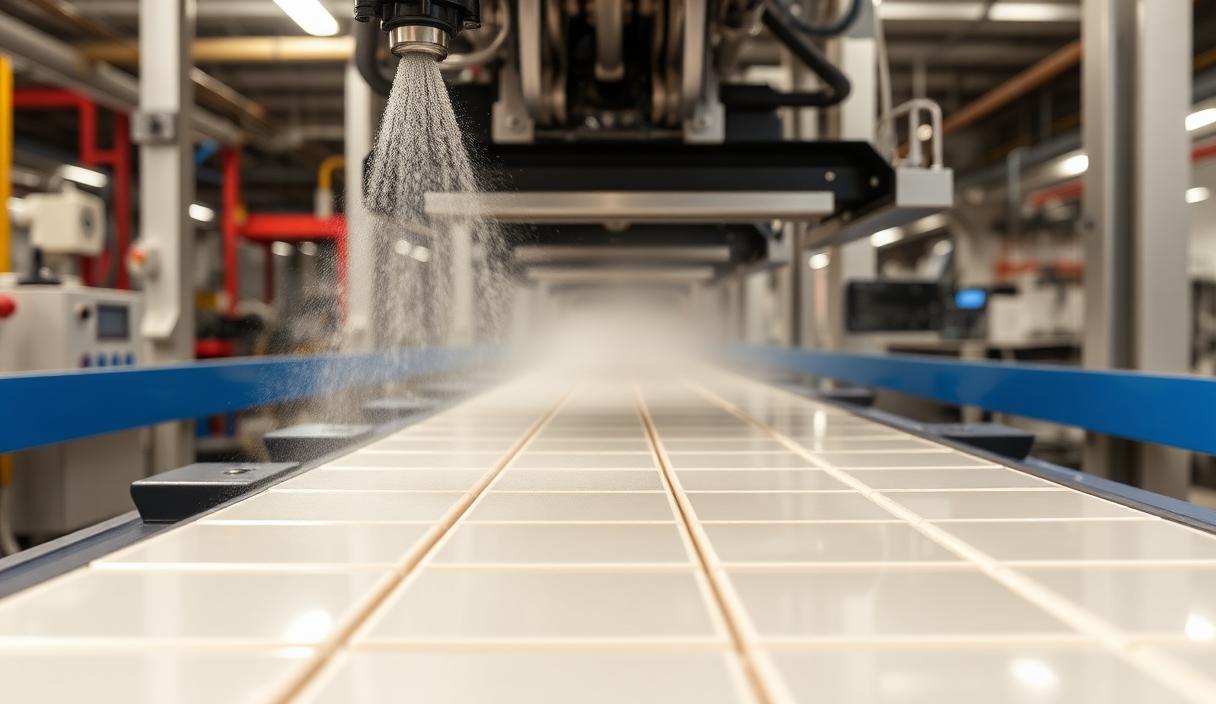 Shear-thinning Guar Gum lets glazes atomize through spray nozzles, then recovers viscosity to prevent running on vertical surfaces.
For manufacturers weighing natural hydrocolloids against synthetic thickeners, a structured comparison of functional properties and cost is available in the B.D. Guar product comparison guide, while grade-level specifications and batch testing protocols are documented on the quality assurance page.
Sustainability and the 2026 Ceramics Market
The 2026 ceramics landscape is shaped by two converging pressures: tightening environmental regulation and relentless operating-cost reduction. Synthetic petrochemical binders and thickeners face growing scrutiny, and manufacturers are actively seeking renewable, biodegradable alternatives that do not compromise performance. Guar Gum answers this demand directly. It is derived from a drought-tolerant legume that requires minimal irrigation and fixes nitrogen in the soil, giving it a favorable environmental profile compared with fossil-derived additives.
Beyond sustainability credentials, advanced biostable Guar Gum derivatives lower total cost of ownership by reducing scrap rates, extending vat life, and cutting the need for synthetic biocides. Sourcing from a vertically integrated supplier close to the growing regions of northwest India adds supply-chain stability and consistent batch-to-batch quality — factors that increasingly influence supplier qualification for global ceramic producers. For a deeper look at responsible sourcing, see the B.D. Guar sustainability commitments.
Key Takeaways
- Green strength and shape retention: Guar Gum binds fine ceramic particles to give unfired green bodies the mechanical strength to survive handling, carving, and glazing without breakage.
- Controlled shear-thinning rheology: The pseudoplastic nature of Guar Gum allows thick pastes to extrude smoothly through high-pressure dies and glazes to atomize flawlessly through spray nozzles, instantly recovering structure at rest to prevent sagging or running.
- Uniform drying and crack prevention: By regulating moisture migration, Guar Gum prevents the differential shrinkage that causes deep stress cracks during the drying phase.
- Flawless kiln burnout: As a 100% natural carbohydrate, Guar Gum undergoes complete thermal oxidation, leaving behind zero carbonaceous ash or voids and entirely preventing black coring defects in the final sintered ceramic.
- Biostable derivatives for industry: Hydroxypropyl and etherified Guar Gum grades resist microbial attack and electrolyte-heavy deflocculated slips, ensuring long-term vat stability.
- Sustainable and cost-effective: Advanced Guar Gum derivatives provide an agriculturally renewable alternative to synthetic petrochemical binders, aligning with strict 2026 environmental and operational cost-reduction mandates.
Frequently Asked Questions
Why do ceramic slurries and slips require organic binders like Guar Gum?
Ceramic slips are heavily concentrated mixtures of clay, rock dust, and water. When the water is removed to form the desired shape, the remaining dry powder is incredibly fragile and brittle. Guar Gum acts as a temporary, flexible glue — coating the microscopic ceramic particles and holding them firmly together to provide the green strength that lets an unfired piece be safely handled, carved, or glazed without breaking.
How does Guar Gum prevent ceramic glazes from running or dripping off the piece?
Guar Gum solutions are highly pseudoplastic. When the glaze is pumped and sprayed, the intense physical force makes the Guar Gum thin out so it applies as a smooth, even mist. The moment the glaze hits the ceramic surface, the force stops and the Guar Gum instantly thickens back into a dense gel. This rapid recovery freezes the heavy layer in place, preventing it from running down the sides of the pottery or tile before it dries.
Does leaving an organic binder like Guar Gum inside the ceramic ruin it during firing?
No — and that is one of its primary advantages. Because Guar Gum is a natural carbohydrate made of carbon, hydrogen, and oxygen, it reacts completely with the oxygen inside the high-temperature firing kiln. It burns out cleanly, turning entirely into harmless water vapor and carbon dioxide. This clean thermal burnout ensures that no ash, black carbon residue, or microscopic air pockets remain to weaken the final glass-like ceramic structure.
Why are modified Guar Gum derivatives often used instead of raw, native Guar Gum in industrial ceramics?
While raw Guar Gum performs excellently, massive industrial holding tanks of ceramic slips often sit for days, making natural gums susceptible to bacterial degradation and a sudden loss of viscosity. Industrial slips also contain aggressive salts and electrolytes. Hydroxypropyl and etherified derivatives resist both microbial attack and electrolyte destabilization, delivering the biostability and chemical tolerance that large-scale operations require.
To specify the ideal Guar Gum grade for your casting slips, extrusion bodies, or glaze lines, explore the full product range or contact the B.D. Guar technical team. B.D. Guar Pvt. Ltd. provides expertly milled, Superior-grade Guar Gum hydrocolloids and advanced derivatives engineered for maximum hydration, flawless glaze suspension, and absolute clean burnout — helping manufacturers elevate ceramic production efficiency in a competitive global market.