The Chemistry of Galactomannan: Solubility and Gel Formation
Galactomannan's 2:1 mannose-to-galactose backbone drives the cold-water solubility and hydrogen-bonded networks behind every high-performance Guar Gum grade.
Last updated:
In 2026, hydrocolloid researchers evaluating natural thickeners increasingly return to a single molecule for answers: galactomannan, the polysaccharide backbone that gives Guar Gum its exceptional cold-water solubility and thickening power. As formulators pursue clean-label, plant-derived rheology across food, oilfield, and industrial systems, a precise understanding of galactomannan structure has become the foundation for predictable performance, dosage optimization, and grade selection.
Research Overview
Galactomannan is a non-ionic polysaccharide built from a linear mannose backbone with galactose side units. In Guar Gum, the mannose-to-galactose ratio sits near 2:1, a distribution that governs solubility, viscosity, and interactions with other hydrocolloids. Industry studies indicate this ratio is central to why Guar Gum hydrates in cold water while related galactomannans require heat.
Molecular Architecture: The 2:1 Mannose-to-Galactose Ratio
The galactomannan of Guar Gum consists of a (1→4)-linked β-D-mannopyranose backbone with single α-D-galactopyranose units attached at the O-6 position. The average mannose:galactose ratio of approximately 2:1 places galactose branches along a large fraction of the backbone, which sterically prevents tight chain-to-chain packing and keeps the polymer readily dispersible.
This structural signature distinguishes Guar Gum from other commercial galactomannans. Locust bean gum carries a ratio near 4:1 and fewer galactose units, producing longer unsubstituted mannose regions that resist cold-water hydration. Cassia gum sits near 5:1. The denser galactose substitution of Guar Gum is the molecular reason for its high water affinity.
- Guar Gum galactomannan: mannose:galactose approximately 2:1 — high cold-water solubility.
- Locust bean gum: approximately 4:1 — requires heating to fully hydrate.
- Cassia gum: approximately 5:1 — low solubility, heat-activated gelling.
For researchers comparing systems, this ratio is the first variable to model when predicting hydration kinetics and viscosity yield. Detailed grade specifications are available in the B.D. Guar product range.
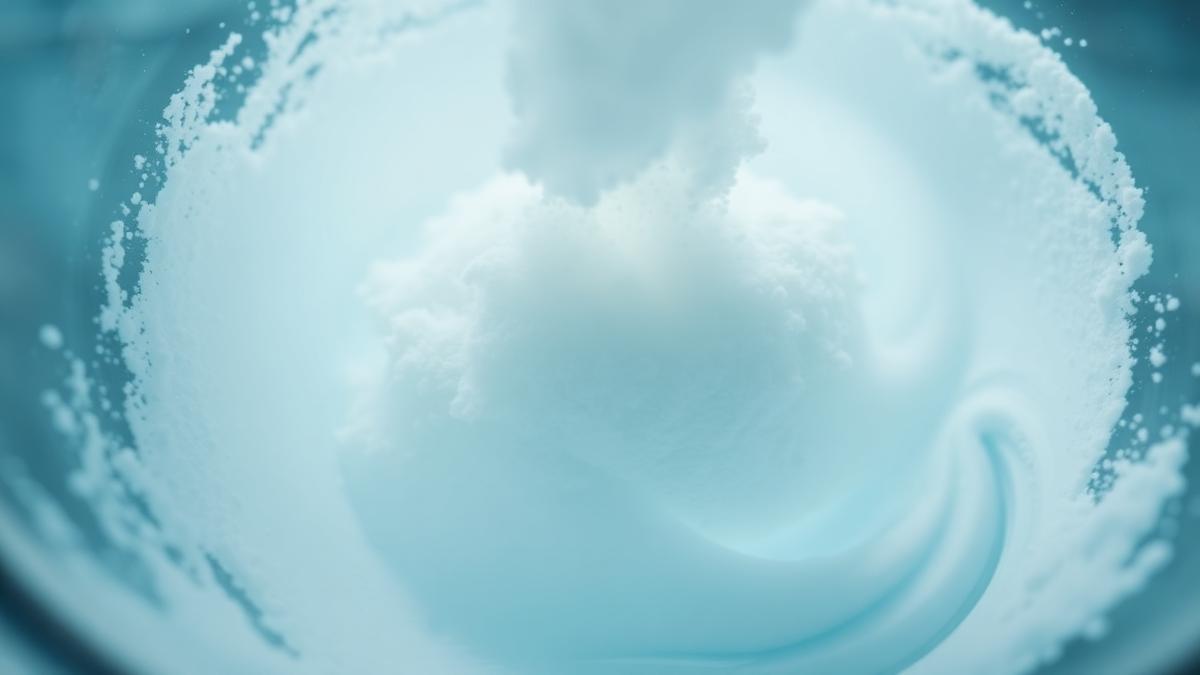 Fine-milled Guar Gum galactomannan dispersing into a high-shear vortex for lump-free hydration.
Hydrogen Bonding and Cold-Water Solubility
Galactomannan is rich in hydroxyl groups distributed across both the mannose backbone and galactose branches. In water, these hydroxyls form extensive hydrogen bonds with surrounding water molecules, driving rapid solvation of the polymer chains. Research published in Carbohydrate Polymers has repeatedly linked galactose branch density to enhanced water-binding capacity.
Because galactose side units interrupt inter-chain association, the polymer remains soluble at ambient temperature rather than crystallizing or aggregating. The result is a solution of highly extended, hydrated chains that overlap and entangle even at low concentrations, generating high viscosity with minimal material. This is the physical basis for the strong thickening efficiency of Superior Guar Gum grades.
- Dry powder contacts water; hydroxyl groups begin hydrogen bonding at the particle surface.
- Water penetrates the swelling particle, unfolding galactomannan chains.
- Fully solvated chains extend and entangle, building bulk viscosity.
The interplay between structure and solubility is explored further in the B.D. Guar technical glossary, a reference for hydrocolloid terminology.
Rapid Hydration Mechanism and Particle Size
Hydration rate is governed not only by molecular structure but also by particle size and dispersion technique. Because galactomannan hydrates from the particle surface inward, finer mesh grades expose more surface area per unit mass and reach peak viscosity faster. Coarser grades hydrate more slowly, which can be desirable when delayed viscosity build is required.
Improper addition causes surface hydration to form a gel layer around dry particle cores, producing lumps known as fish-eyes. Controlled dispersion into a vortex, or dry pre-blending with sugar or starch, separates particles and ensures uniform hydration.
- Fine mesh (200 mesh) hydrates within minutes for instant systems.
- Coarse mesh disperses easily and hydrates gradually, reducing clumping.
- High-shear mixing accelerates chain unfolding and viscosity development.
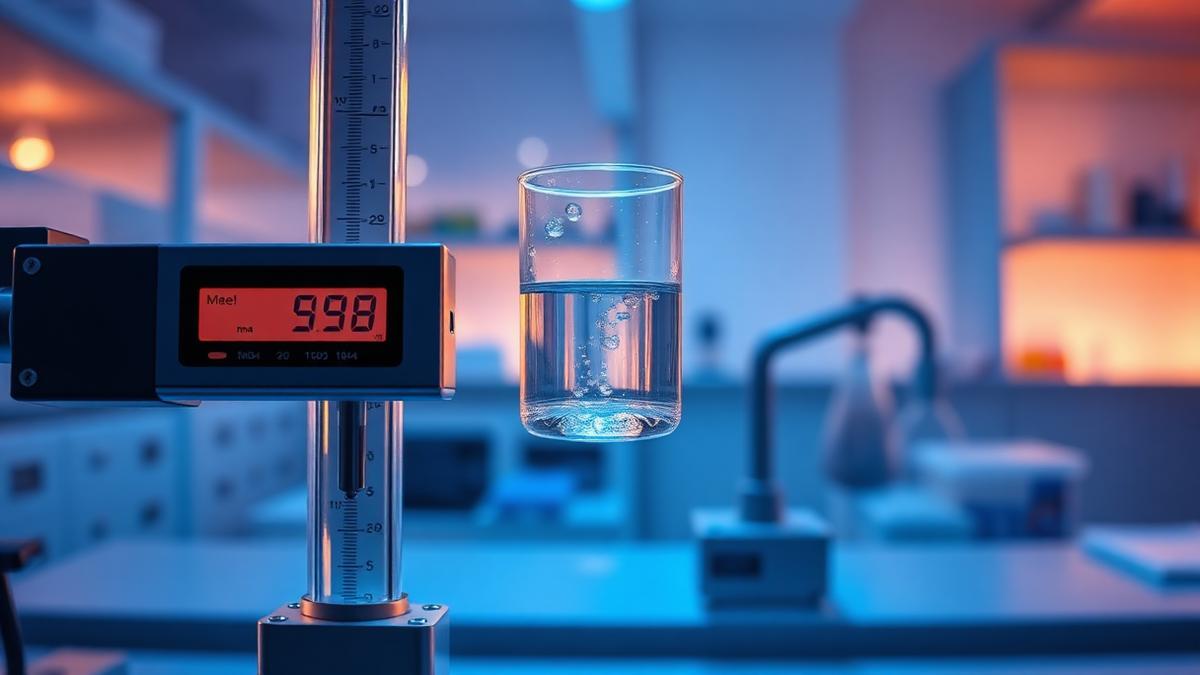 Viscometry of a hydrated galactomannan solution confirms batch-to-batch rheological consistency.
Gel Formation and Hydrocolloid Synergy
On its own, galactomannan is a thickener rather than a true gelling agent, forming viscous pseudoplastic solutions rather than rigid gels. True gelation emerges through synergy. When Guar Gum galactomannan combines with helix-forming polysaccharides such as xanthan gum, the unsubstituted mannose regions of the backbone associate with the ordered helices, forming junction zones that convert two thickeners into a cohesive gel network.
This synergistic behavior, documented in the Journal of Food Science, allows formulators to achieve target textures at lower total gum loading, improving both cost efficiency and clean-label positioning. The degree of galactose substitution again matters: the smoother, less-branched regions of the backbone are the sites available for intermolecular association. A side-by-side comparison of these systems is available at Guar Gum vs xanthan gum.
Every batch of B.D. Guar galactomannan is characterized for viscosity, particle size, and moisture to ensure reproducible gel and thickening behavior, as detailed on the quality assurance page.
Key Takeaways
- Structure defines function: the 2:1 mannose-to-galactose ratio is the primary determinant of Guar Gum solubility and viscosity.
- Hydrogen bonding drives solubility: abundant hydroxyl groups enable cold-water hydration without heating.
- Galactose branching prevents aggregation: side units keep chains extended and dispersible at ambient temperature.
- Particle size controls hydration rate: finer mesh grades reach peak viscosity faster than coarse grades.
- Synergy enables gelation: pairing galactomannan with xanthan gum forms junction zones that build true gel networks.
Frequently Asked Questions
Why does Guar Gum dissolve in cold water when other galactomannans do not?
Guar Gum has a high galactose branch density, near a 2:1 mannose-to-galactose ratio. These branches interrupt inter-chain packing and expose numerous hydroxyl groups for hydrogen bonding with water, allowing full hydration at ambient temperature. Galactomannans with fewer galactose units, such as locust bean gum, require heat to hydrate.
What is the mannose-to-galactose ratio of Guar Gum galactomannan?
The average ratio is approximately 2:1, meaning roughly one galactose side unit for every two mannose units along the backbone. This distribution is central to cold-water solubility and high thickening efficiency, and it differentiates Guar Gum from locust bean and cassia galactomannans.
Does galactomannan form a gel by itself?
Galactomannan alone produces a viscous pseudoplastic solution rather than a rigid gel. True gelation requires synergy with helix-forming polysaccharides such as xanthan gum, where unsubstituted mannose regions form junction zones that create a cohesive network at lower total gum concentrations.
To discuss galactomannan grade selection, synergy blends, or custom milling for a specific formulation, contact the B.D. Guar technical team for tailored polymer-chemistry support.