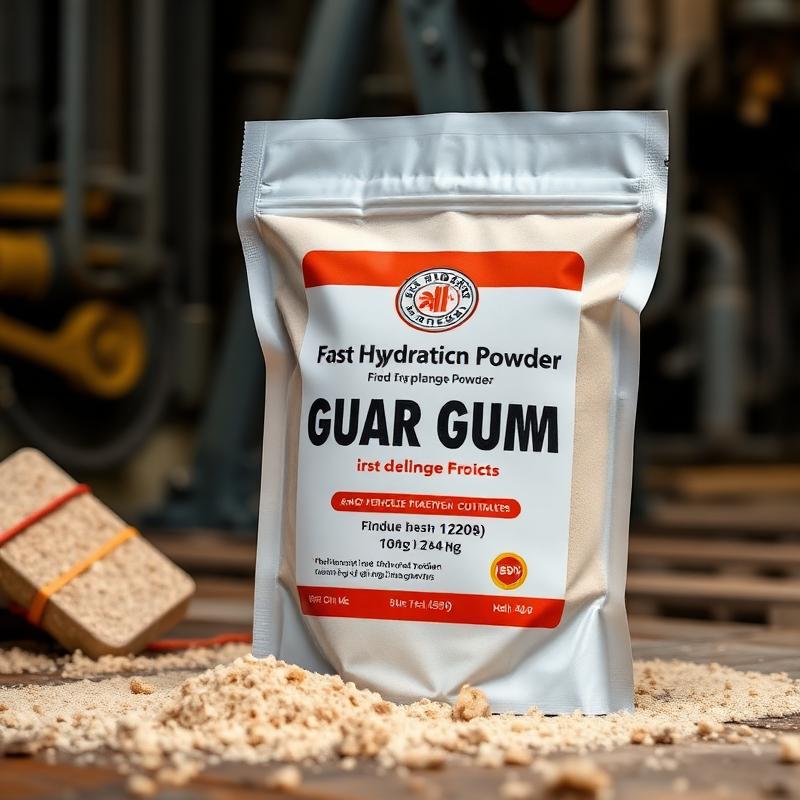
Fast Hydrating Guar Gum (FHGG) for Oil & Gas Drilling
High-performance Guar Gum for hydraulic fracturing and drilling operations. Fast hydrating grades, crosslink-compatible formulas, and diesel slurry options for the global oil and gas industry.
Quick Answer
Why is Guar Gum used in oil drilling?
Guar gum is the most widely used thickener in hydraulic fracturing (fracking) fluids. It creates a viscous gel that suspends and carries proppant (sand) into rock fractures, controls fluid loss, and reduces pipeline friction. After the fracturing operation, enzyme or oxidizer breakers decompose the guar gel, leaving minimal residue. Guar gum is preferred over synthetic alternatives for its cost-effectiveness and biodegradability.
Why Guar Gum for Oil & Gas Operations?
Guar Gum is the industry-standard viscosifier for hydraulic fracturing (fracking) and drilling fluid applications. Its unique properties make it ideal for creating the high-viscosity gels needed to transport proppant into rock formations.
As a leading oil drilling Guar Gum supplier, B D Guar provides specialized grades designed for the demanding conditions of modern oil field operations - including fast hydration, high temperature stability, and salt tolerance.
Key Benefits for Oil Field Operations
Excellent Viscosity
Creates high-viscosity gels for effective proppant suspension and transport
Fast Hydration
FH grades achieve full viscosity in 2-5 minutes for rapid field preparation
Temperature Stable
Crosslinked systems perform up to 150°C+ in deep, hot wells
Environmentally Safe
Natural, biodegradable, non-toxic - preferred over synthetic alternatives
Oil Field Guar Gum Grades
Specialized formulations for every oil and gas application
Fast Hydrating (FH)
Rapid 2-5 minute hydration for on-site fluid preparation. Industry standard for modern frac operations.
Learn MoreSlickwater Grade
Lower concentration, low-residue formula for slickwater fracturing and friction reduction.
Learn MoreCrosslink Compatible
Optimized for borate and metallic crosslinker systems for high-temperature applications.
Learn MoreDiesel Slurry
40-60% guar in diesel for dust-free, instant-hydrating field application.
Learn MoreTechnical Specifications
Meeting stringent oil field quality requirements
| Parameter | Specification |
|---|---|
| Appearance | Off-white to cream powder |
| Moisture | ≤ 10% |
| Viscosity (1%, Fann 35) | 4,500 - 6,000+ cps |
| Hydration Time (FH grade) | 2-5 minutes (80% viscosity) |
| pH (1% solution) | 5.5 - 7.5 |
| Mesh Size | 40-60 mesh (oil field grade) |
| Insoluble Residue | ≤ 2.5% |
| Salt Tolerance | Up to 15% NaCl |
Oil & Gas Applications
Hydraulic Fracturing
Primary viscosifier for fracturing fluids in shale gas and tight oil operations
Drilling Fluids
Viscosifier and fluid loss control in water-based drilling muds
Completion Fluids
Well completion and workover operations requiring controlled viscosity
Friction Reduction
Reduces pumping friction in pipelines and coiled tubing operations
Proppant Transport
Suspends and carries sand/proppant into formation fractures
Fluid Loss Control
Prevents excessive fluid loss into permeable formations
2026 Oil & Gas Market Update
Fracturing — Quick Answer
Why is guar gum used in hydraulic fracturing?
Guar gum is the dominant gelling agent in gel-based fracturing fluids — used in the large majority of gel treatments — because it rapidly builds high viscosity that suspends and transports proppant (sand/ceramic) deep into fractures. Fast-hydrating grades (HICOL-FH) reach working viscosity in roughly 3–5 minutes, enabling on-the-fly, continuous-mix operations. B D Guar (ISO 9001:2015, since 1983) supplies oilfield-grade guar to 50+ countries.
How does guar gum work in fracturing fluid?
Guar acts as the primary viscosifier in both slickwater and crosslinked gel systems, suspending proppant during high-pressure injection so it reaches deep into the fracture network. Typical loadings run around 0.5–2% by weight; the gel is shear-thinning, so it pumps easily under shear and rebuilds viscosity at rest. See fast-hydrating guar gum for the field-preferred grade.
What is fast-hydrating guar gum (FHGG) and why does it matter?
HICOL-FH reaches high viscosity in roughly 3–5 minutes versus hours for standard guar, enabling continuous on-the-fly mixing without oversized hydration tanks. Performance is read on a Fann viscometer at the 3-minute mark. More detail on our fast-hydrating guar gum manufacturer page.
What is the 2026 demand outlook for oilfield guar?
Oilfield guar demand is tied to North American shale capex and drilling activity, with a resurgence across North America and the Middle East driving substantial demand into 2026. Independent market analysis from IndexBox projects roughly a 4.2% CAGR for the overall guar gum market across 2026–2035, and guar remains the dominant gelling agent in the majority of gel-based frac treatments. These market figures are attributed to third-party analysts, not B D Guar internal data.
Why does low-residue, low-insolubles guar matter for fracturing?
Lower acid-insoluble residue means a cleaner gel break after the job, less proppant-pack damage and reduced formation damage — directly protecting well productivity. See our low-residue guar gum grade.
How is oilfield guar quality controlled?
Every oilfield lot is qualified on a Fann 35SA viscometer for hydration and viscosity, with acid-insoluble residue kept low and a full batch COA under our ISO 9001:2015 system. See guar gum quality control and specifications.
Last updated: 2026-07-11
Bulk Supply & Logistics
Container-scale FHGG supply with field-ready packaging and predictable transit times
Container Loading
20 MT per FCL (20' container) palletised or floor-loaded, with LCL consolidations available for trial volumes. Loading photographs and container seal numbers are shared before dispatch.
Packaging Options
25 kg multi-wall paper bags, and 500 kg / 1,000 kg bulk bags (FIBCs) with moisture-proof polyethylene liners to protect hydration performance in humid wellsite storage.
Transit Times
15-20 days to Middle East ports and 25-30 days to the Americas from Mundra and Kandla, with documentation (COO, COA, packing list, BL) issued ahead of vessel arrival.
Indicative Pricing
USD 2-5 per kg FOB India depending on viscosity grade, residue specification and annual volume. Firm quotations are returned within one business day against your fluid specification.
Oil Drilling Guar Gum FAQs
Why is Guar Gum used in oil drilling?
Guar Gum is used in oil drilling primarily for hydraulic fracturing (fracking) operations. It increases the viscosity of fracturing fluids to carry proppant (sand) into rock fractures, controls fluid loss, reduces friction in pipelines, and forms gel that breaks down after the operation. It's cost-effective and environmentally preferable to synthetic alternatives.
What is the role of Guar Gum in hydraulic fracturing?
In hydraulic fracturing, Guar Gum creates a gel that: 1) Suspends and carries proppant into fractures, 2) Provides viscosity for fracture creation, 3) Controls fluid leak-off into formation, 4) Reduces pumping friction, 5) Breaks down cleanly after the job leaving minimal residue. It's the most widely used fracturing fluid thickener.
What grades of Guar Gum are used in oil drilling?
Oil drilling uses several specialized grades: 1) Fast-hydrating (FH) Guar - for rapid fluid preparation, 2) Slickwater grades - lower viscosity for slickwater fracking, 3) Crosslinkable grades - for high-temperature wells, 4) Diesel-slurry Guar - pre-dispersed in diesel, 5) CMC-modified Guar - for enhanced fluid loss control.
How much Guar Gum is used in fracking?
Typical usage rates are 2-10 pounds of Guar Gum per 1,000 gallons of fracturing fluid. A single horizontal well may use 50,000-300,000+ pounds of Guar Gum depending on the number of stages and fluid design. The US shale industry consumes approximately 200,000+ MT of Guar Gum annually.
What is the viscosity requirement for oil drilling Guar?
Oil drilling Guar Gum typically requires viscosity of 4,500-6,000+ cps at 1% concentration (Fann 35 viscometer). Higher viscosity grades are preferred for better proppant suspension. Specifications also include hydration rate (FH grades achieve 80% viscosity in 2-3 minutes), residue content, and crosslink compatibility.
Can Guar Gum work in high-temperature wells?
Standard Guar Gum is stable up to approximately 90°C (195°F). For higher temperature wells, crosslinked Guar systems using borate or zirconate crosslinkers extend stability to 150°C+ (300°F+). Special high-temperature grades and derivatized Guar (like CMC or CMHPG) are available for extreme conditions.
What is the difference between linear gel and crosslinked gel?
Linear gel uses Guar Gum without crosslinkers, providing lower viscosity suitable for slickwater operations. Crosslinked gel adds metal ions (borate, titanium, zirconate) to create higher viscosity, better proppant transport, and temperature stability. Crosslinked gels are preferred for deeper, hotter wells requiring enhanced performance.
Is Guar Gum environmentally safe for oil drilling?
Guar Gum is considered environmentally preferable to synthetic polymers because it's: 1) Natural and biodegradable, 2) Non-toxic, 3) Breaks down naturally over time, 4) Derived from renewable plant sources. It's one of the more environmentally friendly components in fracturing fluid formulations.
How is oil drilling Guar Gum supplied?
Oil drilling Guar Gum is typically supplied in: 1) 25 kg/55 lb multi-wall paper bags on pallets, 2) 1-2 MT bulk bags (FIBCs), 3) Bulk tanker trucks for large operations, 4) Diesel slurry form (pre-dispersed in diesel). Packaging is designed for field conditions with moisture-resistant materials.
What is diesel slurry Guar Gum?
Diesel slurry Guar Gum is a concentrated dispersion of Guar powder in diesel oil (typically 40-60% guar). The diesel prevents premature hydration, allowing easy metering and rapid mixing on location. It eliminates dusting and handling issues, and hydrates instantly when added to water-based fluids.
How fast does fast-hydrating guar gum reach viscosity for fracturing?
Fast-hydrating oilfield grades such as HICOL-FH develop working viscosity in roughly 3–5 minutes, compared with up to a couple of hours for standard guar, which allows continuous on-the-fly mixing during frac operations. Hydration is verified on a Fann viscometer at the 3-minute reading.
What is the 2026 outlook for guar gum in oil and gas?
Oilfield guar demand tracks North American shale drilling activity, with renewed activity in North America and the Middle East supporting demand into 2026; independent analysts (IndexBox) project roughly a 4.2% CAGR for the overall guar gum market through 2026–2035. Guar remains the dominant gelling agent in the majority of gel-based fracturing treatments.
Related Resources
Need Oil Field Grade Guar Gum?
Get reliable supply of high-quality Guar Gum for your oil and gas operations. Technical support and custom formulations available.