The Chemistry of Guar Gum: Galactomannan Structure and Function
Molecular-level explanation of Guar Gum — galactomannan backbone, mannose-galactose ratio, hydrogen bonding, hydration, and how chemistry drives every functional property.
Last updated:
Quick Answer
What is the chemical structure of Guar Gum?
Guar Gum is a non-ionic galactomannan polysaccharide built from a linear backbone of β-(1→4)-linked D-mannose units carrying single α-(1→6)-linked D-galactose side chains. The natural mannose-to-galactose ratio of roughly 2:1 explains its exceptional cold-water solubility and pseudoplastic viscosity — the properties 2026 formulators rely on for clean-label thickening and water retention.
Behind every viscous gram of Guar Gum sits a remarkably elegant piece of plant chemistry. Extracted from the endosperm of the cluster bean Cyamopsis tetragonolobus, the polymer powering modern food, oil-field and pharmaceutical formulations is a high-molecular-weight galactomannan whose performance can only be understood by looking inside its molecular architecture. As 2026 buyers move away from synthetic polymers toward verified plant-derived hydrocolloids, understanding this chemistry has become a procurement decision rather than just an academic one.
Research Overview
This article walks through the molecular structure of Guar Gum in plain language: how the mannose backbone is built, why the galactose side chains decide solubility, what molecular weight means for viscosity, and how the natural polymer can be modified into derivatives such as HPG, CMG and cationic guar. Real-world implications for food, pharma, cosmetics and oilfield applications appear throughout, anchored to the 2026 supply-chain narrative.
The Galactomannan Backbone
At its core, Guar Gum is a polysaccharide — a long chain of sugar units linked together. The backbone is composed exclusively of D-mannose monomers connected through β-(1→4) glycosidic bonds, the same linkage found in cellulose. A pure mannan chain on its own would be insoluble in water, packing tightly into crystalline regions held together by strong hydrogen bonds. What rescues Guar Gum from insolubility, and what gives it the commercial value the industry depends on, is the second sugar.
Roughly every second mannose unit carries a single D-galactose unit branched off through an α-(1→6) linkage. These galactose side chains are physical disruptors. By projecting outward from the main chain, they prevent the backbone from packing into crystalline domains and they create a hydration shell that allows water molecules to surround each polymer strand. Without galactose, there is no soluble Guar Gum.
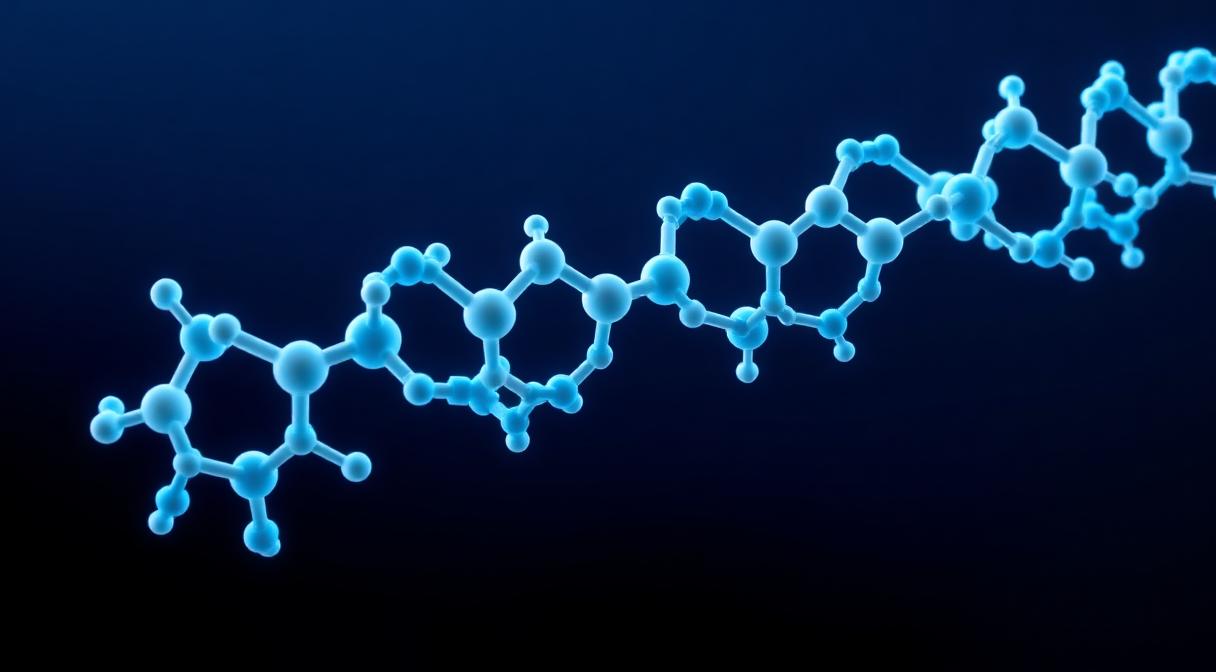 Three-dimensional rendering of the galactomannan chain — mannose backbone in the centre, galactose side units projecting outward to maintain cold-water solubility.
The Mannose-to-Galactose Ratio
The defining numerical signature of Guar Gum is its mannose-to-galactose ratio, which sits naturally between 1.6:1 and 2.0:1. This is not a marketing figure; it is the single most important variable a formulator examines after viscosity. Other galactomannans behave differently because their ratios are different. Locust Bean Gum has a ratio close to 4:1, leaving long unsubstituted regions that crystallise into firm gels but only dissolve fully in hot water. Tara Gum sits in the middle at roughly 3:1.
Because Guar Gum's substitution is denser, the chain stays fully hydrated even in cold water. That single property — cold-water solubility driven by galactose substitution — is the reason Guar Gum has become the default hydrocolloid for high-throughput industrial processes where heating is impractical or expensive.
Molecular Weight and Viscosity
A typical commercial Guar Gum has a weight-average molecular weight between 1 and 2 million daltons, placing it among the largest natural polysaccharides used in industry. When this huge molecule unfolds in water, each chain occupies a tremendous hydrodynamic volume, and the entanglement of millions of chains produces high viscosity at very low concentrations. A simple 1% solution can reach 5,000 to 6,000 centipoise — values that would require five to ten times more starch or synthetic gum to achieve.
This viscosity is also pseudoplastic, meaning apparent viscosity drops sharply when the fluid is sheared and recovers when shearing stops. A Guar Gum sauce thins out beautifully when pumped or stirred and thickens again on the plate, while a hydraulic-fracturing slurry can be pumped through long pipelines and still carry proppants. To match the demands of processes such as oilfield fracturing, the polymer's hydration speed can be modified through controlled de-polymerisation or chemical substitution.
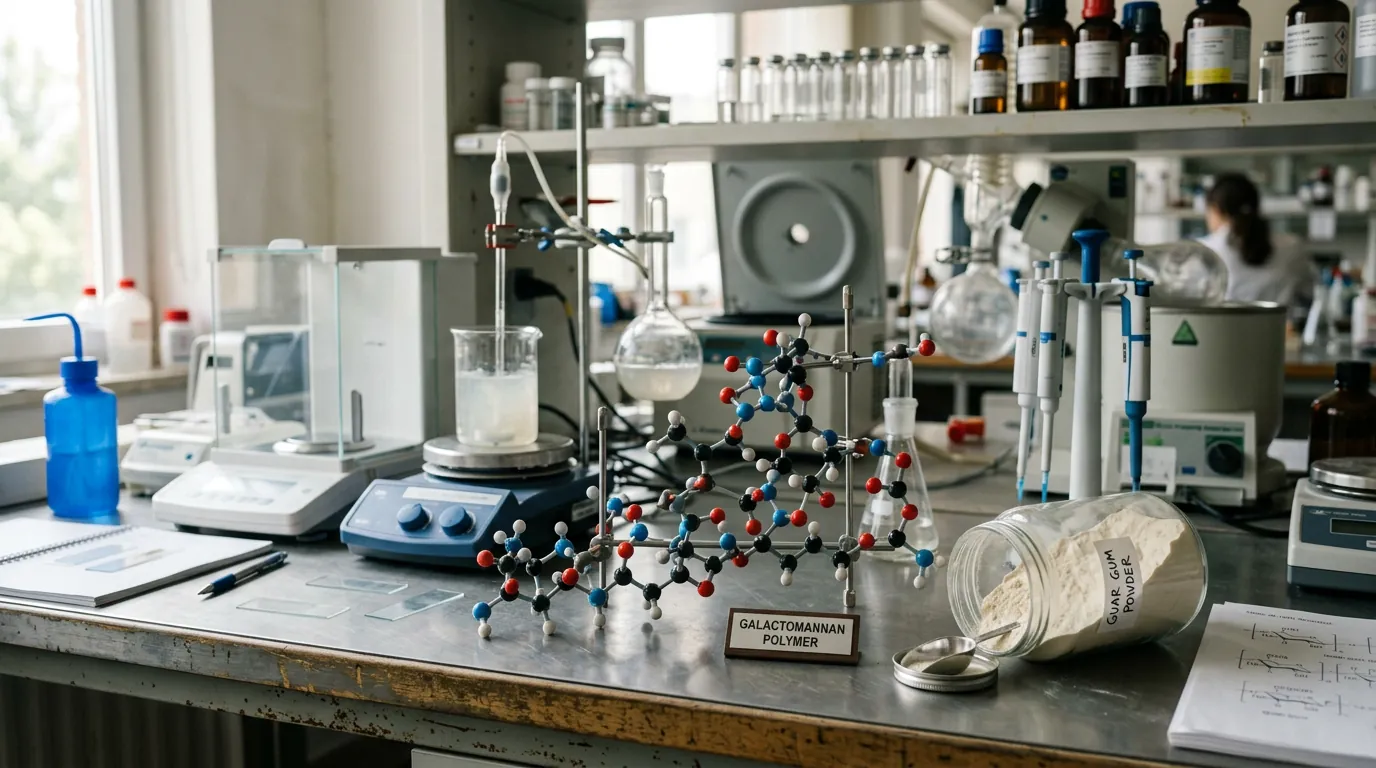
 Quality-control assay of a Guar Gum hydration profile — molecular weight and substitution pattern are verified for every batch leaving the Kalol facility.
Functional Groups and Modification
Each sugar unit carries free hydroxyl groups, and these are the chemical handles that allow Guar Gum to be tailored for specialised applications. Reaction with propylene oxide produces hydroxypropyl Guar (HPG), which gives improved temperature stability and dominates oilfield fracturing fluids. Reaction with sodium chloroacetate yields carboxymethyl Guar (CMG), an anionic derivative used in mining flotation and paper manufacturing. The most commercially valuable derivative for personal care is cationic Guar, produced by quaternisation with a glycidyl trimethylammonium salt — the introduced positive charges adhere strongly to negatively charged hair and skin surfaces, which is why this derivative dominates 2026 conditioner formulations. A complete walkthrough lives in our cationic guar article.
Why the Chemistry Matters in 2026
The global pivot toward ETO-free, non-GMO, traceable ingredients has put the spotlight back on natural polymers whose performance is well understood. Guar Gum's chemistry is fully characterised, its supply chain begins on Indian and Pakistani farms rather than petrochemical plants, and its derivatives can replace synthetic polymers across many industries. For procurement teams comparing options, a clear grasp of the galactomannan structure is the foundation for selecting the right grade — whether the application is a clean-label ice cream stabiliser, a controlled-release tablet matrix or a deep-well fracturing fluid. Comparing competing hydrocolloids becomes much simpler once the underlying chemistry is on the table, as the Guar Gum vs Xanthan Gum guide illustrates.
Frequently Asked Questions
Is Guar Gum a starch?
No. Both are polysaccharides, but starch is built from glucose units while Guar Gum is built from mannose and galactose. Starch is digested rapidly by human enzymes, whereas Guar Gum is a non-digestible soluble fibre fermented in the colon.
Why is Guar Gum cold-water soluble while Locust Bean Gum is not?
The denser galactose substitution along the Guar backbone prevents mannose-to-mannose hydrogen bonding from forming insoluble crystalline regions. Locust Bean Gum, with fewer galactose units, has long unsubstituted segments that only release into solution above 80 °C.
What molecular weight should I specify for a food-grade order?
Most food applications use a weight-average molecular weight of 1.0 to 1.5 million daltons for the right balance of hydration speed and target viscosity. Confirm the value against the final product's shear and pH profile and request a viscosity certificate with each batch.
Can Guar Gum be chemically modified at industrial scale?
Yes. Etherification, carboxymethylation and cationisation are standard routes used to produce HPG, CMG and cationic Guar at industrial scale, each shipped with its own COA covering molar substitution, residual reagents and viscosity profile.
How do I verify the M/G ratio of a delivered batch?
The ratio is measured by acid hydrolysis followed by gas chromatography or high-performance anion-exchange chromatography. Reputable suppliers include this analysis on the COA — request a sample COA before specifying a new grade.
For deeper technical specifications across food, pharma, cosmetic and oilfield grades, browse the complete B D Guar product catalogue or speak with our application team at /contact.